
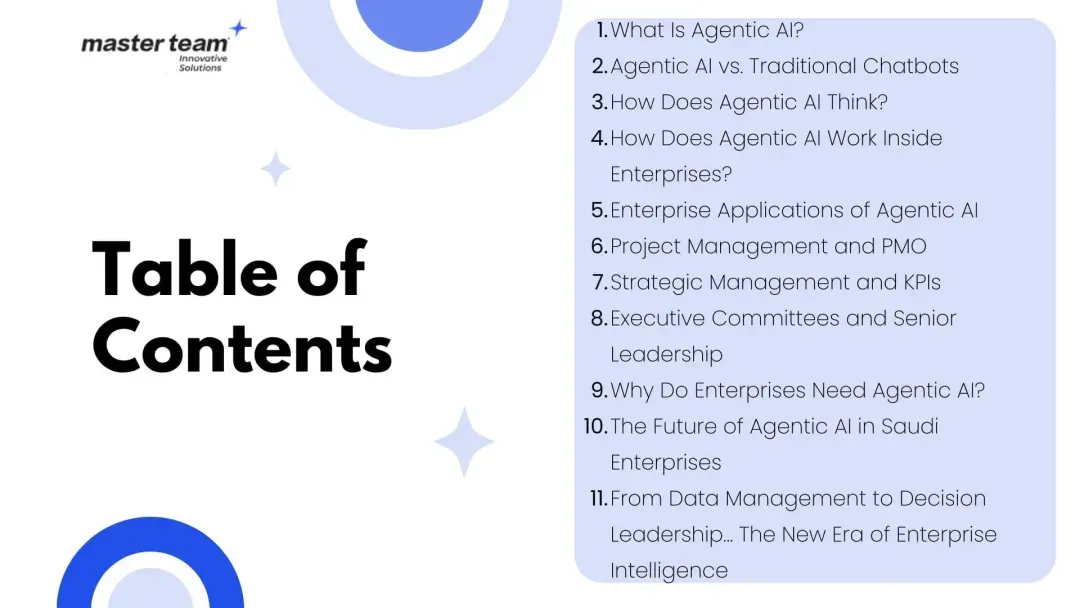
How Agentic AI Works Across the Enterprise: A Complete Guide to Proactive Intelligence and Smarter Decision-Making
🚨 Today's enterprise challenges are no longer driven solely by mounting workloads or an overwhelming volume of data.
The real challenge lies in making fast, informed decisions while navigating fragmented data, back-to-back meetings, and disconnected enterprise systems that slow down every operational process.
Even a minor delay in decision-making or the absence of a unified, organization-wide view can quickly result in financial losses, project delivery delays, and mounting pressure on executive leadership.
💡 The deeper issue is that most conventional AI solutions still operate in a reactive mode. They wait for prompts, answer questions, and generate reports on demand, but they lack a comprehensive understanding of the organization's full operational context.
They cannot anticipate emerging risks or act proactively to protect business continuity and improve operational performance.
Imagine having an intelligent partner embedded within your organization that works alongside your teams in real time.
Instead of simply monitoring data, it understands it, analyzes it, and takes action before small issues escalate into business-critical crises:
🤖 Predicts project delays before they occur
📊 Analyzes KPIs and operational risks in real time
⚡ Recommends intelligent corrective actions to accelerate execution
📝 Automatically generates meeting minutes, decisions, and actionable tasks
🔔 Delivers proactive alerts to management before critical deviations impact performance
🔗 Connects enterprise systems into a unified enterprise-wide view that supports executive decision-making
Most importantly, all of these capabilities operate within an enterprise environment that fully supports Arabic while meeting Saudi data sovereignty requirements and local regulatory compliance standards.
📈 Today, organizations are no longer looking for a traditional chatbot or a limited digital assistant. They are looking for agentic AI that acts as a true decision partner capable of analyzing, predicting, and executing autonomously and proactively.
This is where Faris AI stands apart as Saudi Arabia's first and leading agentic AI system, purpose-built to empower executive leadership, Project Management Offices (PMO), and strategic committees.
Through advanced analytical and predictive capabilities, it helps organizations improve operational efficiency, reduce risk, and accelerate enterprise decision-making.
In this comprehensive guide, you'll discover:
✔ What Agentic AI is and how it operates within enterprise environments
✔ The key differences between Agentic AI and traditional AI tools
✔ How Agentic AI enables proactive decision-making
✔ Its key use cases across project management, strategy, and executive meetings
✔ Why Agentic AI has become a cornerstone of the future of smart enterprises in Saudi Arabia and Vision 2030
What Is Agentic AI?
Agentic AI is an advanced class of artificial intelligence systems designed to operate with near-complete autonomy in pursuit of defined organizational objectives.
These intelligent software agents can ingest and interpret data from their operating environment, make decisions, and execute the actions required to achieve predefined objectives.
According to Gartner, an AI agent leverages machine learning and intelligent models to perceive, decide, and act within its digital environment while continuously adapting its behavior over time.
In essence, Agentic AI is far more than a static software tool. It serves as a proactive decision partner within the enterprise.
Rather than simply executing predefined tasks, it analyzes live data, anticipates emerging trends and potential risks, and recommends or initiates corrective actions before issues impact business performance.
For example, Faris AI is an agentic AI system that automates complex tasks while delivering a more intelligent, seamless, and efficient user experience.
Unlike a traditional chatbot that waits for prompts and simply responds to questions, Agentic AI takes the initiative, enabling a higher level of enterprise interaction and analysis.
Agentic AI vs. Traditional Chatbots
The fundamental difference is that Agentic AI anticipates events and acts proactively, whereas a traditional chatbot remains in a purely reactive mode.
In other words, conventional AI assistants are typically designed to answer questions or summarize information only when prompted.
Agentic AI goes far beyond that model.
Rather than waiting for instructions, it proactively takes action based on a comprehensive understanding of the organization's operational context.
For example, traditional AI tools may answer a query or generate a quick report, but they typically lack a holistic understanding of the enterprise.
The old AI tools cannot connect data across projects, strategy, and governance, predict risks before they emerge, or proactively monitor the execution of decisions.
By contrast, Agentic AI understands the organization's strategic objectives, continuously monitors business operations, and predicts future setbacks.
Agentic AI achieves this through capabilities such as self-learning and multi-source data analysis.
As Faris AI describes itself: an intelligent AI agent... not just a chatbot: unlike traditional chatbots, Faris doesn't simply wait for questions, it takes initiative.
In practice, this means it functions as a genuine decision partner.
Rather than merely responding to requests, it delivers reliable analysis, early warnings, and actionable recommendations without requiring continuous human guidance.
As a result, Agentic AI elevates enterprise interaction, becoming an active contributor to decision-making rather than simply executing routine tasks.
How Does Agentic AI Think?
Agentic AI operates through a proactive intelligence approach.
Rather than simply responding to inputs, it anticipates future events and takes action in advance to prepare for them.
Through its agentic intelligence layer, the AI agent begins by identifying the primary objective to be achieved.
AI then communicates with internal enterprise systems to collect the relevant data.
Next, it collects and analyzes that data within the broader organizational context, using advanced machine learning techniques to evaluate both real-time and historical data.
Based on this analysis, the agent determines the most appropriate recommendations or execution actions within the same workflow.
At the core of Agentic AI lies its proactive nature.
Instead of waiting for detailed instructions, it anticipates future developments and prepares for them.
For example, rather than reacting only after a problem occurs, an AI agent may detect patterns in operational data that indicate an upcoming increase in workload.
An AI agent can then automatically engage the relevant teams and recommend a new task allocation before bottlenecks arise.
In other words, this proactive approach enables the agent to take intelligent action at the right time while correcting deviations at an early stage.
To illustrate the difference, the traditional analytics model follows a reactive approach in which a user asks a question and the system responds.
With Agentic AI, this evolves into a continuous operational loop (Agent monitors → detects → analyzes → acts), where the agent continuously monitors enterprise activities, analyzes data, and takes appropriate actions, while human involvement is required only for review when necessary.
This shift from a reactive to a proactive approach is what makes intelligent agents a true game changer for transforming enterprise decision-making into a more seamless process
How Does Agentic AI Work Inside Enterprises?
Agentic AI operates through an integrated intelligent workflow that begins by collecting data from across the enterprise, then analyzing and contextualizing it before transforming it into proactive decisions and executable actions, all without waiting for direct human intervention.
This means that Agentic AI does far more than display or summarize information.
AI functions as an intelligent operational layer that sits above enterprise systems, connecting operational data with day-to-day decision-making and transforming the organization from a reactive approach into a proactive decision-making environment.
Its workflow begins the moment it connects to the organization's digital ecosystem.
From there, it gathers data from multiple sources, including internal databases, ERP, CRM, and HCM systems, as well as email platforms, calendars, and project management tools.
It then consolidates this information into a single unified data model, providing a complete, organization-wide view instead of leaving information fragmented across disconnected systems.
Next, the process moves into a more advanced stage powered by Machine Learning and predictive models, where the agent analyzes both historical and real-time data to identify patterns and potential deviations.
At this stage, Agentic AI goes beyond monitoring performance. It begins predicting issues before they occur, such as project delays, declining KPIs, or increasing operational risks.
The resulting insights are then translated into direct operational decisions.
The system may reallocate resources, adjust project schedules, send real-time alerts to management, or recommend corrective action plans that are ready for implementation.
In more advanced scenarios, these actions can be executed automatically within the governance policies established by the organization.
Ultimately, Agentic AI operates as a closed-loop intelligence cycle that begins with data and ends with continuous learning.
By learning from the outcomes of previous decisions, it continuously improves its accuracy and effectiveness over time, making it a fundamental component of the modern operational architecture of intelligent enterprises.
To simplify how Agentic AI works in practice, its core capabilities inside enterprises can be summarized as follows:
1. Enterprise Systems Integration: Turning Disconnected Systems into a Unified Intelligent Ecosystem
Agentic AI connects its intelligence layer with an organization's internal enterprise systems to create a unified, data-driven operational view.
Agentic AI gathers information from core databases, enterprise resource planning (ERP) systems, and customer relationship management (CRM) platforms, as well as email and calendar services, then consolidates all of this information into a unified interface designed for analysis and decision-making.
For example, Faris OS connects its intelligence layer to enterprise data repositories such as Oracle and PostgreSQL, transforming enterprise data into actionable insights within the same workspace.
This integration also extends to email and calendar services.
The intelligent agent can read incoming emails, suggest context-aware responses, and associate messages with relevant tasks and alerts within the same interface.
It also consolidates appointments and meetings from multiple applications, such as Google Calendar and Outlook, into a unified experience that simplifies planning, coordination, and execution.
As a result, the agent provides a comprehensive, organization-wide view of business activities without requiring users to switch between multiple platforms.
The more enterprise systems connected to Agentic AI, the more effectively it can align organizational objectives with initiatives and decisions, strengthening alignment between team execution and the organization's overall strategy.
Instead of relying on disconnected data sources and fragmented reports, the unified intelligent interface consolidates enterprise data into a single source of truth, ensuring decision-makers have access to the right information at the right time.
2. Data Analysis and Risk Prediction: Turning Data into Proactive Business Intelligence
Once enterprise data has been consolidated, Agentic AI begins analyzing it to identify patterns and predict potential deviations. It uses advanced machine learning techniques to model both historical and real-time data, detect trends, and forecast future outcomes.
For example, the agent can analyze ongoing project data, predict potential project delays, and anticipate changes in key performance indicators (KPIs) before they become critical.
When the agent detects a potential issue or deviation from the plan, it does more than simply notify the relevant teams.
Agent AI can automatically recommend corrective actions, such as adjusting project timelines, reallocating resources to critical activities, or sending real-time alerts to executive leadership.
According to industry experts such as IBM, integrating AI into predictive monitoring enables earlier issue detection and improves operational workflows.
Reports indicate that intelligent solutions help organizations identify problems before they occur while improving integration across operational applications.
For example, when an AI agent detects that a key project indicator has begun deviating from its expected trajectory, it immediately sends an alert accompanied by a concise analysis of the deviation and recommended Corrective Action Plans (CAPs).
This proactive approach prevents risks from accumulating across business operations, enabling teams to make informed decisions before operational issues escalate into business disruptions.
3. Decision Automation: Transforming Decision-Making from a Human Task into an Intelligent Automated Flow
Once analysis and prediction are complete, the intelligent agent translates results into executable actions without requiring immediate human intervention.
By connecting and interpreting enterprise data, the agent generates operational recommendations or automatically carries out predefined actions, such as rescheduling tasks or sending real-time alerts to the relevant teams.
This intelligent automation model reduces employees' routine workloads, allowing them to focus on higher-value strategic work.
For example, industry leaders such as IBM highlight that AI-powered integration across enterprise systems (ERP, CRM, and other business platforms) eliminates repetitive manual data entry and significantly reduces human error.
Within this unified environment, employees gain more time to focus on value-added activities. With accurate information delivered at the right time, teams can make faster and more informed decisions.
Likewise, research published by MIT emphasizes that AI agents are designed to augment human judgment rather than replace it, enabling organizations to make decisions that are both faster and more accurate.
As a result, Agentic AI accelerates enterprise decision-making cycles.
Analytical results and detected risks are automatically translated into actionable recommendations and intelligent alerts delivered directly to the appropriate stakeholders, significantly reducing the time spent gathering information manually or preparing traditional reports.
In this way, decision-making evolves from a slow, reactive process into a continuously automated operational cycle powered by predictive intelligence and continuous learning.
4. Executive Meetings and Executive Outputs: Transforming Meetings from Discussions into Self-Executing Decisions
In executive meeting management and executive follow-up, Agentic AI automates much of the administrative paperwork by generating meeting minutes and managing follow-up tasks automatically.
For example, within the Diwan executive office management solution, Faris AI enables smarter meetings by converting spoken meeting discussions into accurate Arabic transcripts, generating intelligent meeting minutes ready for formal approval, and automatically extracting decisions before converting them into follow-up tasks within the system.
This level of automation frees teams from time-consuming administrative work, eliminating the need to prepare reports manually or manually transfer meeting notes.
Instead of spending time taking meeting notes, the AI agent automatically tracks decision execution and sends intelligent task reminders to the relevant stakeholders at the appropriate time.
As a result, meetings become more than scheduled events, they become a source of executable decisions with minimal human intervention.
Enterprise Applications of Agentic AI
Agentic AI serves as an intelligent operational framework across project management, strategic planning, and executive governance, transforming enterprise data into proactive, actionable decisions while continuously optimizing day-to-day operations and improving organizational performance.
Rather than serving a single business function, Agentic AI acts as a comprehensive intelligence layer embedded across multiple organizational levels:
From project execution monitoring and risk prediction to strategic performance monitoring, executive meeting management, and decision execution.
As a result, it evolves from a support tool into a core component of the modern enterprise operating model.
The result is a fundamental shift in how organizations operate, enabling faster decision-making, reducing risk, and creating more connected, intelligent business processes.
To better illustrate its enterprise value, the primary use cases of Agentic AI can be summarized as follows:
Project Management and PMO: From Traditional Project Monitoring to AI-Driven Predictive Project Management
Agentic AI empowers Project Management Offices (PMOs) by proactively monitoring project execution, delivery schedules, and operational performance metrics.
For example, +P Project Management, powered by Faris AI, continuously analyzes task execution, project timelines, and risk indicators, enabling project teams to keep execution on track and take timely corrective action whenever needed.
If early signs of project delays begin to emerge, the AI agent predicts the expected schedule variance, or even the most likely completion date, and recommends corrective measures, such as rescheduling activities or optimizing resource allocation, before the project goes off track.
This reduces reliance on manual estimates and replaces them with scientifically grounded, data-driven predictions based on real-world operational data.
Agentic AI also enhances PMO reporting by consolidating data from project execution tools such as Jira and Asana, then automatically generating real-time alerts and reports ready for executive review.
This enables project managers to allocate resources more effectively, minimize unnecessary schedule overruns, and maintain greater control over project delivery.
The result is more predictable project delivery, greater execution accuracy, higher operational efficiency, and significantly fewer unexpected delays.
Strategic Management and KPIs: From Performance Measurement to Proactive Decision-Making
In strategic management, Agentic AI transforms performance monitoring and strategic decision support into a continuous, data-driven process. It continuously monitors key performance indicators (KPIs) and tracks deviations in real time.
When any KPI begins to deviate from its target, the system immediately alerts strategic leaders with a concise analysis of the current situation and recommends appropriate corrective actions.
This enables decision-makers to anticipate potential issues before they escalate and respond with preventive or corrective measures instead of waiting for periodic reports to identify problems.
From a strategic planning perspective, Agentic AI also strengthens the alignment between organizational objectives and strategic initiatives.
Agentic AI continuously maps strategic objectives to the progress of related initiatives and projects, providing a comprehensive view of how effectively execution supports the organization's strategic priorities.
Based on performance insights, the agent can recommend reallocating strategic resources or refining strategic objectives, enabling the enterprise to respond more effectively to changing business conditions while maintaining strategic alignment.
Executive Committees and Senior Leadership: From Periodic Meetings to Real-Time Decisions Powered by Proactive Intelligence
Agentic AI enables executive committees and senior leadership to automate routine day-to-day operational processes, allowing leaders to focus on high-impact decisions and long-term strategic direction.
For example, an AI agent can automatically transform executive meetings into structured meeting minutes, executable decisions, and actionable follow-up tasks.
In practice, Faris, within the Diwan executive office management solution, streamlines executive meeting management by converting spoken discussions into accurate Arabic transcripts and generating intelligent meeting minutes ready for formal approval.
It then summarizes the decisions made during the meeting and automatically converts them into follow-up tasks within the system.
This ensures that no critical decision is overlooked while saving executive teams significant time that would otherwise be spent preparing reports manually.
In addition, the agent sends intelligent reminders to stakeholders responsible for meeting decisions and assigned tasks, ensuring consistent follow-up without requiring manual intervention.
Ultimately, this strengthens intelligent governance across the enterprise.
Rather than spending valuable time on routine administrative work, executives can focus on strategic vision, organizational priorities, and long-term business direction. With Agentic AI, meetings evolve from time-consuming events into a direct driver of strategic execution and efficient operational action.
Why Do Enterprises Need Agentic AI?
Today's enterprises need Agentic AI because traditional solutions are no longer sufficient to bridge the gap between information availability and timely, informed decision-making.
While existing tools (such as reports, chatbots, and conventional dashboards) can provide data and answers on demand, they do not connect information across systems or transform it into strategic action.
This is where intelligent agentic systems excel, intelligently connecting enterprise data, generating proactive alerts, and executing actions automatically.
Adopting Agentic AI significantly increases enterprise operational efficiency.
By automating complex routine tasks and reducing dependence on manual processes, organizations free their workforce to focus on higher-value strategic initiatives.
At the same time, it minimizes errors caused by manual data processing and disconnected systems.
Consolidating fragmented enterprise data into a unified source of truth improves data consistency and significantly enhances information accuracy.
Agentic AI also enables faster and more accurate decision-making.
Through predictive models and autonomous decision support, it empowers executives and business leaders to make informed decisions in a fraction of the time previously required.
According to reports from leading technology companies, organizations that adopt Agentic AI systems can significantly accelerate decision-making while improving decision quality.
In practice, this means teams no longer need to wait for lengthy reports or complete time-consuming manual data processing.
Instead, they receive clear recommendations, real-time insights, and proactive alerts that enable them to respond quickly and confidently.
The overall outcome can be summarized as early alerts, fewer unexpected disruptions, smoother workflows, and less rework.
As a result, decision-makers experience less operational burden because the agent handles automation and proactive alerting, allowing leaders to focus on strategic thinking and high-value business decisions.
Ultimately, compared with traditional enterprise solutions, Agentic AI creates a new level of synergy between enterprise information, business objectives, and operational execution.
The result is faster, more accurate decision-making and significantly greater organizational efficiency.
The primary benefits of agentic AI for enterprises include the following:
The Future of Agentic AI in Saudi Enterprises
Agentic AI is becoming a cornerstone of Saudi Arabia's Vision 2030 and the Kingdom's digital transformation strategy.
As Saudi leadership continues to drive the transition toward a knowledge-based, technology-enabled economy, agentic AI is emerging as one of the key enablers of this transformation.
For example, industry experts emphasize that early adoption of agentic AI is no longer simply a technology investment but has become a strategic necessity for organizations seeking to achieve Vision 2030 objectives while strengthening the Kingdom's long-term competitive advantage.
Across Vision 2030's priority sectors, Agentic AI acts as a force multiplier for digital transformation.
Rather than limiting automation to repetitive tasks, these intelligent systems enable organizations to shift from bureaucratic, process-driven operations to proactive, intelligence-driven decision-making.
Industry leaders have noted that Agentic AI can transform routine compliance workflows into API-driven services, reducing approval cycles from months to days.
By embedding local policies and regulatory requirements directly into the AI agent's operational logic, approval and audit processes become automated and significantly more efficient without compromising governance or regulatory compliance.
This directly supports Vision 2030's objective of building a more agile, resilient, and responsive economy.
National initiatives are advancing in parallel with this transformation.
Alongside major investments in data infrastructure and high-performance computing for large-scale projects such as Neom, regulatory authorities (SDAIA, NCA, and SAMA) continue to strengthen data sovereignty requirements across AI solutions.
For example, current regulatory frameworks require sensitive data to be stored within Saudi Arabia, making Sovereign AI a critical architectural requirement for developing and operating AI systems locally.
As a result, Saudi organizations are increasingly seeking agentic AI platforms that fully comply with national regulatory requirements.
Master Team emphasizes that Faris AI was specifically designed to meet this need by fully complying with SDAIA regulations, enabling government entities and private enterprises to adopt AI while maintaining complete data privacy and sovereignty.
In the near future, organizations are expected to become AI-native, with intelligent agents embedded at the core of every business function and enterprise platform.
Master Team envisions Faris AI evolving into an executive decision intelligence partner that goes beyond analysis to autonomous execution, automatically rescheduling tasks, reallocating resources, and delivering real-time operational insights to decision makers.
This future envisions organizations where intelligent agents and human decision-makers work together to drive digital transformation.
As AI increasingly supports operational execution while leaders focus on strategic direction, productivity will continue to increase, accelerating digital transformation across both the public and private sectors.
In other words, Saudi enterprises are entering a new era in which Agentic AI becomes a strategic partner in achieving national objectives.
The key trends shaping the future of Agentic AI in Saudi Arabia:
Conclusion: From Data Management to Decision Leadership… The New Era of Enterprise Intelligence
Agentic AI is no longer just a supporting technology within modern enterprises. It has evolved into a strategic operational layer that fundamentally reshapes how organizations operate.
Instead of treating data as raw inputs or information limited to retrospective reports, organizations can now transform enterprise data into real-time insights, proactive actions, and a unified operational view that enables more precise and intelligent decision-making.
The shift toward agentic AI is not simply about optimizing business processes. It represents a transition from managing operations to intelligently leading them through automation and data-driven insights.
In this model, enterprise systems become more context-aware, more predictive, and more capable of executing actions autonomously.
This is the defining difference between traditional organizations and intelligent enterprises equipped to compete in an era of constant change and rapidly evolving business demands.
Within this context, Faris AI stands out as an advanced agentic AI solution designed to help organizations achieve this transformation by connecting enterprise data, analyzing it effectively, and converting insights into actionable decisions within a unified digital workspace.
Frequently Asked Questions
1. How does Agentic AI transform decision-making within enterprises?
Agentic AI shifts decision-making from a reactive process based on periodic reports to a proactive, real-time model.
AI continuously analyzes enterprise data and generates actionable recommendations at the right moment, enabling organizations to reduce delays and make faster, more accurate decisions.
2. What makes Agentic AI suitable for complex enterprise environments?
Its ability to integrate and analyze data from multiple enterprise systems (ERP, CRM, email systems, and project management platforms) within a unified context gives decision-makers a comprehensive view of organizational performance, enabling more informed decisions in highly complex environments.
3. How does Agentic AI help reduce operational risks?
By continuously monitoring enterprise data and detecting abnormal patterns at an early stage, Agentic AI can anticipate potential risks before they occur and recommend immediate corrective actions, minimizing the impact of issues on projects and business operations.
4. What strategic value does Agentic AI provide for executive leadership?
Agentic AI gives executives real-time visibility into organizational performance through intelligent dashboards and proactive alerts while transforming meetings and strategic decisions into actionable workflows.
This enables leadership teams to focus on strategic planning and organizational growth rather than day-to-day operational management.