
Did you know that nearly 70% of business projects fail due to poor coordination, weak governance, and ineffective planning?
Now imagine managing an organization with dozens of complex initiatives, multiple stakeholders, and cross-functional teams without a unified system for planning, execution, and oversight. In such environments, delays, budget overruns, and strategic misalignment become almost inevitable, directly impacting organizational performance and long-term growth.
This is where modern Project Management Tools and Digital Project Management Solutions play a decisive role. According to a PwC study, organizations that adopt structured Project Management Software and centralized governance models achieve up to a 77% improvement in successful project delivery.
The real value of these tools goes beyond task tracking. End-to-end Integrated Project Management Systems enhance visibility, strengthen collaboration, control costs, and align projects with strategic objectives ensuring delivery on time, within budget, and at the expected quality level.
At Master Team’s integrated digital solutions, we help organizations translate strategy into execution through advanced digital solutions designed for enterprise and government environments. Our ecosystem includes:
- P+ PMO Digital Solution – A comprehensive PMO Digital Platform that standardizes governance, enables Project Portfolio Management (PPM), and delivers real-time performance visibility across all projects.
- S+ Strategy Digital Solution – A strategic execution platform that connects corporate strategy with programs and initiatives, supporting data-driven decision-making and measurable outcomes.
- Diwan Executive Office Solution – An advanced Executive Office Management Tool designed to enhance leadership oversight, streamline decision workflows, and ensure alignment at the highest organizational level.
Together, these solutions form an end-to-end digital ecosystem that empowers organizations to achieve operational excellence and accelerate Digital Transformation in Project Management.
How Do Project Management Tools Improve Organizational Efficiency?
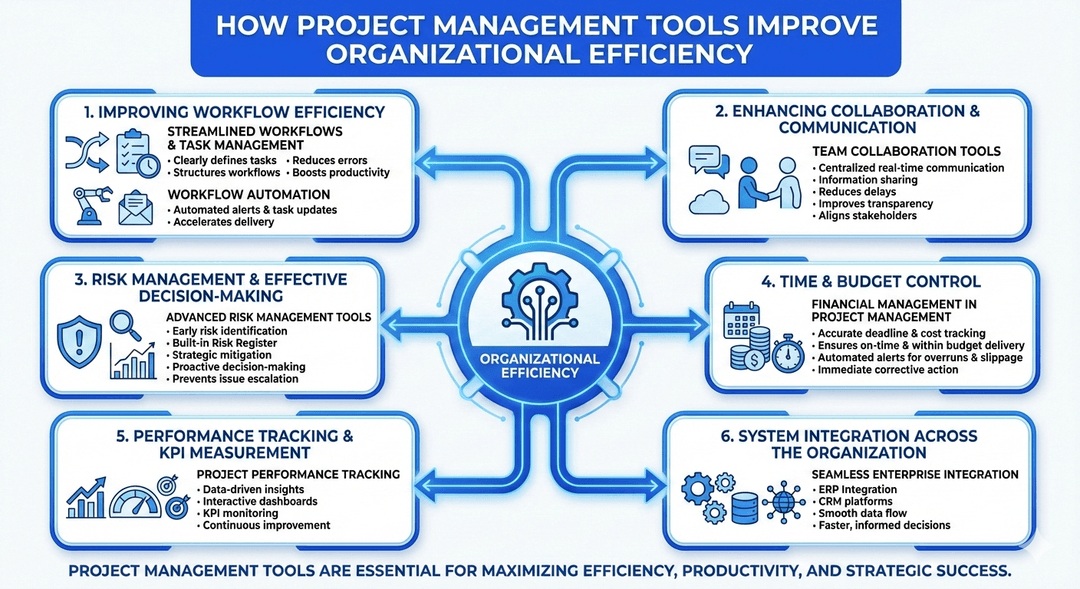
Project Management Tools help organizations enhance efficiency by streamlining workflows, strengthening collaboration, managing risks proactively, maintaining accurate control over time and budget, tracking performance metrics, and integrating seamlessly with enterprise systems.
By clearly defining tasks and structuring workflows, a Task Management System boosts productivity while reducing errors. Real-time Project Tracking Software enables teams to monitor progress instantly, improving coordination and accelerating delivery through Workflow Automation, such as automated alerts and task updates.
From a collaboration perspective, Team Collaboration Tools provide centralized environments for real-time communication and information sharing, reducing delays, improving transparency, and aligning stakeholders across departments.
In terms of risk control, advanced Risk Management Tools, including a built-in Risk Register, enable early risk identification and strategic mitigation helping decision-makers act before issues escalate.
These tools also support Financial Management in Project Management by tracking deadlines and costs with high accuracy, ensuring projects are delivered on time and within approved budgets. Automated alerts notify managers of cost overruns or schedule slippage, enabling immediate corrective action.
Finally, through Project Performance Tracking, KPIs, and interactive dashboards, organizations gain data-driven insights for continuous improvement. Integration with enterprise systems such as ERP Integration for Project Management and CRM platforms ensures smooth data flow, enabling faster and more informed decisions.
Key Areas Where Project Management Tools Drive Efficiency:
- Improving workflow efficiency
- Enhancing collaboration and communication
- Risk management and effective decision-making
- Time and budget control
- Performance tracking and KPI measurement
- System integration across the organization
1. Improving Workflow Efficiency – Faster Delivery with Smart Tools
Project Management Software significantly improves workflow efficiency by clearly defining tasks and monitoring progress in real time. This structured approach increases productivity, reduces rework, and improves output quality.
As a core pillar of Digital Project Management Solutions, these tools enable precise task assignment, accountability, and continuous monitoring. Unified dashboards provide full visibility into project status, improving coordination across teams.
Additionally, Workflow Automation including milestone alerts and automated status updates accelerates execution while reducing human error. The result is more accurate, higher-quality project delivery.
2. Enhancing Team Collaboration – Seamless Communication Through Unified Platforms
Team Collaboration Tools strengthen alignment between team members through integrated platforms that support instant communication, file sharing, and automated updates.
By acting as a central collaboration hub, Project Management Platforms allow distributed teams to work cohesively. Features such as comments, shared documents, and real-time status updates reduce friction and speed up decision-making.
Built-in messaging tools enable real-time communication without switching between systems, improving transparency and minimizing delays.
3. Risk Management and Effective Decision-Making – Protecting Projects with Advanced Analytics
One of the most powerful capabilities of Project Management Tools is proactive risk analysis. Through embedded Risk Management Tools and Risk Registers, project managers can identify, assess, and prioritize risks based on probability and impact.
These insights support informed decision-making before risks escalate. Automated alerts notify managers of potential schedule delays or budget overruns, allowing early intervention such as reallocating resources or adjusting timelines to protect overall project performance.
4. Time and Budget Control – Precision Oversight for Guaranteed Success
Effective Time Management Systems for Projects and Project Cost Control Systems are essential for delivering projects within approved constraints.
Modern Project Scheduling Software provides detailed timelines, cost baselines, and real-time budget tracking. Managers can monitor actual spending against planned budgets and dynamically adjust allocations as project needs evolve.
Accurate financial reports enable tighter cost control, reducing waste and supporting long-term financial sustainability.
5. Performance Tracking and KPIs – Continuous Improvement Through Data
Through Project Performance Dashboards and KPI tracking, organizations can continuously evaluate progress and outcomes.
Key indicators such as Schedule Performance Index (SPI), Cost Performance Index (CPI), and quality metrics allow teams to detect deviations early and take immediate corrective actions.
Interactive dashboards present data visually, enabling faster insights and more effective governance through Project Monitoring Software.
6. System Integration – Seamless Operations Across the Enterprise
Integration between Project Management Systems, ERP, and CRM platforms is essential for unified operations.
Integrated Project Management Systems eliminate duplicate data entry and provide a single source of truth for financial, operational, and project data. This holistic view improves coordination across departments and accelerates executive decision-making.
Integrations with tools such as Salesforce and Slack ensure real-time information flow, supporting agility and execution speed.
Future Trends in Project Management Tools – How Master Team Leads Innovation
Master Team aligns with future trends in AI in Project Management by integrating AI-powered Project Management Solutions, predictive analytics, and machine learning.
These technologies reduce manual effort, enhance forecasting accuracy, and support strategic decision-making. Master Team continuously evolves its platforms to leverage these innovations.
How Master Team Adapts to the Future of Project Management:
- AI Project Assistant: Automates scheduling, risk analysis, and reporting, enabling leaders to focus on strategy.
- AI-powered Real-Time Dashboards: Detect delays and resource bottlenecks early, shifting management from reactive to proactive.
- Enhanced Team Collaboration: AI-driven meeting summaries and real-time updates keep all stakeholders aligned.
- Agentic Intelligence Platform: Transforms complex data into actionable insights using simplified language.
- Future-Ready Integration: Master Team solutions (+P and +S) evolve alongside AI and advanced analytics to support modern business needs.
Through these innovations, Master Team empowers organizations with flexibility, resilience, and leadership in Digital Transformation in Project Management.
Conclusion – Driving Efficiency and Innovation with Master Team
In summary, modern Project Management Tools play a critical role in improving organizational efficiency by optimizing workflows, enhancing collaboration, enabling early risk detection, and maintaining strict control over time and budget.
Their integration with enterprise systems ensures seamless data flow and reliable decision-making environments. As AI and advanced analytics shape the future, Master Team continues to deliver cutting-edge Digital Project Solutions that help organizations achieve faster, more reliable results within defined timelines and budgets.
To learn more about optimizing your projects and achieving measurable outcomes, contact us today and explore how Master Team’s integrated solutions can support your organization’s growth with efficiency and professionalism.
Frequently Asked Questions (FAQs)
1. How do Project Management Tools improve performance and KPI tracking?
Project Management Tools enhance performance by enabling continuous Project Performance Tracking through clearly defined Key Performance Indicators (KPIs) such as schedule adherence, cost efficiency, resource utilization, and delivery quality. Using real-time dashboards and analytics, project teams can quickly identify deviations, address bottlenecks, and take corrective actions before issues escalate ensuring consistent alignment with project and organizational objectives.
2. Why is integration with ERP and CRM systems important in Project Management?
Integration with enterprise systems such as ERP and CRM is critical for creating a unified operational environment. ERP Integration for Project Management ensures accurate financial tracking, resource planning, and cost control, while CRM integration aligns project execution with customer requirements and business priorities. This seamless data flow reduces manual errors, saves time, and enables faster, more informed decision-making across departments.
3. Can Project Management Tools be customized to fit different organizational needs?
Yes. Modern Project Management Software offers extensive customization capabilities to meet the unique needs of different organizations and industries. Dashboards, workflows, task templates, approval processes, and automated rules can all be configured to align with specific governance models, operational structures, and strategic goals, making these tools suitable for enterprises, government entities, and organizations of all sizes.
4. How do AI-powered Project Management Solutions add value to organizations?
AI-powered Project Management Solutions enhance efficiency by automating routine tasks, predicting risks, optimizing schedules, and generating intelligent insights from project data. Features such as an AI Project Assistant, predictive analytics, and smart dashboards help organizations move from reactive management to proactive, data-driven decision-making improving delivery speed, accuracy, and overall project success rates.
5. How do Project Management Tools support governance and executive oversight?
Advanced Project Governance capabilities provide executives with full visibility into project portfolios through centralized dashboards and reporting tools. Solutions such as PMO Software and Executive Office Management Tools enable leadership teams to monitor performance, track strategic alignment, approve decisions efficiently, and ensure accountability across all initiatives strengthening governance and organizational control.