
📉 Imagine owning a strategic project worth millions of riyals, having a skilled team, and a precise execution plan… yet the results are falling short!
Reports are delayed, decisions are based on estimates rather than data, and risks are discovered too late.
This scenario is not an exception, but a common reality in organizations still managing their projects with disconnected systems that don’t integrate.
⚙️ In the age of digital transformation, the issue is no longer the lack of project management tools or ERP systems, but rather how they are operated in isolation.
When a project management system works separately from the financial system, resource management, and supply chains, the vision becomes fragmented, and management loses its ability to make accurate, timely decisions (Real-Time Decision Making).
📊 Today’s most digitally mature organizations do not rely on isolated tools, but on integrated digital ecosystems that directly connect:
🔹 Strategic planning and aligning initiatives with goals
🔹 Project, program, and portfolio management (P3 / PPM)
🔹 Resources, budgets, and costs (Resources & Financial Control)
🔹 Executive governance and leadership decision support (Executive Governance & BI)
💡 Here, the integration of project management tools with ERP transitions from a technical choice to a strategic lever; A seamless integration that turns raw data into instant insights, projects into measurable assets, and management from a reactive response to proactive leadership driven by data and analysis.
🔍 In this article, we provide a practical and in-depth analysis showing how integrated project management tools with ERP enable organizations to make more precise real-time decisions, achieve higher operational transparency, control costs, and accelerate execution.
We also tie this to global best practices and advanced digital solutions relevant to both the public and private sectors in Saudi Arabia, with real-world examples from Master Team digital solutions like P+ platform, supporting digital transformation and the achievement of Saudi Vision 2030 goals.
How Integrated Project Management Tools with ERP Contribute to Real-Time Decision-Making
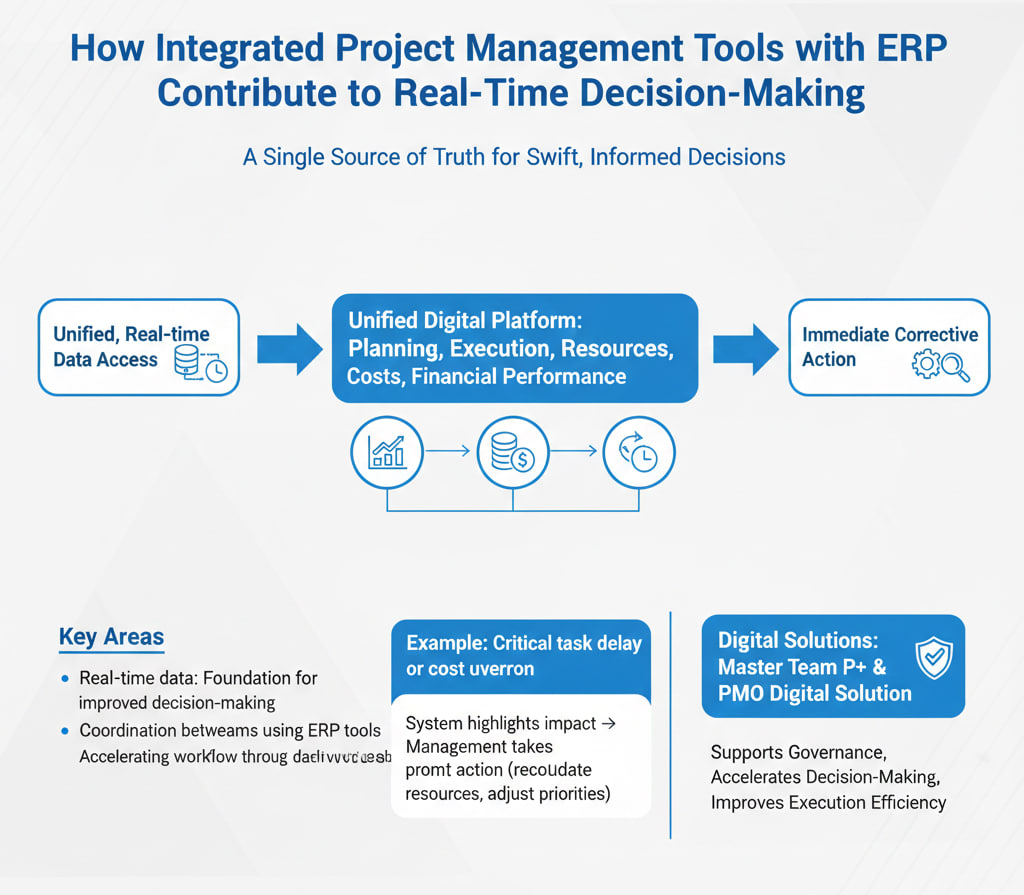
Integrated project management tools with ERP systems enable decision-makers to access unified, real-time data, allowing for accurate and swift decisions based on the actual project status, rather than relying on outdated reports or incomplete estimates.
When this integration is applied, the organization shifts from managing projects with separate systems to a unified digital platform that consolidates planning, execution, resources, costs, and financial performance in one environment. This direct link allows managers to track task progress, resource consumption, and time and cost deviations as they happen, without needing to wait for periodic reports or manual interventions.
For example, if a critical task is delayed or costs exceed the budget, the integrated system immediately highlights the impact on the timeline and budget, enabling management to take corrective action promptly, such as reallocating resources or adjusting priorities.
Digital solutions like Master Team P+ and PMO Digital Solution embody this concept practically by providing a Single Source of Truth that supports governance, accelerates decision-making, and improves execution efficiency in alignment with the digital transformation requirements in Saudi Arabia.
To further clarify, the contribution of integrated project management tools with ERP to decision-making can be broken down into the following key areas:
- Real-time data: The foundation for improving the decision-making process
- Coordination between teams using ERP tools for project management
- Accelerating workflow through data-driven decisions
1. Real-Time Data: The Foundation for Improving Decision-Making
Real-time data is essential for making accurate decisions in project management. Direct access to live reports and interactive dashboards enables managers to track task progress, allocate resources, and monitor costs as they happen.
When integrated with project management tools, the ERP system provides real-time information (such as inventory levels or task progress) without the need for delayed manual updates. These instant insights allow project managers to adjust strategies proactively and avoid risks before they escalate.
For example, when system analytics show higher-than-expected material consumption, the system sends immediate alerts to the team to take corrective actions (such as renegotiating with suppliers). In short, real-time data from the ERP system acts as the lifeblood of the project, enabling leaders to quickly reassess plans and guide the team more effectively.
2. Coordination Between Teams Using ERP Project Management Tools
The integration of project management tools with ERP systems enhances coordination and communication across different teams within an organization. When teams share a single unified platform, everyone has a "shared view" of the latest project developments.
The system instantly connects information between departments (such as finance, human resources, and procurement) and eliminates barriers caused by isolated data islands. For example, when a technical team completes a task, the system sends an immediate notification to the next team, eliminating the need for manual updates, thereby preventing delays caused by missing information.
Additional benefits of ERP coordination include:
- Shared Workspace: A unified platform serves as a common communication hub (such as dashboards and digital reports), where each member is aware of their role and responsibilities in real-time.
- Real-Time Information Sharing: Instant updates for any change in the project (e.g., timeline or resource updates), ensuring all teams are aligned with the latest data.
- Reducing Gaps: Since everyone works with the same data, errors resulting from different versions of reports or misunderstandings are minimized, and cross-departmental collaboration improves.
These advantages enable working teams to align and focus on common goals, improving the speed and quality of project completion. For example, in government projects in Saudi Arabia, integrated solutions such as the "P+ PMO Digital Solution" have helped organizations enhance institutional coordination and accelerate task execution, fully aligning with the objectives of Vision 2030.
3. Accelerating Workflow Through Data-Driven Decisions
The availability of accurate and real-time data accelerates the workflow process. Managers can take immediate action to implement corrective measures or reassign tasks as soon as any deviation from the plan occurs.
When the unified platform holds all the necessary information (such as scheduled tasks, calculated costs, and performance indicators), the team avoids wasting time on coordination and focuses directly on execution. For example, instead of waiting for a meeting or a monthly report, ERP management dashboards immediately show project progress and highlight any bottlenecks.
This enables companies to:
- Reduce Decision-Making Time: A single platform provides leaders with data at any moment, reducing approval stages and coordination, speeding up the implementation of changes.
- Allocate Resources Effectively: When data enhances the accuracy of insights, managers can quickly reallocate resources to maximize productivity without disrupting ongoing processes.
- Increase Productivity and Efficiency: Leveraging real-time data allows for the elimination of routine manual tasks (such as updates and reconciliations) through automation and instant alerts, freeing up team members to focus on strategic work.
In short, integrated ERP tools help speed up every step in the workflow chain. Decisions based on timely, real-time data mean that bottlenecks can be addressed immediately, avoiding unnecessary delays.
Best Practices to Maximize the Benefits of Integrating ERP and Project Management Tools
To fully benefit from the integration of ERP systems with project management tools, a set of key practices must be applied, including: accurate needs analysis, data unification and cleansing, the use of advanced analytics and artificial intelligence, investing in user training, and adopting a gradual approach to testing and continuous monitoring.
To achieve the maximum benefit from ERP and project management tool integration, proven strategies should include:
- Comprehensive Needs Analysis: Identify the functions and departments that will benefit most from the integration. For example, using Business Intelligence (BI) to set up Key Performance Indicators (KPIs) may be a key element in large projects.
- Data Cleansing and Unification: Ensure the accuracy and consistency of data before integration. Well-organized data maintains its credibility and prevents errors resulting from duplicate or isolated records.
- Advanced Analytics Usage: Integrating Business Intelligence (BI) tools and Artificial Intelligence (AI) enables deeper insights from unified data. For instance, machine learning (ML) can predict cost overruns or detect early risks.
- Continuous Training for the Team: Investing in hands-on training and workshops accelerates system adoption and ensures that all features are effectively utilized. An informed user operates more efficiently and benefits from automation capabilities and advanced reporting.
- Continuous Testing and Monitoring: Initially launching the integration in a pilot project helps identify gaps before full-scale implementation. After the full launch, performance dashboards and data analytics are used to ensure the system meets the intended goals.
By following these practices and focusing on the continuous improvement of information and processes, companies benefit from faster and more flexible project management. For example, through ERP Analytics, the project management team can leverage smart dashboard reports to take proactive measures, enhancing overall effectiveness and efficiency.
Future Trends in Integrated Project Management Tools with ERP
In light of rapid technological developments, the integration of project management system tools with ERP systems will enhance decision-making in the future in smarter and more flexible ways.
Artificial Intelligence (AI) technologies are expected to play a key role, as they will analyze big data in real time and provide predictive recommendations regarding schedules, costs, and resources. Additionally, the Internet of Things (IoT) will enable the collection of more real-time operational data from fields and factories, increasing the accuracy of monitoring and control.
For example, today, cloud-based ERP systems integrated with AI allow machine learning (ML) and the use of advanced analytics tools (such as Agentic AI) to improve the accuracy of predictions and automatically alert teams to potential risks. Moreover, augmented reality (AR) platforms and voice learning will enhance the project management experience by providing visual and easy interactions for virtual meetings and a digital RACI system to track responsibilities.
In the near future, the focus will shift towards establishing "Project Vision Realization Offices" (PVRO), supported by AI to transform real-time data into effective strategies, just as Saudi Vision 2030 promotes advanced technologies. The integration of ERP and project management tools will remain a central factor in empowering decision-makers to leverage emerging technologies, leading to more successful and less risky projects in the ever-changing business world.
Challenges Companies May Face When Integrating Project Management Tools with ERP and How to Overcome Them
The key challenges when integrating project management tools with ERP systems include technical complexity, data security concerns, resistance to change from users, and initial costs.
These challenges can be addressed through careful planning, selecting the appropriate integration technologies, applying strong security policies, and providing training and gradual implementation.
Despite the significant benefits, companies may face several challenges when integrating project management tools with ERP systems, including:
- Technical Complexity: Integrating multiple systems and synchronizing their data can be complex, especially if some systems are legacy systems. This challenge can be addressed by using Application Programming Interfaces (APIs) or middleware platforms that ensure data flow without conflicts.
- Security Concerns: Transferring sensitive data between systems may raise concerns about data breaches or leaks. To address this, strong encryption, strict access controls, and compliance with security standards and policies should be implemented to ensure confidentiality and integrity of information.
- Resistance to Change: Employees may resist adopting the new system due to familiarity with traditional methods or unclear benefits. This can be mitigated by providing intensive training programs and creating safe, experimental environments for users to gradually adapt to the system.
- Initial Costs: System integration may require significant upfront investment for purchasing licenses or developing custom solutions. However, the long-term returns such as reducing waste and increasing productivity can offset these initial expenses.
To overcome these challenges, best practices involve careful planning, including assessing the current systems, cleaning and standardizing data before integration, and selecting an appropriate methodology (e.g., using APIs or iPaaS).
Additionally, involving stakeholders from all departments and providing necessary support throughout the integration process will help increase acceptance. By applying these strategies, along with continuous training programs, companies can minimize operational risks and fully benefit from system integration without disrupting operations.
Conclusion: Integrated ERP Tools are the Key to Faster and More Accurate Decision-Making
Specialized project management evidence shows that linking PM tools with ERP systems is a strategic investment that enhances operational efficiency and shortens decision-making time. Thanks to integrated data on a single platform, companies move from a reactive environment driven by estimates to one powered by facts. This means fewer financial and scheduling errors, and increased success in delivering projects on time and within budget.
For example, Master Team offers integrated solutions like P+ PMO Digital Solution, S+ Strategy Digital Solution, and Diwan Executive Hub that streamline data collection and real-time analysis, enabling Saudi organizations to meet the digital transformation requirements of Vision 2030.
By implementing best practices such as continuous business analytics and intensive employee training, companies can fully leverage this integration and elevate their project management to a new level of professionalism.
Ultimately, integrating project management systems with ERP is one of the key tools for accelerating decision-making speed and quality. It allows teams to work in complete harmony and makes data accessible to everyone, thus paving the way for successfully achieving project goals sustainably.
Frequently Asked Questions (FAQ):
1- How can project management systems integrate with ERP?
Integration can be achieved by connecting different systems through APIs (Application Programming Interfaces) or specialized middleware platforms. The process begins with analyzing existing tools and cleaning the data, followed by selecting an appropriate integration method (such as direct Point-to-Point or via iPaaS) to ensure smooth data exchange between the project management system and ERP.
2- Do small businesses need to integrate ERP with project management tools?
The need depends on the size and complexity of the company's operations. While simple projects may not require a comprehensive integrated system, adopting flexible, cloud-based ERP solutions can benefit small businesses by streamlining basic tasks. Some modern ERP solutions are suitable for small businesses with a low budget and offer integrated project management features, enabling them to leverage unified data for smarter decision-making without high costs.
3- What are the benefits of ERP tools in project management?
Key benefits of ERP tools in project management include real-time tracking of resources, clear visibility of project progress and timelines, and monitoring of costs and budgets in real time. The unified platform also enhances team collaboration, reduces errors, and provides accurate analytics to help identify risks early and respond to them. In short, integration boosts productivity and ensures the project is executed within the planned time and budget.
4- How can real-time data improve decisions in projects?
Real-time data provides project managers with an up-to-date, instant snapshot of every aspect of the project (costs, progress, risks, etc.), allowing them to make informed decisions as changes happen. Instead of working with outdated data, receiving real-time reports enables swift actions (such as budget overrun alerts or task rescheduling) before the issue escalates, improving the accuracy and impact of decisions.
5- What are the best tools for integrating project management with ERP?
The best tool depends on the company's needs, but there are well-known platforms that support this integration. One example is Master Team P+, an integrated ERP system that includes project management functionalities and allows seamless connection with other financial and operational units.