
🚀 Imagine all your projects, resources, and financial decisions working as one cohesive mind… No conflicts, no delays, and no contradictory data!
While many companies still manage their projects in systems separate from Enterprise Resource Planning (ERP) systems, project teams face daily struggles with duplicate numbers, mismatched reports, and decisions based on an incomplete view of reality. The problem here is not a lack of systems... but rather their lack of integration.
📊 The reality is that most project failures don't occur because of poor planning, but due to data gaps between project management systems and financial or operational systems.
When the project management system doesn't communicate with the ERP system in the same language, budgets become estimates, timelines turn into assumptions, and the comprehensive view needed for management to make accurate, timely decisions is lost.
🔗 Integrating project management systems with ERP is no longer just a technical option, but a strategic decision that directly impacts:
✔ Cost and budget accuracy
✔ Speed of decision-making
✔ Resource utilization efficiency
✔ Performance transparency
✔ Business continuity without disruption
But… 💡 Despite all these benefits, the integration path is not without challenges.
From technological compatibility and high costs to resistance to change, data integration, and risk management, organizations face real challenges that could turn the integration project from a golden opportunity into a heavy burden if not managed professionally.
⬇️ In this article, we’ll take you step by step through the key challenges of integrating project management systems with ERP systems, and show you how to handle them intelligently and realistically, drawing on best global practices and practical experiences, with a specific focus on the fast-paced business environment of Saudi Arabia.
Key Challenges in Integrating Project Management Systems with ERP Systems
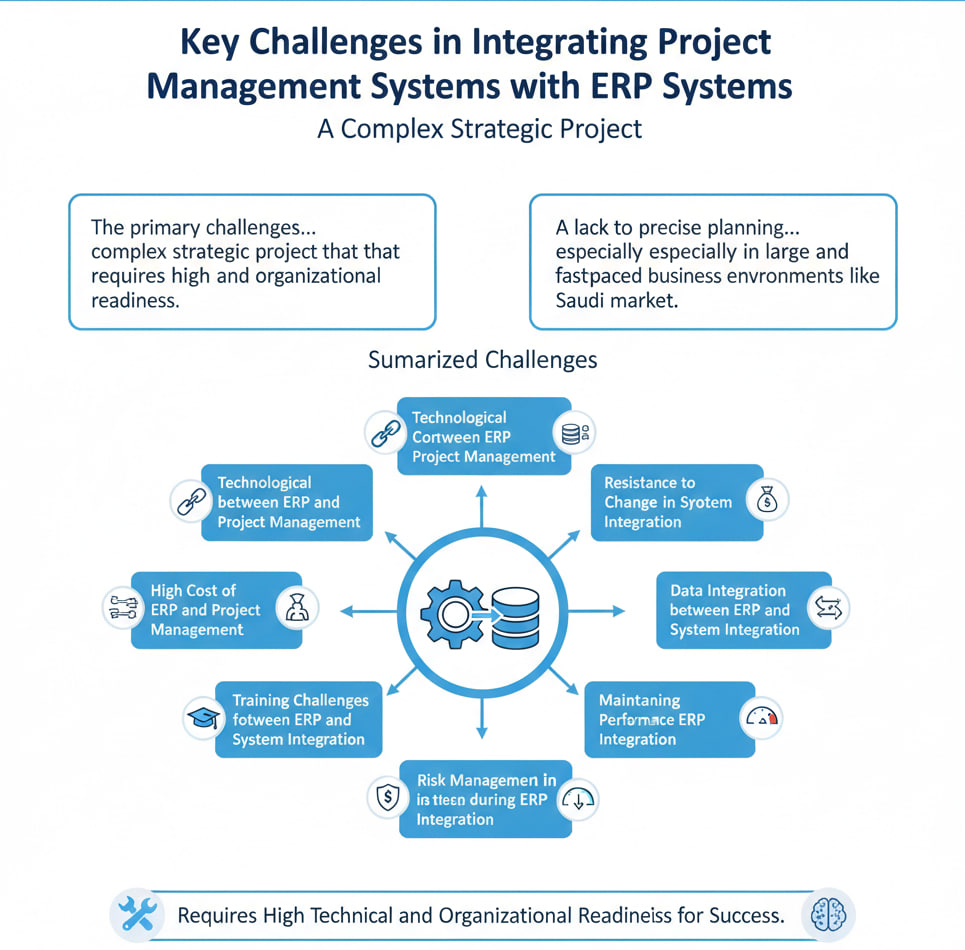
The primary challenges in integrating project management systems with ERP systems lie in technological compatibility between different systems, the high cost of integration, employee resistance to change, training and support challenges, data integration complexities, risk management, and maintaining performance and business continuity during the integration process.
In reality, although integrating the project management system with ERP provides organizations with a unified view of data, better resource control, and more accurate decisions, this integration is a complex strategic project that requires high technical and organizational readiness.
A lack of precise planning or underestimating the challenges involved could lead to operational disruptions, budget overruns, or poor adoption of the new system by operational teams, especially in large and fast-paced business environments like the Saudi market.
To create a clear and comprehensive picture of why many integration projects fail, the key challenges can be summarized in the following points:
- Technological Compatibility between ERP and Project Management
- High Cost of ERP Integration
- Resistance to Change in System Integration
- Training Challenges for ERP and Project Management
- Data Integration between ERP and Project Management
- Risk Management in System Integration
- Maintaining Performance during ERP Integration
Each of these challenges requires a tailored approach, and addressing them proactively will ensure a smoother integration process that leads to operational efficiency and success.
1. Technological Compatibility Between ERP and Project Management: How to Overcome Technical Obstacles in System Integration?
Technological compatibility between the Project Management System (PMS) and ERP is one of the most significant challenges in integration. This is because it requires the unification of programming languages, databases, and different data formats. To overcome these obstacles, organizations can rely on middleware platforms or unified Application Programming Interfaces (APIs).
One common issue is the difference in data formats between systems. According to a report by Spinnaker, "without proper data transformation, transferring data between systems with different formats can be a real challenge." To address this, data mapping tools can be used to convert the data into a common format.
Furthermore, integrating legacy systems with modern software may require custom development because these older systems often lack integrated connection features.
To take advantage of automation and avoid human errors, modern cloud solutions and integration methods like iPaaS (Integration Platform as a Service) facilitate system integration through standardized protocols. This ensures technological compatibility between ERP and project management systems, reducing integration challenges across systems. By using middleware and APIs, organizations can unify databases and information, effectively overcoming the issues of integrating legacy systems without having to rebuild everything from scratch.
2. High Cost of ERP Integration: A Long-Term Investment or Additional Burden?
The cost is seen as a significant challenge at the outset. System integration requires a large initial investment to purchase and customize software, along with licensing fees and updates.
For example, a HAL report confirms that ERP integration tools, middleware solutions, or custom development require a substantial upfront investment. This also involves data mining, transferring, and updating, which can incur additional costs if the data is not already organized.
Furthermore, the cost includes training sessions and technical support to help employees learn the new system, as well as ongoing expenses for maintenance and support. According to an Odoo Institute guide, future costs include training, maintenance, upgrades, and support, which are recurring expenses that affect the operational budget.
Additionally, poor budget management or scope creep may lead to exceeding the planned costs. Experts warn that "budget overruns are a common risk" during ERP system implementation.
However, these expenses are viewed in the long term as a worthwhile investment that returns efficiency and automation to the project. In summary, integrating systems imposes a high initial cost for ERP integration, but careful budget management and planning can turn this into a long-term investment that generates operational savings.
3. Resistance to Change in System Integration: How to Overcome the Challenge of Motivating Employees to Adapt to the New System?
Resistance to change is a natural aspect of any digital transformation, and employee resistance in system integration is one of the most prominent human challenges. Many employees may be skeptical about the new system, fearing for their jobs or struggling to learn how to use it.
To address this challenge, it is crucial to foster a culture of change within the organization and implement an effective change management strategy. Experts advise clearly explaining the benefits of integration to all stakeholders and how the new system aligns with the broader organizational goals. Leadership communication and clarity of vision are central to motivating employees.
For example, an ERP implementation risk analysis highlights the importance of involving employees in the decision-making process and clarifying the real reasons for the change. The analysis states: “Employee resistance can be alleviated through effective change management strategies and by involving employees in the decision-making process and explaining the reasons behind system implementation.”
Additionally, offering simple incentives and encouragement for training can motivate employees to adapt to the ERP system. Employees who are aware of the new system's benefits will become champions of the change rather than its detractors.
4. ERP and Project Management Training Challenges: Ensuring the Effectiveness of the New System through Proper Training
The success of system integration cannot be achieved without a comprehensive training program and continuous support for the end-users. Employees need to have a deep understanding of how to use the new system in their daily tasks.
According to specialized sources, insufficient training can disrupt operational efficiency. Therefore, it is essential to provide comprehensive training programs that include hands-on practice and ongoing support. HAL recommendations emphasize investing in both training and change management, as comprehensive training sessions are one of the key practices for reducing resistance and enhancing adoption.
Moreover, user support must be guaranteed after system integration, whether through an internal or external support team. A British report recommends establishing a dedicated support team or help center to handle user queries post-implementation and offer regular update training sessions.
These challenges also involve monitoring system usage by managers to ensure process consistency and efficiency. Providing the appropriate training and supporting resources transforms the new system from a burden into a productive tool, as employees master their skills and become capable of managing the system efficiently, taking full advantage of its features.
5. Data Integration Between ERP and Project Management: How to Ensure Smooth Data Transition Between Systems?
Data integration is at the heart of linking the Project Management System (PMS) with the ERP system. Organizations face technical challenges in transferring and unifying data from multiple sources.
For instance, a report by Spinnaker notes that without proper data transformation procedures, transferring data between systems with different formats can be a real challenge. To overcome this, it is recommended to use data integration tools that ensure accuracy and consistency (Data Mapping). Data mapping tools are valuable for discovering discrepancies in the structure or format of data across systems, simplifying integration by reducing manual processes.
Moreover, attention must be given to scattered and multiple data sources; the Project Management System, HR team, and accounting system may work with different databases. Therefore, unifying this data is essential. For example, creating a centralized data platform to collect information or using iPaaS tools for real-time synchronization is an effective approach.
In short, unifying data for system integration requires applying unified strategies like data cleansing and establishing common formats. Additionally, utilizing synchronization tools helps maintain data integrity and quality control, ensuring a seamless transition between ERP and project management systems.
6. Risk Management in System Integration: How to Predict Potential Risks During Integration?
As with any large-scale technical project, organizations must identify potential risks and plan for them before starting the integration. Experts recommend conducting a comprehensive risk assessment and preparing contingency plans in advance.
According to specialized guidelines, organizations should carry out a thorough evaluation of risks and develop backup plans to mitigate the impact of unexpected expenses. When predicting risks, this includes technical risks (such as connection failures or software conflicts), as well as financial and organizational risks.
For practical examples, project management teams can maintain a Risk Register, which includes all possible scenarios such as data loss or budget overruns, along with predefined early actions to address these issues.
Moreover, sources emphasize that careful planning significantly reduces risks. “Detailed and comprehensive planning reduces risks and provides a clear path during the implementation process.” Therefore, a combination of pre-planning, continuous evaluation, and regular reviews with stakeholders enhances the team's ability to anticipate and resolve issues before they escalate.
By keeping a proactive approach to risk management, the organization can ensure that the integration process remains smooth and that any unforeseen challenges are handled promptly.
7. Ensuring Performance Continuity During ERP Integration: How to Guarantee Uninterrupted Operations?
System integration carries the risk of disrupting daily operations or slowing down performance if the transition process is not carefully managed. To ensure business continuity, a Phased Migration Strategy should be applied to minimize the shock of change.
ERP experts recommend performing extensive testing on the new system in a trial environment before full deployment. Weak or inadequate testing can lead to numerous performance issues and system failures. This includes End-to-End Testing and Load Testing to ensure the infrastructure can handle the expected increase in data and users.
Additionally, it is crucial to have a Business Continuity Plan with procedures for quick recovery in place. Business consultants emphasize the importance of verifying this plan during the integration process to handle any potential system interruptions effectively.
For example, it is recommended that the team start formulating a continuity plan at the beginning of the project and conduct regular tests (such as simulating system failures). By doing so, early signs of performance deviation can be detected and corrected without impacting daily operations.
Furthermore, close collaboration between IT teams and operational teams ensures constant monitoring of Key Performance Indicators (KPIs) and allows for immediate corrective actions, which helps maintain operational stability during the integration process. This proactive approach ensures minimal disruption while the system is being integrated.
Conclusion: A Successful Integration Starts with Understanding Challenges, Not Ignoring Them
Integrating Project Management Systems with Enterprise Resource Planning (ERP) systems has evolved beyond a mere technical step to improve performance.
It has become a strategic decision that determines an organization’s ability to grow, control costs, achieve transparency, and respond swiftly to market changes. As we’ve explored in this article, challenges ranging from technological compatibility and cost, to resistance to change, data integration, and risk management are real obstacles. However, these challenges are manageable if addressed with a clear vision and a professional methodology.
Organizations that succeed in this integration view it as a comprehensive transformational project, not just a system link. These organizations invest in thorough planning, effective change management, capability building, and ensuring operational continuity throughout the integration process. In fast-paced business environments, such as the Saudi market, intelligent integration between ERP and Project Management becomes a critical factor in achieving operational efficiency and sustainable competitive advantage.
🚀 Ready to turn challenges into real opportunities?
At MasterTeam, we help organizations implement well-thought-out and effective integrations between Project Management Systems and ERP systems through advanced digital solutions like:
- P+ PMO Digital Solution: To enhance project management and monitoring efficiency.
- Diwan Executive Office Solution: To improve governance and decision-making.
- S+ Strategy Digital Solution: To support data-driven strategic planning.
👉 Discover how MasterTeam can help you build an integrated system that confidently supports your projects and decisions, and start your journey toward intelligent and sustainable integration.
Frequently Asked Questions (FAQ):
1- What are the key benefits of integrating an ERP system with a Project Management system?
Integration unifies information and reduces data entry duplication, which enhances report accuracy and resource balancing. It also facilitates task coordination across teams (increasing flexibility and efficiency), and provides a comprehensive view of project status and financial operations in one platform.
2- How can we prepare employees to accept the new system?
By involving them early in the design stages and goal-setting, clearly explaining the anticipated benefits. Providing intensive integration training courses and continuous support, along with a change management strategy led by inspiring executive leadership, can increase enthusiasm, as recommended in best practices.
3- What is the importance of choosing a good implementation partner or service provider for the integration process?
A qualified partner has technical expertise in complex systems and helps reduce risks and improve performance. Support companies like Spinnaker or specialists facilitate technical integration, handle legacy system issues, and ensure effective post-integration follow-up. Solutions from experts like MasterTeam help seamlessly connect systems.
4- How can we ensure business continuity during the testing of the new system?
A phased migration strategy should be implemented with continuous performance monitoring. The new system should be tested in a separate (test) environment under real-world scenarios before full deployment. Additionally, a contingency and continuity plan (such as automatic backups and a rapid recovery plan) should be in place to prevent any disruption to normal operations.