
📉 Imagine leading a multi-million Riyal strategic project, with a highly skilled team and a well-thought-out execution plan... and yet, the results fall short!
Reports arrive late, decisions are made based on assumptions rather than live data, and risks emerge only after they’ve escalated into full-blown crises.
This scenario is not an exception but a recurring reality for many organizations that still manage their projects using isolated systems that don’t communicate with each other, leaving management without a unified, comprehensive view.
⚙️ In the age of Digital Transformation, the problem is no longer the lack of Project Management Systems or ERP (Enterprise Resource Planning) systems, but the fact that each system is operating in isolation.
When a Project Management System works independently from the financial system, resource management, or supply chains, data becomes fragmented, and the ability to make real-time decisions (Real-Time Decision Making) erodes.
📊 Today, the most digitally mature organizations no longer rely on separate tools, but rather on integrated digital ecosystems that directly connect:
🔹Strategic Planning and Linking Initiatives to Objectives
🔹Project, Program, and Portfolio Management (P3 / PPM)
🔹Resources, Budgets, and Cost Control
🔹Executive Governance, Reporting, and Leadership Decision Support
💡 This is where ERP integration with project management tools transforms from a mere technical choice into a true strategic lever. It turns raw data into actionable insights, projects into measurable assets, and management from reactive to proactive leadership based on analysis, AI-powered solutions, and digital governance.
🔍 In this article, we provide a practical and in-depth analysis showing how ERP integration with Digital Project Management Systems is reshaping the future of project management through:
🔹Improving real-time decision-making
🔹Increasing operational transparency
🔹Reducing risks and controlling costs
🔹Accelerating execution and achieving institutional efficiency
We also connect this with global best practices and the local context of Saudi Arabia, highlighting advanced digital solutions that support both the public and private sectors, such as P+ PMO Digital Solution from Master Team digital solutions, as one of the models supporting digital transformation and achieving the targets of Saudi Vision 2030.
The Future of Project Management in the Era of Integrated Systems (ERP Integration)
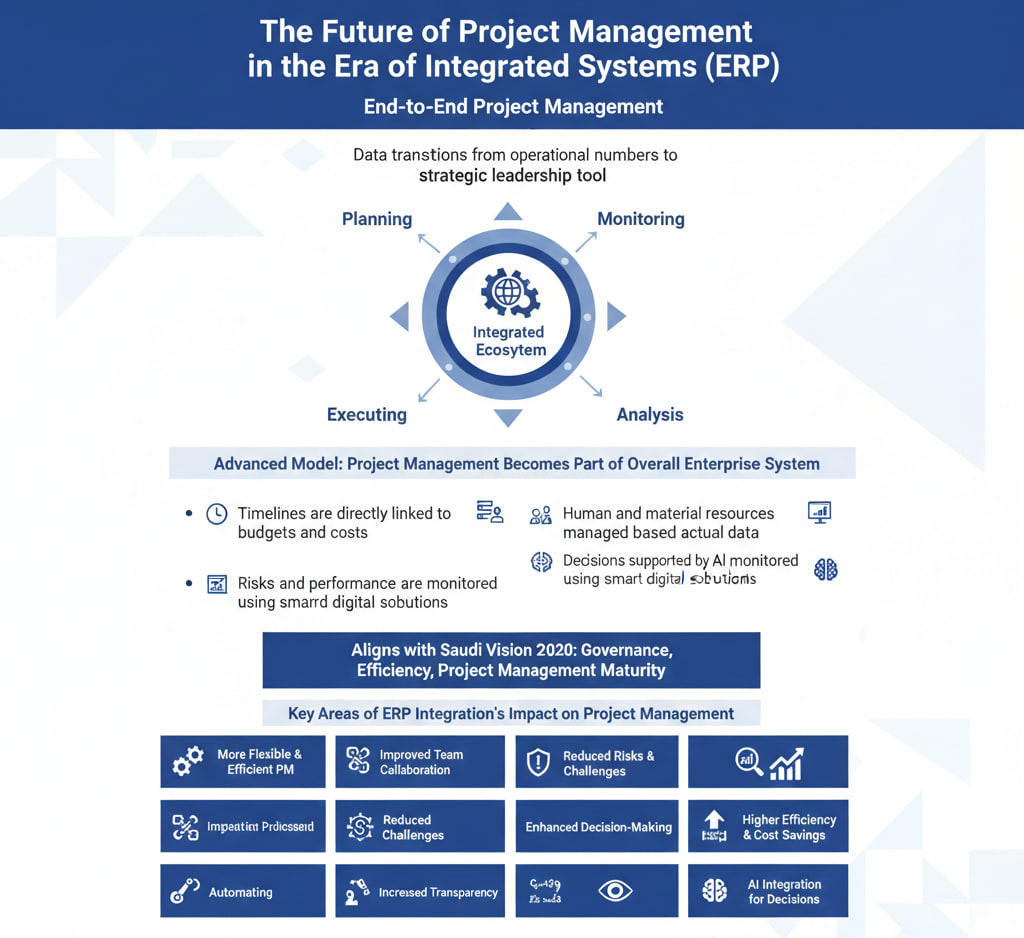
The future of project management is now shaped around the integration of ERP systems with digital project management tools. This integration is the crucial factor in achieving a comprehensive vision, real-time decision-making, cost control, and risk reduction across the entire project lifecycle (End-to-End Project Management).
Modern project management no longer relies on traditional spreadsheets or isolated systems. It has evolved into an integrated digital ecosystem that combines planning, execution, monitoring, and analysis on a single platform.
When a Project Management System is integrated with ERP, data transitions from being merely operational numbers to a strategic leadership tool that supports senior management, PMOs (Project Management Offices), and execution teams in real-time.
In this advanced model, project management becomes part of the overall enterprise system, where:
- Timelines are directly linked to budgets and costs.
- Human and material resources are managed based on actual data, not estimates.
- Risks and performance are monitored using smart BI dashboards.
- Decisions are supported by AI-powered digital solutions.
This transformation directly aligns with the digital transformation requirements in Saudi Arabia, and with the objectives of Saudi Vision 2030, which focuses on governance, efficiency, and enhancing project management maturity in both public and private sectors.
To understand the full picture of how ERP integration impacts the future of project management, we explore in the following sections the key areas where this integration is creating a fundamental shift in performance and outcomes.
Key Areas of ERP Integration's Impact on Project Management:
- ERP Integration as a Foundation for More Flexible and Efficient Project Management
- Improving Team Collaboration Through a Unified Data Management Platform
- Reducing Risks and Challenges via Predictive Analysis and Early Alerts
- Enhancing Decision-Making with Real-Time Data
- Achieving Higher Efficiency and Cost Savings Through Smart Resource Management
- Automating Processes and Enhancing Operational Efficiency within Projects
- Increasing Transparency and Real-Time Performance Monitoring
- Integrating AI with ERP to Analyze Data and Support Decision-Making
1. ERP Integration: A Key Step Towards More Flexible and Efficient Project Management
The integration of ERP systems with project management tools enhances the flexibility and efficiency of operations by providing a unified and real-time view of all project aspects.
This allows for accurate tracking of project progress and real-time updates, enabling managers to allocate resources optimally and make immediate decisions based on reliable data.
On one hand, ERP integration breaks down data silos between departments, allowing different teams to access the same information without delays or duplication.
For example, Trimble has documented that real-time data flow between the ERP system and project management tool increases team confidence and makes projects more adaptable. Project managers can view actual costs moment by moment, enabling them to quickly adjust to any changes.
In this way, most traditional project management challenges are transformed into opportunities for performance improvement, allowing projects to be completed faster and more efficiently.
2. Enhancing Team Collaboration Through ERP Integration
ERP integration facilitates seamless and clear communication between all teams, ensuring that engineering, financial, and administrative departments operate in the same informational language.
When data is stored and updated within a unified ERP system, the sharing of information becomes easier and faster, eliminating the need for duplicated efforts or errors caused by discrepancies between departmental records.
For instance, imagine that both the finance and engineering teams can access the project budget and schedule simultaneously, without waiting for updates from another department. This level of transparency boosts collaboration and accelerates task completion.
Sources confirm that such integration builds trust between different teams.
As Trimble highlighted, real-time cost synchronization between the two systems strengthens the relationship between the finance and operations teams. As a result, teams can coordinate more efficiently, contributing to the on-time delivery of projects with high quality.
3. Reducing Risks and Challenges Through Technological Integration
ERP integration helps mitigate project-related risks by enabling early alerts and continuous performance analysis. When the system gathers vast amounts of data from all project sources, it can detect deviations or problems before they escalate.
For example, studies show that real-time data analysis allows managers to identify budget overruns or delays in workflows early on, enabling them to intervene before issues spiral out of control. Additionally, the use of AI and Internet of Things (IoT) technologies enhances these capabilities. Research has shown that AI-powered systems can identify bottlenecks or cost overruns before they occur.
As a result, financial or technical surprises are reduced, saving time, cutting unplanned costs, and significantly improving the project's chances of success with greater security.
4. Improving Decision-Making with Real-Time Data from ERP
ERP integration supports precise and swift strategic decision-making by providing up-to-date information and comprehensive analytics. ERP systems generate real-time reports and data displayed on advanced dashboards, making all key performance indicators available instantly.
This allows leaders to review the full project performance at any moment and adjust plans accordingly to meet goals, moving away from reliance on outdated reports.
For example, specialized sources explain that AI algorithms embedded in ERP systems analyze real-time data to offer actionable insights and recommendations for optimizing operational strategies.
According to a study published by DCKAP, integrating accurate information into the system enables teams to extract high-level insights more easily. This means that strategic decisions are made based on live, reliable data. As a result, corporate decisions are grounded in a realistic foundation and deeper analysis, helping to maintain project quality and alignment with organizational objectives.
5. Cost Savings through ERP Integration with Project Management
ERP integration helps improve resource allocation and operational efficiency, leading to significant cost reductions. By continuously monitoring activities and assets, the system can easily identify areas of financial or time wastage, reallocating resources to reduce waste and enhance performance.
For example, integrating an ERP system provides a comprehensive financial view of projects, significantly reducing financial losses. Additionally, embedded automation eliminates the need for excessive manual labor, making routine tasks like data entry and report generation fully automated.
In a real-world example, a study showed that AI-powered ERP systems can reduce operational costs by approximately 30%. Consequently, expenses that were previously wasted on repetitive tasks are redirected towards process improvements or team training, thereby enhancing return on investment (ROI) and fostering long-term profitability.
6. Process Automation and Achieving Operational Efficiency
ERP integration plays a vital role in automating many repetitive processes within a project, significantly boosting an organization's operational efficiency. Instead of employees performing routine manual tasks like data entry or generating periodic reports, the system automatically takes over these robotic tasks.
For example, artificial intelligence (AI) technologies manage data entry and enhance inventory record accuracy without human intervention. Additionally, system-programmed workflows trigger specific actions once certain conditions are met, such as issuing an invoice or sending notifications to the relevant parties, all without any manual input.
The outcome is the liberation of teams from the burden of routine tasks, allowing them to focus on value-added activities like planning and creativity. According to sources, process automation not only saves time but also improves accuracy and reduces human error, leading to a significant increase in overall project execution efficiency.
7. Enhancing Transparency and Real-Time Performance Monitoring
ERP integration enhances transparency at every stage of the project by providing immediate access to data for all relevant stakeholders. When information is shared on a single platform, managers, supervisors, and execution teams can all instantly view performance indicators and the latest updates.
This reduces last-minute surprises, as everyone involved has a precise understanding of the project's status and phases. A specialized source mentions that ERP systems enable continuous data extraction from all departments and present it in live dashboards, giving management a comprehensive and up-to-date view of the project.
Moreover, integrating task management with ERP provides insights into what each team is working on simultaneously. Supervisors can quickly assess ongoing stages and the progress made in real-time. In short, this high level of transparency ensures that all stakeholders are continuously informed and aligned with the same goals, which accelerates workflow and minimizes operational errors.
8. ERP Integration with AI Tools for Data Analytics
Artificial Intelligence (AI) enhances the capabilities of ERP integration by enabling deeper analytics and predictive insights from the data. When AI technologies are embedded within ERP systems, the tools become capable of learning from historical data and forecasting future trends, thereby improving planning accuracy.
For example, AI provides predictive analytics that help anticipate future sales trends or proactively optimize the supply chain. Machine learning algorithms continuously identify process inefficiencies and suggest improvements.
As these technologies process real-time data continuously, decision-makers receive smart recommendations that enhance execution. For instance, the system can send immediate alerts to stakeholders without waiting for manual reports. Notably, leading global companies have already integrated AI into their ERP systems, with studies indicating that around half of organizations use AI to enhance their systems.
In Saudi Arabia, development plans specifically encourage the incorporation of AI in both government and private institutions to improve performance, making the combination of ERP and AI a pivotal step towards smarter and more sustainable project management.
Conclusion: ERP Integration as a Strategic Step Towards the Future of Project Management
In conclusion, integrating ERP systems with project management tools is not just a technological luxury but a fundamental factor shaping the future of project management. By enhancing collaboration among teams, providing real-time progress reporting, and delivering precise data analytics, these systems empower organizations to execute their projects with higher quality and in less time.
Moreover, process automation and risk mitigation contribute to reducing costs and improving return on investment. In other words, companies that rely on this integrated ecosystem gain a powerful strategic tool to face future challenges and achieve sustainable growth.
Whether through simplified financial reports or interactive interfaces in both Arabic and English, like those offered by local solutions such as P+ PMO Digital Solution, S+ Strategy Digital Solution, and Diwan Executive Office Solution from MasterTeam, the future of project management is increasingly tied to the seamless integration of data and technology to achieve organizational goals with maximum efficiency.
Ready to transform your project management experience?
Contact MasterTeam today to explore how PMO Digital Solution, Strategy Digital Solution, and Executive Office Solution can help your organization achieve a new level of efficiency and success. Book a call now!
Frequently Asked Questions (FAQ)
1. How can ERP integration improve project flexibility?
ERP integration enhances project flexibility by providing a unified platform to track all aspects of a project in real-time. When data from various departments is automatically integrated, it's easier to reallocate resources or adjust plans quickly in response to new developments. The integration eliminates the use of disconnected systems and reduces errors, allowing projects to be executed with flexible timelines and high efficiency.
2. What are the key benefits of ERP integration in reducing risks?
ERP integration reduces risks by ensuring that the right information is available at the right time. Integrated systems immediately detect deviations such as budget overruns or delays and notify managers instantly, enabling them to intervene before issues escalate. The integration also enhances data accuracy and minimizes manual processing, lowering the risk of human error and increasing the reliability of financial and technical information.
3. How does ERP integration impact strategic decision-making in projects?
When project data is integrated with an ERP system, detailed analytical reports and real-time updates allow decision-makers to have a full and accurate view of the project. Managers benefit from live data and up-to-date information to support strategic decisions, whether it's in resource allocation or goal adjustments. With AI-powered insights, ERP integration also enables forecasting future trends and taking quick action when project conditions change.
4. How does ERP help improve resource allocation and reduce costs?
Integrated ERP systems allow for regular monitoring of available and utilized resources, leading to optimal allocation and reducing waste. Excess resources can be redirected to priority projects, and the system helps identify areas where high costs may be incurred without corresponding benefits. Additionally, automation reduces the time spent on routine tasks, which translates into overall lower operational costs.
5. What benefits does process automation bring to projects after ERP integration?
Automation, thanks to ERP integration, saves significant time and effort for teams by transferring repetitive tasks to the system. For instance, tasks like data entry and financial reporting are handled by the system rather than individuals, speeding up completion times and reducing errors. This allows teams to focus on strategic activities such as planning and innovation, making project execution smoother and more operationally efficient. As a result, output quality improves, and project deadlines are met with greater discipline.