
🌟 In a world full of continuous challenges and rapidly changing technologies, have you ever wondered how organizations can maintain their leadership and achieve sustainable success? The answer may be simpler than you think, and it lies in one key element: Executive Office Management.
🔑 Imagine a leader equipped with all the necessary tools to coordinate efforts and achieve their organization’s strategic goals, without getting lost in the exhausting daily details. This is the pivotal role of Executive Office Management: transforming leadership efficiency into a strategic tool capable of driving organizations towards success. But how exactly can Executive Office Management facilitate this transformation? And what makes it a vital key to effective leadership?
🚀 In this article, we will explore in depth the role that Executive Office Management plays in achieving organizational success by improving leadership efficiency, enhancing organization, supporting strategic decision-making, and contributing to digital transformation. As technological tools like digital project management systems evolve, it is crucial for organizations to stay ahead of these changes to ensure their success.
🎯 Are you ready to leverage these tools and achieve leadership in your field? If you're looking to improve time management, enhance internal organization, or make strategic decisions based on accurate data, Master Team's Diwan platform is exactly what you need. Begin now by transforming your executive office into a high-efficiency environment with sustainable innovation, and be part of the transformation led by Master Team an ideal partner for Saudi organizations!
What is Executive Office Management?
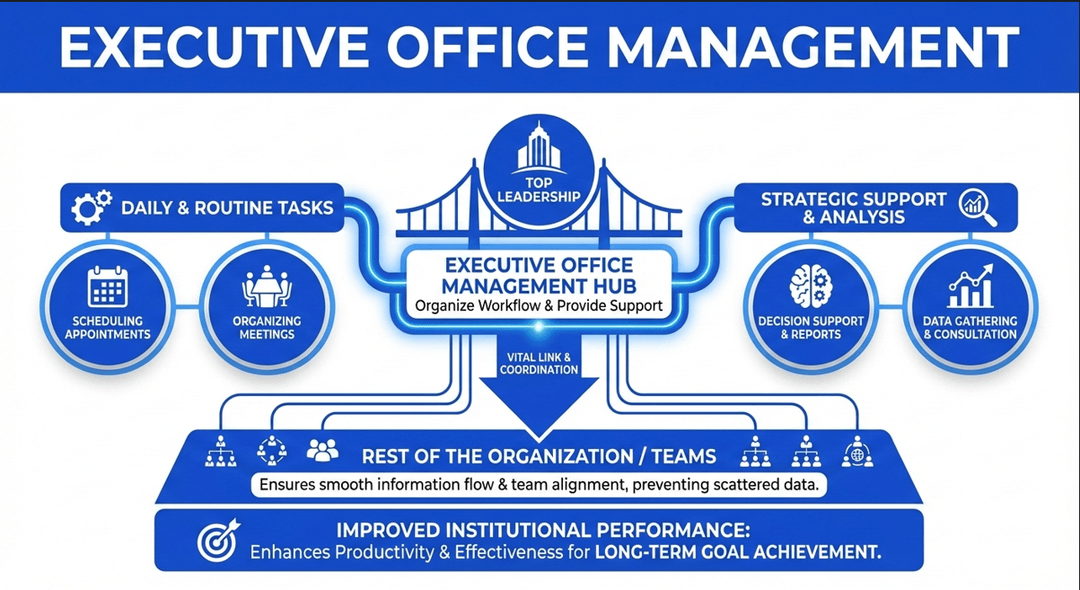
Executive Office Management is a set of administrative activities designed to organize and coordinate workflow within executive offices and provide necessary support to top leadership in organizations. It is considered the cornerstone of enhancing administrative efficiency by ensuring that all aspects of administrative work from scheduling appointments and organizing meetings to coordinating between teams and communicating with external parties, are carried out in an organized and effective manner.
📊The tasks of Executive Office Management range from routine daily work, such as scheduling appointments and organizing meetings, to strategic tasks that include supporting decision-making, preparing crucial reports, and providing consultations on team management and complex operations. Additionally, it plays a role in providing essential support to executive leaders by gathering and analyzing data, which helps them make critical decisions in a timely manner.
⚙️Executive Office Management is also the vital link between top leadership and the rest of the organization, ensuring smooth coordination between different teams. Without Executive Office Management, leaders may struggle with scattered information and lack of coordination between teams, which can negatively affect leadership efficiency and organizational success.
🎯Therefore, it plays a pivotal role in improving institutional performance by implementing an integrated organizational strategy that enhances productivity and effectiveness, contributing to the long-term achievement of organizational goals.
The Importance of Executive Office Management in Enhancing Leadership Efficiency: The Path to Organizational Success
Executive Office Management is one of the key factors that contribute to improving leadership efficiency within organizations. It saves leaders time, enhances internal organization, supports strategic decision-making, and directly contributes to increasing productivity.
Executive Office Management plays a crucial role in facilitating daily tasks for leaders and providing them with strategic support. Here’s how this works:
🕒Saving Time: Executive Office Management helps leaders better invest their time by prioritizing tasks and organizing their daily schedules. By carefully arranging appointments and meetings, time spent on unnecessary activities is minimized, allowing leaders to focus on the most important strategic goals. This organization gives leaders the freedom to concentrate on setting the primary direction for the organization.
🔄 Enhancing Internal Organization: Through coordination between different teams and ensuring smooth operations, Executive Office Management contributes to improving organization within the company. It ensures that tasks are distributed effectively among various teams and that everyone knows what is expected of them. This leads to faster workflow and reduces complications or delays in daily operations.
📈 Supporting Decision-Making: Executive Office Management provides leaders with the necessary information to make sound and timely decisions. By collecting and analyzing data, it helps present clear and consistent insights, enabling leaders to make informed decisions quickly and confidently, thus driving strategic decisions.
⚙️ Increasing Productivity: By improving task organization, Executive Office Management enhances productivity within teams. It fosters collaboration among employees, resulting in faster and more efficient task execution. The executive office ensures that time isn’t wasted on irrelevant activities, focusing instead on actions that directly contribute to the organization’s goals.
Executive Office Management is more than just organizing appointments; it is the cornerstone of achieving leadership efficiency within organizations, contributing to organizational success.
Essential Skills for Executive Office Management: How to Become an Effective Executive Leader?
The core skills for Executive Office Management include organization and priority management, effective communication, strategic thinking, and crisis management. These skills are essential for achieving the highest levels of effectiveness and efficiency in supporting leaders and organizing administrative work.
Executive Office Management is not just about handling daily tasks; it requires multiple skills that help leaders manage work with the utmost efficiency. Here’s how these skills contribute to making an executive office leader more effective:
🗂️ Organization and Prioritization: Organization is the foundation that allows a leader to make the most of their available time and resources. Prioritization involves identifying the most important tasks based on the organization’s strategic goals, which helps allocate time effectively and reduce distractions. A leader with strong organizational skills can handle urgent issues without neglecting long-term tasks.
💬 Effective Communication: Communication within and outside the organization is a critical skill in Executive Office Management. The ability to build strong relationships helps ensure the smooth flow of information between teams and departments. This communication contributes to reducing errors, speeding up decision-making, and enhancing collaboration toward achieving shared goals.
🌍 Strategic Thinking: An executive leader needs to be capable of strategic thinking. This requires analyzing the current situation, understanding future trends, and crafting strategic decisions based on accurate data. Executive Office Management plays a role in providing leaders with the necessary information and insights, which helps them make decisions that positively impact the organization’s success.
⚠️ Crisis Management: Handling crises requires the ability to make quick, informed decisions under pressure. A leader skilled in crisis management can address urgent situations efficiently and professionally, ensuring that workflows remain uninterrupted. Executive Office Management helps in planning preventive measures and responding swiftly to unforeseen issues.
To become an effective leader in Executive Office Management, you must master the following skills:
- Effective Time Management
- Internal Team Coordination and Organization
- Crisis Management and Quick Decision-Making
- Clear Communication with All Stakeholders
- Strategic Planning and Prioritization
🌟 Applying these skills in daily operations will enhance your ability to manage the executive office effectively and contribute to improved productivity and organizational excellence.
Technology and Executive Office Management: Future Tools to Enhance Leadership Performance
Technology plays a pivotal role in improving Executive Office Management performance through the use of digital tools, automation, and cloud-based systems. These tools help accelerate processes, improve time organization, and facilitate more accurate and efficient decision-making.
In today’s digital age, technology has become an integral part of Executive Office Management. Modern technological tools assist in automating processes, enhancing communication, and providing the necessary data to make strategic decisions quickly.
Here’s how each technology contributes to improving leadership performance within the executive office:
- Digital Tools for Time Management and Task Organization: Technology tools such as Task Management Platforms and Smart Calendars help executive leaders organize their time more effectively. By tracking appointments, meetings, and daily tasks, leaders can allocate time to the most important priorities, increasing team productivity and reducing delays or wasted time.
- Automation: Automation helps simplify routine processes that consume a significant amount of time and effort. For example, technology tools can automate workflows, such as sending automatic reminders or updating task statuses regularly. This reduces human errors and accelerates process execution.
- Cloud-Based Systems: Cloud systems make data accessible from anywhere, at any time. These systems improve collaboration between different teams within the organization, allowing leaders to review reports, project updates, and work files in real time. This ensures that everyone is working with the same updated information, contributing to faster decision-making.
Future Tools to Enhance Leadership Performance
Future technologies in Executive Office Management include advanced tools such as digital project management systems, artificial intelligence (AI), cloud-based communication tools, and cloud systems that support enhanced leadership efficiency. These tools not only improve daily operations but also assist leaders in making precise strategic decisions by providing instant insights and analytics, helping drive organizational transformations more efficiently.
Here are some of these advanced technological tools that represent the future of improving leadership performance within organizations:
📅 Digital Project Management Systems: Tools like AI-powered Project Management Solutions provide intelligent solutions for efficiently leading projects. These platforms optimize workflows and provide leaders with real-time data to manage complex projects more effectively.
📲 Task Management and Communication Tools: Tools such as P+ PMO Digital Solution and S+ Strategy Digital Solution facilitate team coordination, ensuring smooth collaboration across different departments. These platforms help teams stay aligned, improving overall workflow and accelerating task execution.
🤖 Artificial Intelligence (AI): AI tools enable the analysis of large datasets and provide accurate insights that support strategic decision-making. With AI, leaders can uncover hidden patterns, predict trends, and make informed decisions that drive organizational success.
☁️ Cloud Tools: Platforms like Google Workspace and Microsoft 365 streamline information access and sharing among relevant teams in real time. These tools help ensure everyone works with the latest data, making collaboration seamless and decision-making faster.
Future technology in Executive Office Management will not only improve operations but also support transformational leadership by delivering accurate insights and data to help leaders make pivotal strategic decisions.
The Role of Executive Office Management in Modern Organizations: Technological Leadership for Success
💡 Executive Office Management plays a critical role in enhancing technological leadership within modern organizations. It contributes to the adoption and application of digital technologies that improve leadership performance and streamline workflows across the organization.
In the face of ongoing digital transformations that most organizations are experiencing today, the role of Executive Office Management has become central to adopting and implementing new technologies that align with organizational strategies. The executive management team is no longer limited to handling day-to-day administrative tasks; it has become a core pillar supporting digital transformation and innovation within the institution.
By utilizing digital systems such as AI-powered Project Management Systems and cloud automation solutions, Executive Office Management can provide accurate insights and data analysis, helping leaders make strategic decisions with confidence.
Moreover, applying tools for task management improves coordination between teams and simplifies processes. AI technologies also support leaders by analyzing complex data, helping them make quick and informed decisions.
🌟 Technological leadership is not just about applying digital tools but also preparing leaders and teams to transition to flexible, technology-driven work practices. This form of leadership fosters innovation within the organization and contributes to achieving strategic goals more efficiently, making Executive Office Management the cornerstone of sustainable success in modern organizations.
Best Practices in Executive Office Management: Strategies for Success in the Modern Business Environment
Best practices in Executive Office Management involve adopting flexible and effective strategies that contribute to enhancing efficiency, organization, and productivity in today’s fast-paced business environment.
In the current era, Executive Office Management requires a high level of adaptability to the rapid changes in the workplace. To achieve success in this evolving environment, executive offices must follow strategies that align with modern business trends.
These strategies include improving internal organization through automation, enhancing communication between teams using digital platforms, and applying advanced technologies to streamline daily processes.
To excel in the current work environment, executive offices must adopt new tools and methods that enable effective time management and provide strategic support to leaders. ⏳
Moreover, the flexibility of the executive office and its ability to adapt to technological transformations are key factors contributing to improving the overall performance of the organization. Below are some of the best practices that can help achieve these objectives:
To implement these strategies efficiently, Executive Office Management can adopt several practices that enhance organization and productivity while helping tackle daily challenges:
- Advance Planning: Set clear priorities and schedule tasks to ensure smooth and timely operations.
- Adaptation to Changes: The ability to adapt to rapid changes in the work environment and adjust strategies as needed.
- Enhanced Coordination: Use tools to improve coordination between teams and ensure effective collaboration.
- Boosting Time Efficiency: Implement automation techniques in scheduling meetings and task planning to save time and increase productivity.
- Cloud-based Information Management: Use cloud systems (like Google Workspace and Microsoft 365) to facilitate real-time access to data and documents.
- Crisis Management: Develop emergency plans and respond swiftly to unexpected situations to ensure business continuity.
- Improving Work Environment: Create a work environment that encourages collaboration and innovation, boosting team engagement and performance.
Challenges in Executive Office Management: Overcoming Obstacles and Enhancing Performance
Executive Office Management faces numerous challenges in modern organizations that hinder operational efficiency and place significant pressure on leadership teams. These challenges range from time constraints, coordination across multiple teams, limited organizational visibility, to managing urgent crises. However, with technological advancements, these obstacles can be effectively overcome through integrated digital solutions that support administrative processes and increase efficiency.
Many organizations, particularly large ones with multiple departments, experience persistent challenges that impact overall performance. Digital solutions are designed to address these challenges by integrating advanced technologies within Executive Office Management.
⏳Time Pressure and Prioritization: Executive leaders in organizations often face significant challenges in prioritizing tasks amidst a long list of daily responsibilities. With numerous meetings and urgent decisions, allocating time for important strategic choices becomes difficult. However, using AI-powered time management tools, tasks can be automatically organized and priorities can be set intelligently. These tools allow leaders to allocate their time to strategic activities, thereby enhancing their ability to make effective decisions.
🤝Difficulty in Coordination Between Teams: Coordinating efforts across different teams within the organization can be a major challenge. Sometimes, conflicting goals or delays in task execution occur due to a lack of communication. By using collaborative communication tools, the flow of information between teams can be facilitated instantly and effectively. These tools help reduce errors caused by poor coordination and improve collaboration across departments, speeding up execution and enhancing understanding among teams.
📊Lack of Comprehensive Organizational Performance Visibility: Without effective performance measurement systems, leaders struggle to obtain a comprehensive and accurate view of how things are progressing. This leads to strategic decisions being made based on incomplete or inaccurate information. This is where Executive Dashboards play a crucial role. They provide comprehensive performance analysis and real-time indicators on projects and organizational goals. These dashboards help leaders gain a holistic view, allowing them to make accurate decisions at the right time.
🚨Ineffective Crisis Management: Crisis situations can arise unexpectedly, and leaders often find it difficult to respond quickly and effectively to urgent situations. Without flexible systems, decision-making may be delayed, making the crisis more complicated. The solution lies in using flexible digital systems that allow leaders to interact with their teams swiftly. This enables real-time updates and helps manage crises professionally and efficiently.
By integrating digital solutions into Executive Office Management, organizations can effectively overcome these challenges, improving organizational performance and contributing to the achievement of strategic goals with higher efficiency.
Conclusion: The Importance of Executive Office Management in Transforming Leadership in Modern Organizations
Executive Office Management plays a pivotal role in enhancing leadership efficiency within modern organizations. It is not merely about organizing administrative and logistical tasks but has a direct impact on achieving strategic goals and facilitating decision-making processes. By providing effective strategic support and exceptional resource organization, Executive Office Management strengthens institutional performance and enhances the ability to adapt to the ever-evolving challenges in today’s dynamic business environment.
Moreover, the integration of digital solutions with Executive Office Management has become indispensable. It contributes to improving coordination between teams, fostering internal communication, and providing a comprehensive view of strategic performance. These tools aid in making more precise and faster decisions, thus helping organizations achieve their goals with greater flexibility and efficiency.
🚀To fully benefit from these concepts, it is recommended to invest in integrated technological solutions that support these processes. If you are looking to improve your leadership performance and increase the efficiency of your Executive Office Management, don’t hesitate to visit Master Team's website, where we offer you comprehensive solutions to enhance your business strategy and streamline your organizational operations professionally.
Contact us at Master Team to start transforming your leadership efficiency today!
Frequently Asked Questions:
1- How do digital tools contribute to improving time management within the executive office?
Digital tools play a significant role in improving time management within the executive office by automating routine tasks and allowing executives to focus on strategic activities. Tools like smart calendars, task management software, and executive dashboards enhance efficiency by tracking appointments and projects effectively. These tools also provide executives with real-time access to information, helping them make quick and effective decisions.
2- How can automation help speed up daily operations in the executive office?
Automation helps accelerate daily operations by reducing the need for repetitive manual tasks like sending reminders, organizing appointments, and distributing reports. With automation tools, executives can track project progress and status updates automatically, which speeds up workflow and minimizes human errors. This enhances efficiency, freeing up teams to focus on strategic activities.
3- What are the benefits of using cloud systems in executive office management?
Cloud systems allow executive offices to access data and resources from anywhere, at any time. These systems contribute to better team collaboration and enable real-time data updates, making rapid decision-making easier. Cloud systems also offer a centralized hub for storing information, reducing the issues caused by scattered data access and improving security through trusted systems.
4- What is the Diwan Executive Office Management Platform?
The Diwan Executive Office Management Platform is an innovative digital solution designed to streamline and organize tasks within executive offices. The platform enhances leadership efficiency by simplifying administrative processes, automating tasks, and improving inter-team collaboration. Diwan allows executives to manage schedules, meetings, reports, and task coordination smartly, which helps in faster decision-making and improved organization within organizations.
5- What is the S+ Strategy Digital Solution?
The S+ platform is an integrated solution for managing digital strategies within organizations. It aims to enhance organizational efficiency and achieve strategic success by automating and simplifying strategic processes. S+ provides analytical and integration tools for performance measurement, decision-making support, and future planning, helping leaders execute strategies effectively and deliver accurate insights based on real-time data.