
📉 Imagine an organization managing projects worth millions of riyals, with expert teams and well-planned schedules… Yet, the results still fall short!
The issue isn’t a lack of competence or resources, but something more serious: fragmented data, inconsistent reports, and decisions being made without a comprehensive view.
This scenario is no longer an exception, but a recurring reality in organizations that manage their projects in isolation from their operational and financial systems.
⚙️ In the age of digital transformation, the challenges no longer lie in having Project Management Systems or Enterprise Resource Planning (ERP) systems, but in the lack of real integration between them.
When a project management system operates in isolation from the financial system, resources, or supply chains, decisions are based on incomplete data, reports are delayed, and estimates are prone to errors.
📊 Global trends indicate that high-performing organizations are those that build Integrated Digital Ecosystems, which intelligently link:
🔹Strategic Planning
🔹Project & Portfolio Management (PPM)
🔹Resources & Financials
🔹Executive Governance & Decision Making
💡 Here, the integration of Project Management Systems with ERP systems emerges as a strategic necessity, not just an operational need.
This integration transforms data into real-time decisions, projects into measurable investments, and management from reactive to proactive leadership based on analysis and transparency.
🔍 In this article, we take you through an in-depth analysis showing how to ensure seamless and effective integration between Project Management Systems and ERP systems. We will also highlight the real benefits of this integration in terms of operational efficiency, cost control, governance, and smart decision-making, tying it to best practices and advanced digital solutions suitable for Saudi organizations under Vision 2030.
Importance of Integrating Project Management Systems with ERP: How Does Integration Enhance Overall Performance?
The integration between Project Management Systems and ERP seamlessly connects information and teams, enhancing coordination and speeding up strategic decision-making. The unified integration process ensures that accounting and planning data are synchronized in real-time, improving the efficiency of operational processes and budget control.
Data sharing across systems breaks down barriers between financial, administrative, and engineering teams. Instead of relying on two isolated systems, the unified system automates routine tasks (such as data entry and report generation) and consolidates information into a central database.
This integration is like creating a unified "nervous system" for the company, where departments share real-time updates, reducing human errors and accelerating cost and schedule monitoring. Experts point out that integrated platforms (like P+ for Portfolio & Project Management) provide PMO Analytics Dashboards that display key performance indicators (KPIs), allowing managers to see the progress of portfolios and projects simultaneously.
Additionally, advanced platforms enable real-time decision-making based on accurate data. Instead of holding lengthy meetings to gather information, leaders can instantly access comprehensive KPIs to take corrective actions quickly. In short, integration enhances operational efficiency, transparency, and the ability to identify risks early, transforming project management from a routine operational task into a key pillar of corporate governance and the success of strategic vision.
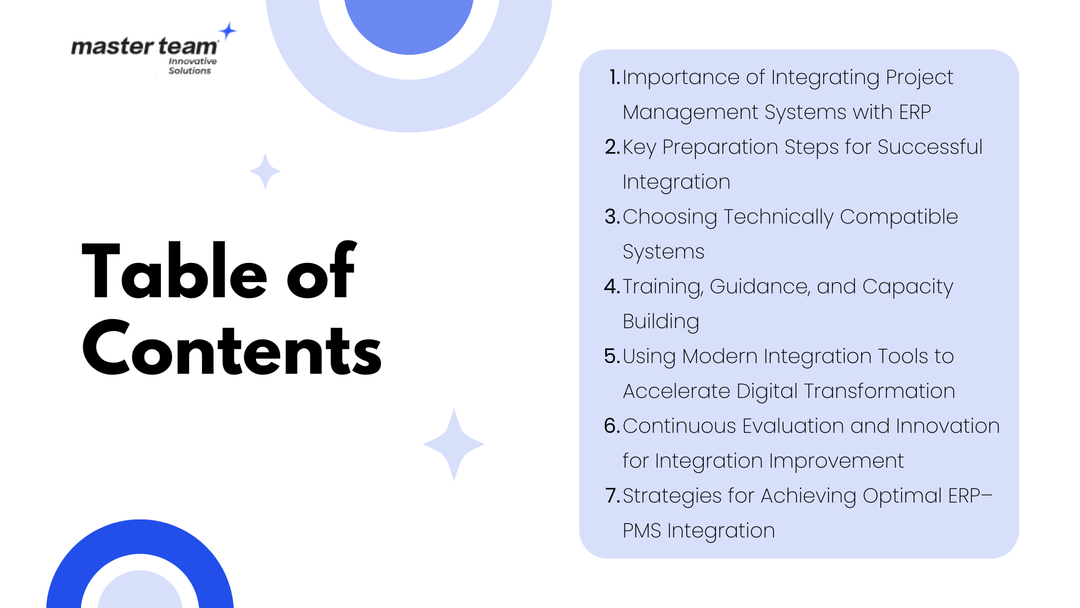
Steps for Preparing a Successful Integration Between Project Management Systems and ERP
To ensure a successful and seamless integration between Project Management Systems and Enterprise Resource Planning (ERP) systems, proper preparation is essential through a set of key steps. These include clearly defining objectives, selecting technically compatible systems, building human capabilities through training, leveraging modern integration tools, and preparing to face potential challenges from the early stages.
Preparation represents a critical phase in the integration journey, as it determines whether the project will succeed or stumble later on. Integration is not just a technical link between two systems; it is a transformational project that touches processes, governance, and human resources. This phase starts with aligning the vision of what the integration should achieve in terms of performance, transparency, and decision-making, followed by setting up the technical environment and selecting systems that are ready for integration, while ensuring that the involved teams are prepared to work with the unified system.
Furthermore, relying on modern integration tools, along with change management and addressing potential challenges, helps reduce risks and increases the chances of success. The more methodical and well-thought-out the preparation is, the more strategic the integration becomes, supporting digital transformation rather than becoming an operational burden.
Here are the key areas that form the foundation for any successful preparation process for integrating Project Management Systems with ERP:
- Choosing Compatible Systems
- Training, Guidance, and Capacity Building
- Accelerating Digital Transformation Using Modern Integration Tools
- Continuous Evaluation and Innovation for Integration Improvement
1. Choosing Compatible Systems: What You Need to Know About Selecting Compatible Systems
When choosing ERP and Project Management systems, it's crucial to select those that support flexible APIs (Application Programming Interfaces) and Middleware so that they can easily communicate with other systems and the current infrastructure.
Focus on systems that provide cloud integration capabilities or standard protocols (such as REST APIs or iPaaS), meet security requirements, and align with your organization’s standards to ensure smooth integration.
It is essential to first verify that the ERP system supports communication with external systems via strong and reliable APIs. For example, experts highlight that technical compatibility is one of the biggest obstacles when linking Project Management Systems and ERP. Data authentication might require the unification of databases and data formats.
To overcome this, you can rely on Middleware platforms or modern integration platforms (like iPaaS - Integration Platform as a Service) that facilitate data alignment between old and new systems.
You should also ensure that the system aligns with your organization’s IT infrastructure (such as AD integration, user permissions, and access control) to provide a seamless user experience. Other important factors include the system’s customizability to meet the specific project requirements, and its support for modules like Performance Dashboards, Task Tracking, and Issue Tracking.
2. Training and Guidance: Why is Training a Critical Element for Success?
Comprehensive training for users on the integrated systems is an essential step, as integration tools will not succeed if the team does not know how to use them effectively. Training programs and hands-on workshops should be provided to explain to employees how to work with the unified system, with continuous support to motivate them toward change.
Even if the systems are fully integrated, the absence of proper guidance leads to employee dissatisfaction and the loss of expected benefits. Specialized reports indicate that resistance to change and training issues are among the major human obstacles to integration projects.
Therefore, investing in Change Management alongside training is crucial: this includes explaining the benefits of the new system (such as increased productivity and reduced manual tasks) and involving employees in the process.
Interactive hands-on training is recommended, allowing users to physically engage with the system, including building process templates (such as E-form Builder) and monitoring integrated approval workflows. Sources also suggest incorporating post-implementation support sessions, either internally or through external experts, as technical consultations are crucial for addressing inquiries and resolving technical issues.
It is also important to assign expert managers to monitor system usage and ensure process consistency. Ongoing training and motivation transform the new system into a productive tool rather than a burden for teams, enabling employees to acquire skills that allow them to fully leverage the capabilities of the integrated systems.
3. Accelerating Digital Transformation Using Modern Integration Tools: How Do Modern Tools Help Speed Up Integration?
Technologies such as APIs, iPaaS platforms, and cloud platforms that enable bidirectional data flow between systems can be relied upon. In addition, AI-powered analytics tools can be used to monitor performance and guide decision-making.
The latest integration tools provide ready solutions to overcome technical barriers. For example, using APIs is the best way to link data directly between the systems, which shortens time and reduces human errors. Furthermore, integration platforms like iPaaS enhance connectivity by applying standardized protocols that link databases and allow real-time synchronization.
These tools ensure that any changes in project data are immediately reflected in the financial system, and vice versa, accelerating the integration cycle and reducing manual errors in tasks like project cost tracking (financial tracking software) or automated reporting.
Moreover, AI tools (such as an AI Project Assistant) add further value to integration. For example, Master Team provides a smart assistant named Faris that works within the P+ platform to analyze project data and provide real-time recommendations. Some systems also support features like News Sentiment Analysis Modules that link media updates to project performance.
These tools, along with others (such as internal messaging systems like Project Chat App and task role classification tools like RACI), contribute to speeding up execution and ensuring smooth workflows with high efficiency, while maintaining centralized governance and transparency across all stakeholders.
4. Continuous Evaluation and Innovation to Improve Integration: Why Must You Keep Up with Technological Advancements?
As ERP and project management systems undergo continuous updates, the application of modern technologies such as artificial intelligence and advanced analytics increases the value of integration and ensures that data is used to its maximum potential.
With technological evolution, new tools emerge that enhance the efficiency of the integrated system. For example, using artificial intelligence such as the Faris AI digital assistant allows the platform to analyze predictive data and automatically suggest actions.
In this way, the system becomes capable of predicting issues before they occur and providing recommendations (such as rescheduling tasks or redistributing resources) without waiting for manual human intervention. Additionally, innovations like News Sentiment Analysis provide external insights, helping decision-makers stay on top of environmental risks and opportunities.
Ongoing innovation also includes the automatic updating of databases, security frameworks, and reporting systems, ensuring data quality and protection. Furthermore, adopting new standards (such as international project management standards or aligning with PMI systems) is one of the key factors for continuous improvement.
In summary, the integration system remains vital when we adopt advanced digital tools regularly, transforming integration into a dynamic process that helps businesses stay more efficient and responsive to market changes and new regulations.
Strategies for Achieving Optimal Integration Between Project Management Systems and ERP
Optimal integration between Project Management Systems and Enterprise Resource Planning (ERP) systems is achieved through a clear strategy that begins with accurately defining integration objectives, selecting systems that are compatible and scalable, and investing in training and modern integration tools to ensure the sustainability and effectiveness of the integration.
A clear strategy is the cornerstone of any successful integration, as it should connect the integration process with the strategic objectives of the organization, rather than treating it as an isolated technical project. This requires developing a comprehensive implementation plan, involving all stakeholders, to ensure operational and organizational alignment between technical, administrative, and executive teams.
The integration also necessitates the selection of flexible and scalable systems that support open communication through Application Programming Interfaces (APIs) and centralized databases, ensuring continuous performance as businesses grow and project portfolios become more complex. Training teams and building technical awareness are crucial elements, as insufficient user readiness may fail the integration even if the technical infrastructure is advanced.
Moreover, investing in modern integration tools such as iPaaS platforms and Business Intelligence (BI) systems powered by Artificial Intelligence (AI) accelerates system linkage, reduces operational errors, and enhances decision-making accuracy. Practical applications confirm the effectiveness of this approach. For example, Master Team’s P+ platform for portfolio and project management has advanced capabilities to directly connect procurement and budgets with ERP systems, supported by the smart assistant Faris AI to improve integration quality and decision support.
Furthermore, Diwan Executive Hub stands out as a practical model for integrating task, meeting, and project management into a unified executive environment that enhances coordination and strategic planning.
To ensure these strategies are applied systematically and effectively, the key pillars of optimal integration can be summarized as follows:
- Defining integration objectives and aligning them with corporate strategy
- Developing a comprehensive implementation plan with all stakeholders involved
- Selecting ERP and Project Management systems that support APIs and centralized databases
- Ensuring scalability and compatibility with business growth
- Training teams, building technical awareness, and managing change
- Investing in iPaaS tools, Business Intelligence (BI), and Artificial Intelligence (AI)
- Leveraging integrated solutions like P+ and Diwan platform to support governance and execution
- Aligning integration with Saudi Vision 2030 digital transformation goals
Conclusion: Smart Integration Between Projects and ERP… From Operational Efficiency to Competitive Advantage
In the face of rapid digital transformation and the increasing complexity of corporate projects, the integration of Project Management Systems with Enterprise Resource Planning (ERP) systems is no longer an optional technical addition but has become a strategic pillar to ensure governance, decision-making accuracy, and performance sustainability. Organizations that succeed in building an integrated digital ecosystem capable of linking strategy to execution, budgets to delivery, and governance to transparency are the ones best equipped to control costs, enhance resource efficiency, and accelerate project delivery with confidence.
This article has demonstrated that seamless integration is not achieved through partial solutions or superficial linking, but through a comprehensive vision that begins with planning and preparation, continues through selecting compatible systems, building human capacities, and investing in integration tools and artificial intelligence, and culminates in continuous evaluation and innovation.
When managed according to global best practices, project management becomes a leadership tool that supports proactive decision-making and delivers real value to the business, in line with the digital transformation and smart governance goals of Saudi Vision 2030.
If you're seeking effective and sustainable integration between Project Management Systems and ERP, and aiming to transform your projects from operational burdens into measurable strategic investments, Master Team provides you with the integrated solutions for that.
Through platforms like P+ for Portfolio and Project Management, S+ Strategy Digital Solutionand Diwan Executive Hub, supported by AI via Faris AI, you can build a unified digital ecosystem that enhances transparency, improves performance efficiency, and supports decision-makers at the highest levels.
Frequently Asked Questions:
1- What systems should I look for to ensure smooth integration between project management and ERP?
The best systems are those that support virtual integration through standard protocols (such as REST API) or advanced integration platforms (iPaaS), and are compatible with your existing infrastructure. Look for solutions that offer a unified, scalable database, such as P+ Portfolio & Project Management systems or cloud-based ERP systems (Cloud ERP) that support integration with external applications. Also, ensure the system supports user permission management and unified authentication (AD Integration) to streamline administration.
2- How do I start implementing the integration between an ERP system and a project management system?
Start by mapping out the process: identify the key data you wish to sync between the two systems and set clear objectives (for example, linking financial costs directly with project phases). Then, form a specialized team of system engineers and project managers to assess the technical options. Next, perform data cleansing and standardization (Data Cleansing) to ensure easy transfer, and choose the right integration tool (API or iPaaS) and begin with a limited test integration. In later stages, gradually expand the integration scope, reviewing and updating the plan based on the results of initial tests.
3- What are the common issues that may arise during the integration of project management and ERP systems?
Common issues in integration of project management and ERP systems include data duplication due to differing formats between the two systems, which can be handled using data mapping and synchronization tools. Sometimes, software conflicts may arise due to version mismatches, so it’s advisable to conduct comprehensive end-to-end testing before the full rollout. Additionally, differences in work culture between technical and administrative teams can sometimes cause challenges.
4- Are there tools that help speed up the integration between project management and ERP systems?
Absolutely, there are cloud integration platforms (iPaaS) and specialized tools (such as Dell Boomi or MuleSoft) that facilitate faster and more secure system integration. Some ERP and project management tools also provide out-of-the-box integration modules or standard APIs. For organizations requiring on-premise implementation, middleware solutions can connect databases. In general, using iPaaS and modern integration tools significantly reduces implementation time and minimizes errors.