
🚀 Imagine you're leading a strategic project worth millions of riyals, with dozens of stakeholders, tight timelines... while the plans are scattered, decisions are delayed, and changes are managed reactively rather than with a clear vision.
In a world where business accelerates and project complexities increase, failure is no longer due to a lack of effort but rather the absence of a structured management approach that links vision to execution.
📌 Recent global reports indicate that projects managed with professional project management practices are more than twice as successful compared to those relying on individual effort or traditional tools. The reason is clear: project management is not just about schedules and plans; it's an integrated system that unites goals, resources, risks, and expectations into a measurable and controllable framework.
📊 As the size of projects grows, stakeholders multiply, and change accelerates, the question is no longer:
Do we need project management?
But the real question is:
How can we manage our projects professionally to ensure the achievement of strategic goals, control time and costs, and deliver real and sustainable value?
💡 Modern project management is no longer an operational function but has become a cornerstone for organizational success, enabling you to:
✔ Transform strategy into actionable projects
✔ Control scope, time, and cost with flexibility and professionalism
✔ Manage risks before they turn into crises
✔ Enhance transparency and communication with all stakeholders
✔ Improve output quality and maximize return on investment
⏳ In this comprehensive guide, you'll move from understanding the fundamental concepts of project management, to mastering the stages, methodologies, knowledge areas, and key challenges. You’ll discover how project management can transform work from merely task execution... into organizational capacity that drives achievement, builds success with confidence, and ensures sustainability.
What is Project Management?
Project management is defined by the Project Management Institute (PMI) in the PMBOK Guide as “the application of knowledge, skills, tools, and techniques to project activities to meet project requirements.” This definition focuses on the practical and applied side of the discipline.
Meanwhile, the International Organization for Standardization (ISO) defines it in ISO 21500 as “the application of methods, tools, techniques, and competencies to the project,” emphasizing the importance of human competencies alongside technical tools.
The British Association for Project Management (APM) defines project management as “the application of processes, methods, knowledge, skills, and experience to achieve project objectives within agreed acceptance criteria according to defined standards.” This definition adds an important dimension related to acceptance criteria and the pre-agreed standards.
Despite the differences in definitions, the essence remains the same: project management is a set of processes, tools, methods, methodologies, resources, and procedures to manage a project.
To gain a deeper understanding of project management, it is essential to grasp the following concepts:
Definition of a Project
According to the PMBOK Guidea project is defined as “a temporary endeavor undertaken to create a unique product, service, or result.” It is characterized by essential traits that distinguish it from routine operational processes. Each project has a defined start and end, and the term "temporary" does not necessarily imply a short duration; projects can span many years. Furthermore, projects are undertaken to achieve specific objectives through the production of deliverables, unique, verifiable products, services, or results.
The goal of every project is to transition the organization from its current state to a desired future state. This may involve several transitional phases during which continuous steps are taken to reach the envisioned future. Successful project completion results in the organization achieving its future state and the defined objectives through effective project management and the accompanying organizational change.
Project Manager
The project manager is the individual responsible for leading the team to achieve the project's objectives. This role involves overseeing the development of the team by enhancing competencies and fostering interaction among team members within their working environment, aiming to improve project performance and ensure the achievement of its defined goals. The success of the project manager relies on their ability to integrate various administrative processes and efficiently direct resources toward achieving the desired outcomes within the constraints of time, cost, and quality.
Project Deliverables
Project deliverables are defined in project management as all the outputs and outcomes, whether tangible or intangible, that are produced during the execution of a project with the aim of completing it and achieving the agreed-upon objectives.
These deliverables may include a unique product, a specific service, a report or program, or even an improvement or correction to an existing product or process. Deliverables are a key tool for measuring project progress and evaluating its success. They also serve as the basis for satisfying stakeholders, as they clearly define what must be accomplished, unlike milestones, which are focused solely on measuring progress without describing the outputs.
Project deliverables include both interim deliverables completed during the project's intermediate phases and final deliverables representing the project's final outcome.
Deliverables can be tangible, such as a finished building, designs, or a software program, or intangible, such as training, a marketing plan, an operational process improvement, or a new organizational capability. The importance of deliverables lies in guiding the team, setting priorities, measuring work quality, and enhancing effective communication with stakeholders.
Since each project is unique in its fundamental characteristics, such as location, design, environment, and the nature of the individuals involved, its deliverables reflect these specifics. This makes every project a unique case that requires a tailored management approach to achieve the best results.
PMBOK Guide (Project Management Body of Knowledge)
The PMBOK Guide (Project Management Body of Knowledge) is the globally recognized reference that compiles best practices, concepts, and standard terminology in the field of project management, issued by the Project Management Institute (PMI).
The PMBOK provides a comprehensive methodological framework designed to help project managers plan, execute, monitor, and control projects systematically, ensuring efficient and effective achievement of objectives. It organizes knowledge around process groups and knowledge areas, offering a unified language and a flexible standard basis that can be adapted to various types, sizes, and sectors of projects.
The guide is regularly updated to stay current with the evolution of the project management profession, incorporating modern methodologies such as Agile and Hybrid approaches. This makes it a practical roadmap for improving performance and achieving successful outcomes, in addition to being the primary reference for obtaining globally recognized professional certifications, including the PMP (Project Management Professional) certification.
The sixth edition of the guide, released in 2017, includes 49 management processes distributed across five process groups (Initiating, Planning, Executing, Monitoring and Controlling, Closing) and ten knowledge areas, including: Integration Management, Scope, Schedule, Cost, Quality, Resources, Communications, Risk, Procurement, and Stakeholder Management.
Project Life Cycle
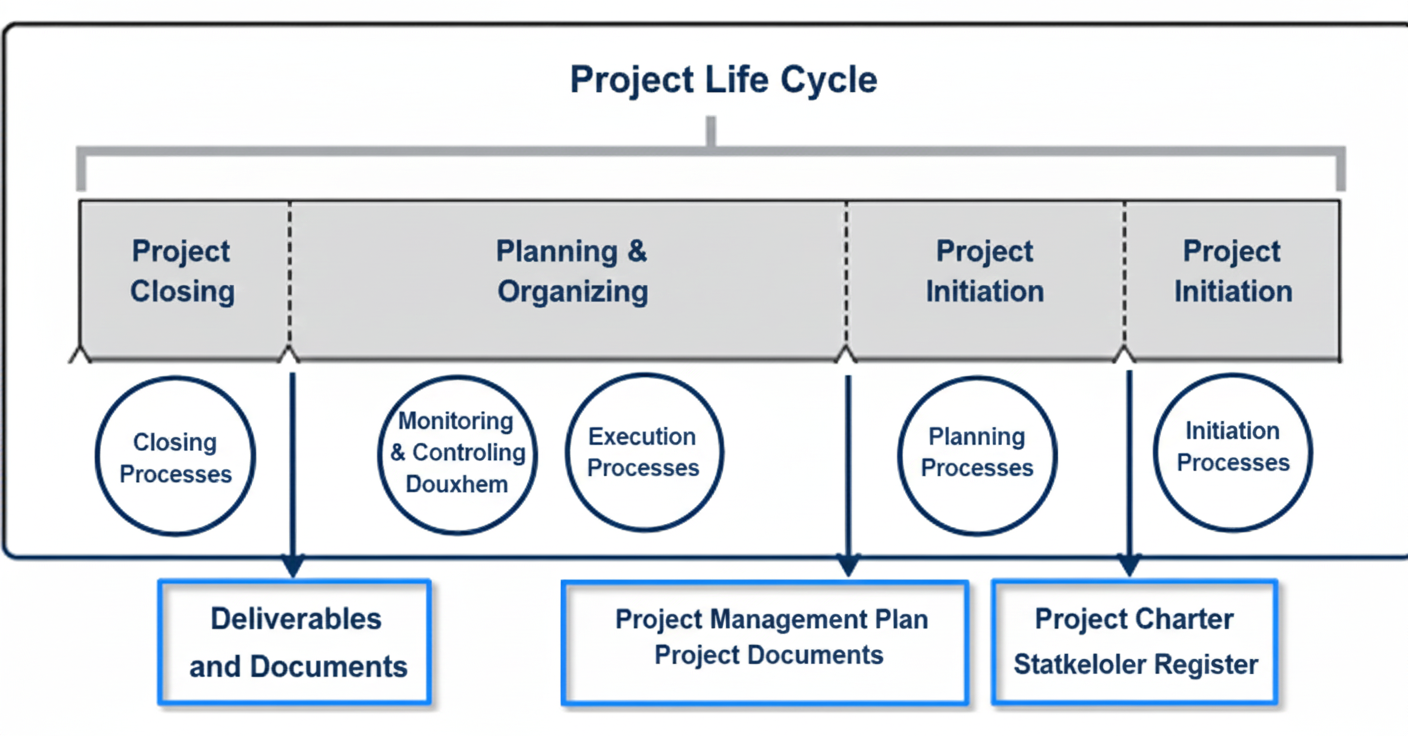
The Project Life Cycle is defined as the methodological framework that outlines the sequence of phases a project goes through from its inception to its official closure, ensuring that the project’s objectives are achieved efficiently and effectively.
Typically, the Project Life Cycle includes interconnected major phases that begin with the project initiation phase, where the overall idea is defined, the project charter is created, and stakeholders are identified. This is followed by the planning and preparation phase, during which the project management plan (scope management plan, requirements management plan, schedule management plan, etc.) and detailed project documents (activity list, cost estimates, etc.) are developed.
The execution phase then translates the plans into actual activities, with continuous monitoring and control to ensure adherence to schedules and predefined standards. Finally, the closure phase focuses on delivering the final outputs, documenting lessons learned, and officially closing contracts and documentation.
The Project Life Cycle is a fundamental framework for managing projects, applied regardless of the project’s nature or industry. It helps organize efforts, clarify responsibilities, and improve the quality of management decisions, enhancing the likelihood of project success and achieving the expected value.
Key Phases of Project Management
Project management goes through five interconnected main phases according to the PMBOK Guide, starting with the initiation phase, where the project is officially approved and its objectives and stakeholders are identified. This is followed by the planning phase, during which a comprehensive plan is developed to define the project scope, approach, and execution and control mechanisms. Next, the execution phase brings the plans to life through task completion and deliverable production. The monitoring and controlling phase runs in parallel with execution to track performance, manage deviations, and ensure adherence to the plan. The cycle concludes with the closure phase, where the final deliverables are accepted, lessons learned are documented, and resources are released.
Here’s a list of the main phases in project management:
- Initiating Process Group
- Planning Process Group
- Executing Process Group
- Monitoring and Controlling Process Group
- Closing Process Group
Below is a detailed explanation of each step in the project management process:
1. Initiating Process Group
Initiating processes are the activities required to define a new project or a new phase of an existing project and obtain official authorization to start.
This phase involves developing the project charter, which grants the project manager formal authority to use resources. It also includes identifying and documenting the project stakeholders, laying the legal and administrative foundation for the project’s launch and defining its initial goals.
2. Planning Process Group
Planning processes are necessary to establish the project’s scope, enhance its objectives, and define the required path to achieve those objectives.
This is the largest process group in terms of the number of activities. It involves developing the project management plan, which outlines how the project will be executed, monitored, and closed. This includes planning for all ten knowledge areas: scope, schedule, cost, quality, resources, communication, risk, procurement, and stakeholders.
3. Executing Process Group
Executing processes are the activities performed to complete the work defined in the project management plan to meet project requirements and produce deliverables.
Plans are turned into tangible results by directing and managing project work, acquiring and developing the project team, managing quality, communication, procurement, stakeholder engagement, and applying risk responses. This phase consumes the majority of the project’s resources and budget.
4. Monitoring and Controlling Process Group
Monitoring and controlling processes are the activities required to track, review, and regulate progress and performance and identify areas where changes to the plan are needed.
These processes are executed alongside the execution phase and include monitoring and controlling project work, integrated change control, and controlling scope, schedule, cost, quality, resources, communication, risk, procurement, and stakeholders to ensure the project stays on track.
5. Closing Process Group
Closing processes are those performed to formally complete or close a project, phase, or contract, and release the allocated resources.
This includes formally closing the project or phase once all deliverables are completed and accepted by the client, closing all contracts with vendors, documenting lessons learned, archiving project documents, and releasing team members and resources to return to operational duties or other projects.
Core Knowledge Areas of Project Management
The core knowledge areas in project management include ten interconnected areas, as outlined in the PMBOK Guide. These areas aim to ensure the integrated planning, execution, and control of a project. They begin with Project Integration Management to coordinate all efforts, followed by Scope Management to control the work required, and Schedule and Cost Management to ensure adherence to time and budget constraints. Quality, Resource, and Communication Management ensure efficient performance and information flow. Risk Management aims to reduce threats and maximize opportunities, while Procurement Management organizes dealings with suppliers. Stakeholder Management focuses on engaging stakeholders and ensuring their satisfaction to guarantee the project's success.
Below are the core knowledge areas of project management as per the PMBOK Guide, forming the knowledge framework that project managers use to ensure integrated planning, execution, and control:
- Project Integration Management: This includes the processes and activities required to define, combine, unify, and coordinate the various project management processes and activities. Integration management ensures that all project elements work together cohesively. It includes seven key processes, from developing the project charter to closing the project.
- Project Scope Management: This includes processes required to ensure the project includes all the necessary work, and only the necessary work, to complete the project successfully. It includes six processes, starting from collecting requirements and defining the scope, preparing the Work Breakdown Structure (WBS), and ending with scope verification and control to prevent scope creep.
- Project Schedule Management: This includes processes required to ensure the project is completed on time. It involves six processes, beginning with defining activities, sequencing them, estimating their durations, and developing the schedule. It concludes with controlling the schedule to ensure adherence to deadlines and addressing potential delays.
- Project Cost Management: This involves processes related to planning, estimating, budgeting, financing, managing, and controlling costs to ensure the project is completed within the approved budget. It includes four processes to ensure the optimal use of financial resources and prevent budget overruns.
- Project Quality Management: This includes processes to integrate the organization’s quality policy into the planning, managing, and controlling of the project and the product quality requirements to meet stakeholder expectations. It includes three processes: quality planning, quality management (quality assurance), and quality control (monitoring quality), supporting continuous process improvement.
- Project Resource Management: This includes processes to determine the resources necessary for project success, acquire them, and manage them, whether human, material, or equipment resources. It covers six processes that include resource planning, estimating, acquiring, developing, managing, and controlling resources, ensuring the right resources are available at the right time.
- Project Communications Management: This involves processes to ensure timely and appropriate planning, collection, distribution, storage, retrieval, and final disposition of project information. It includes three processes: communication planning, communication management, and communication monitoring, ensuring effective information flow among all stakeholders.
- Project Risk Management: This includes processes to plan for, identify, analyze, respond to, and monitor risks throughout the project. It consists of seven processes designed to minimize the likelihood and impact of negative risks (threats) and maximize the likelihood and impact of positive risks (opportunities).
- Project Procurement Management: This includes processes for acquiring products, services, or results needed from outside the project team. It involves three processes: procurement planning, procurement conducting, and procurement control, including managing contracts and relationships with suppliers and contractors.
- Project Stakeholder Management: This includes processes for identifying individuals, groups, or organizations that may impact or be impacted by the project, analyzing their expectations and impact, and developing an appropriate strategy for effectively engaging stakeholders in project decisions and execution. It includes four processes to ensure stakeholder satisfaction and continuous project support.
Iron Triangle of Project Management (Triple Constraint)
The Iron Triangle, also known as the Triple Constraint, is a fundamental framework that highlights the interrelationship between three core elements that determine the success of any project. These elements represent the primary constraints that the project manager must balance continuously.
The three sides of the triangle are:
- Scope: Scope represents the amount of work required to achieve the project's objectives and the deliverables that must be produced. It defines what will be delivered and includes all requirements, specifications, features, and functionalities that the final product or service must fulfill.
- Time: Time represents the schedule required to complete the project, including the total project duration, key delivery dates, and milestones. Time defines when the project will be delivered, and it includes all scheduled activities and their logical sequencing.
- Cost: Cost represents the financial resources allocated for the project and the approved budget. Cost defines how much the project will cost, including all expenses related to human resources, materials, equipment, services, and overheads.
Relationship Between These Elements:
The relationship between these three elements is interdependent, meaning a change in one element will inevitably affect the other two:
- If the scope increases (new requirements are added): This will likely require either more time, more cost, or both, to meet the new demands.
- If time is reduced (the schedule is shortened): This may necessitate an increase in cost (by hiring additional resources or accelerating work) or a reduction in scope (removing certain requirements).
- If the budget is reduced: This may lead to an extension of time to complete the project or a reduction in scope to ensure the project stays within the revised budget.
The project manager must continuously balance the scope, time, and cost constraints to ensure the project is delivered successfully. This balance is essential to achieving the best results and satisfying stakeholders' expectations.
The Relationship Between the Project Management Triangle and Knowledge Areas
The Project Management Triangle (scope, time, and cost) represents the primary constraints and direct objectives of any project, while the ten knowledge areas represent the tools, processes, and methodologies necessary to manage these constraints and achieve an optimal balance between them. The first four areas (integration, scope, schedule, and cost) are directly linked to the sides of the triangle, while quality management represents the center of the triangle. The other five areas (resources, communication, risks, procurement, and stakeholders) represent supporting and auxiliary factors for achieving the project's objectives.
Project success depends on a deep understanding of the Project Management Triangle and the ability to apply knowledge and skills across the ten knowledge areas in a cohesive and integrated manner, with sufficient flexibility to adapt to changes and challenges that may arise throughout the project’s lifecycle.
Project Management Methodologies
Project management methodologies are structured frameworks and approaches used to guide the planning, execution, and monitoring of projects from inception to closure. These methodologies have evolved to suit various project sizes, complexities, and work environments.
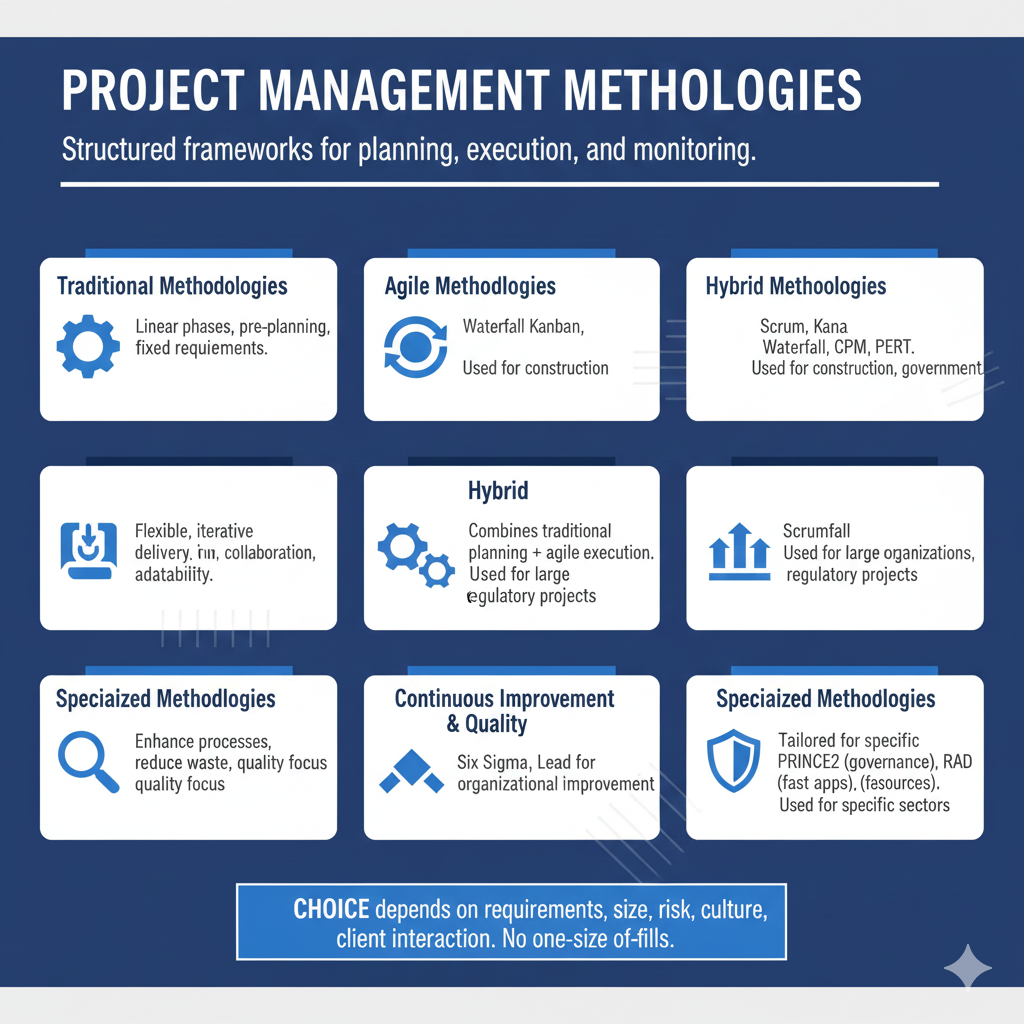
These methodologies are divided into traditional, which focuses on pre-planning and linear phase sequences, agile, which relies on flexibility and incremental delivery, hybrid, which combines both approaches, and specialized methodologies that focus on quality and continuous improvement or specific sectors.
The choice of an appropriate methodology depends on factors such as clarity of requirements, project size, risk level, organizational culture, and nature of client interaction. There is no one-size-fits-all methodology for every project; success lies in selecting and adapting the most suitable one.
Here is a list of the main categories of project management methodologies:
- Traditional Methodologies
- Agile Methodologies
- Hybrid Methodologies
- Continuous Improvement and Quality Methodologies
- Specialized Methodologies
If you're interested in diving deeper into the details of each of these project management methodologies, here's a detailed explanation of each.
Traditional Project Management Methodologies
Traditional project management methodologies rely on pre-planning and a linear sequence of phases, where requirements are fully defined at the start, and then each phase is completed sequentially with no overlap. These methodologies are characterized by clarity, high documentation, and easy tracking, but they lack flexibility in handling changes. Some of the most famous traditional methodologies include Waterfall, Critical Path Method (CPM), and Program Evaluation and Review Technique (PERT). They are commonly used in projects with fixed requirements, such as construction and government projects.
Agile Project Management Methodologies
Agile project management methodologies focus on flexibility, adaptability to change, and continuous collaboration with the client, delivering value in short, iterative phases. These methodologies reduce reliance on long-term planning and rely on self-organizing teams. Popular agile frameworks include Scrum, Kanban, Extreme Programming (XP), and Feature-Driven Development (FDD). These are suitable for software development projects and products with changing requirements.
Hybrid Project Management Methodologies
Hybrid project management methodologies combine the strict planning of traditional methodologies with the flexibility of agile execution. This aims to balance documentation with flexibility. They are used in environments that require formal approvals and regulations, along with the need for adaptation during execution. Examples include Scrumfall and Water-Scrum-Fall, and they are suitable for large organizations and projects with regulatory constraints.
Continuous Improvement and Quality Methodologies in Project Management
Continuous improvement and quality methodologies in project management focus on enhancing processes, reducing waste, and increasing quality using analytical tools and real data. These methodologies include Six Sigma, Lean, and Lean Six Sigma, and are widely used in organizational, industrial, and service improvement projects, focusing on efficiency, sustainability, and delivering real value to clients.
Specialized Project Management Methodologies
Specialized project management methodologies are developed to suit specific project environments or types, characterized by clear structure, fast execution, or a special focus on resources. Some of the key specialized methodologies include PRINCE2 for governance and corporate organization, Rapid Application Development (RAD) for fast application development, and Critical Chain Project Management (CCPM) for efficient time and resource management. These are applied based on the nature of the project and the sector in which the project operates.
Project Management Objectives
The goal of project management is to ensure the efficient and effective execution of projects by achieving a balance between scope, time, and cost, while adhering to quality standards, managing risks, and ensuring stakeholder satisfaction. This approach supports the strategic objectives of the organization and maximizes value and return on investment (ROI). Project management also contributes to better resource utilization, improved communication, institutional capacity building, and systematic handling of changes, all of which increase the likelihood of project success and sustainability.
Here is a list of the key objectives of project management:
- Complete the project within the defined scope: The objective is to deliver all agreed-upon outputs without any additions or omissions, fully complying with functional and technical requirements. Scope control helps prevent scope creep, which could lead to project delays or increased costs.
- Complete the project on time: Focuses on adhering to the planned schedule through precise planning and constant progress monitoring. Meeting deadlines contributes to customer satisfaction, seizing opportunities, and reducing indirect costs.
- Complete the project within the approved budget: Aims to control costs and prevent budget overruns through accurate estimation and continuous monitoring of spending. This ensures that the expected return is achieved while maintaining the financial stability of the organization.
- Achieve the required quality standards: Ensures that the final product or service meets or exceeds stakeholder expectations in terms of performance and reliability. High quality reduces errors, improves customer satisfaction, and enhances the organization’s reputation.
- Effectively manage risks: Aims to identify and analyze potential risks and proactively respond to them. This helps reduce threats, maximize opportunities, and protect the project from failure.
- Achieve stakeholder satisfaction: Focuses on meeting stakeholder expectations through effective communication and involving them in key decisions. Their satisfaction enhances continuous support for the project and increases its chances of success.
- Support and achieve the strategic objectives of the organization: Ensures that the project aligns with the organization’s vision and overall strategy. This contributes to achieving real value such as growth, improved efficiency, or enhanced competitiveness.
- Maximize return on investment (ROI): Aims to extract the maximum possible value from the resources invested in the project. This is achieved through proper planning and making investment decisions based on feasibility and value.
- Build and develop institutional capabilities: The project contributes to developing individual skills, improving processes, and documenting lessons learned. This leads to higher organizational maturity and greater success in future projects.
- Improve communication and collaboration: Focuses on creating clear communication channels and promoting teamwork among project stakeholders. Effective communication reduces conflicts and improves the quality of decision-making.
- Optimize resource utilization: Aims to efficiently use human, material, and financial resources without waste. This helps reduce costs, increase productivity, and maintain balance in workloads.
- Effectively manage change: Seeks to systematically address any changes that occur during the project to ensure it stays on track. It ensures that changes are well-considered and add real value to the project.
The Importance of Project Management
Professional project management contributes significantly to increasing the success rates of projects by balancing scope, time, and cost, reducing risks and waste, and improving efficiency and output quality. It also strengthens communication and transparency, supports data-driven decision-making, and ensures alignment with the organization’s strategic objectives. In addition, project management helps optimize resource utilization, build a culture of continuous improvement, and adapt to change and complexity, resulting in greater customer satisfaction and providing the organization with a sustainable competitive advantage.
To summarize, the importance of project management lies in:
- Increasing Project Success Rates: Professional project management greatly enhances the likelihood of completing projects successfully within scope, time, and budget. Organized methodologies and standardized processes provide a clear framework, reducing improvisation and chaos.
- Reducing Risks and Waste: Through comprehensive planning, identifying potential risks, and taking preventive actions, project management helps avoid or mitigate issues and crises. This reduces resource, time, and financial waste and protects the organization from potential losses.
- Improving Efficiency and Productivity: Organized processes, appropriate tools, and clear task allocation increase work efficiency and reduce wasted time and effort. Teams working within clear methodologies are more productive and less prone to confusion and distraction.
- Enhancing Output Quality: Focusing on quality standards from the beginning of the project, continuous monitoring, and periodic improvements ensures the delivery of high-quality products and services that meet or exceed customer expectations.
- Improving Communication and Transparency: Project management provides structured communication channels between all stakeholders, reducing misunderstandings and ambiguity. Regular reports, follow-up meetings, and dashboards provide transparency regarding project progress and challenges, enabling stakeholders to make informed and timely decisions.
- Achieving Strategic Alignment: Project management ensures that the executed projects align with the organization's strategic goals and priorities. This prevents wasting resources on ineffective or low-priority projects and ensures that investments are directed toward initiatives that bring the most value to the organization.
- Improving Resource Management: Effective resource planning and allocation ensure resources are available when needed and in the required quantity. This prevents bottlenecks and delays and improves the utilization of human, material, and financial resources. Efficient resource management reduces costs and increases ROI.
- Facilitating Decision-Making: The data and insights provided by project management systems enable leaders to make decisions based on facts and analysis, rather than intuition or guesswork. Key performance indicators (KPIs), status reports, and predictive analytics provide valuable insights for strategic direction and problem-solving.
- Building a Culture of Continuous Improvement: Through documenting lessons learned, performance analysis, and applying best practices, project management contributes to building a culture of learning and continuous improvement. Every project becomes an opportunity for growth and development, elevating the organization's maturity and future success rates.
- Adapting to Change and Complexity: Project management provides the tools and methodologies needed to adapt to changes and handle complexity. Agile and flexible methodologies enable organizations to respond swiftly to changes in market demands, customer needs, or technology.
- Enhancing Stakeholder and Customer Satisfaction: By delivering on time, within the required quality, and within budget, along with effective communication and managing expectations, professional project management increases customer and stakeholder satisfaction. This strengthens long-term relationships and opens new business opportunities.
- Achieving a Competitive Advantage: Organizations that excel in project management can complete projects faster, better, and more cost-effectively than their competitors. This gives them a competitive edge in the market and enhances their ability to innovate, grow, and expand.
Statistics Indicating the Importance of Project Management
Recent global data indicates that adopting professional project management practices clearly improves project outcomes, reduces failure rates, and increases the chances of achieving goals. According to a 2025 Ravetree study, projects that apply organized project management practices are 2.5 times more likely to succeed than those that do not follow these practices. This demonstrates the significant impact of structured frameworks on improving execution results and achieving desired goals.
The same source also showed that Agile projects have a success rate of approximately 64%, much higher than the 49% success rate of traditional methodologies such as Waterfall. This highlights the importance of choosing the appropriate methodology in project management to improve success rates.
Furthermore, Wellingtone's 2024 statistics indicate that only 36% of organizations fully achieve the expected benefits from their projects. This emphasizes the need to focus on project management methodologies to ensure that the true goals of the project are realized. Standish Group data also reveals that the success rate of projects remains relatively low (with less than a third meeting traditional success criteria), reflecting the urgent need to adopt project management principles to enhance organizational performance by improving planning, execution, and monitoring.
Key Sectors and Fields That Should Rely on Project Management Tools
Project management tools are essential for the success of organizations across various sectors, but their importance is amplified in sectors that are complex, involve numerous stakeholders, have large investments, and experience rapid changes. Below are the key sectors where adopting project management tools and methodologies is a strategic necessity rather than an organizational option.
1️⃣ Information Technology and Communications Sector
The technology sector relies on project management to keep up with rapid developments and constant changes in technical requirements. Its projects include software development, ERP and CRM systems, cybersecurity, digital infrastructure, and digital transformation. Agile and hybrid methodologies are the most suitable for this sector due to the high need for flexibility and rapid iteration.
2️⃣ Construction, Engineering, and Architecture Sector
The construction sector is characterized by large-scale projects, long durations, and numerous stakeholders, making project management tools essential to control time, cost, and quality. These projects include infrastructure, buildings, factories, and energy projects. Traditional methodologies such as Waterfall, CPM, and PERT are commonly used for these projects.
3️⃣ Healthcare and Pharmaceutical Sector
Given its direct impact on human safety, the healthcare sector requires precise project management that focuses on quality and compliance. Its projects include hospital construction, drug development, medical records systems, and medical research, with a combination of traditional and agile methodologies.
4️⃣ Financial and Banking Sector
Project management tools in the financial sector are used to ensure regulatory compliance, risk management, and the protection of sensitive data. Projects in this sector include banking system development, digital services, compliance, and anti-money laundering initiatives, with a strong emphasis on governance and oversight.
5️⃣ Government and Public Sector
Government projects require high levels of transparency and accountability. These projects include infrastructure, government digital transformation, education, healthcare, and housing. Methodologies such as PRINCE2 are suitable for this sector due to the clear governance frameworks they provide.
7️⃣ Manufacturing and Production Sector
Project management in the industrial sector focuses on improving efficiency, quality, and cost reduction. Projects in this sector include product development, automation, process improvement, and digital industrial transformation, using Lean, Six Sigma, and hybrid methodologies.
8️⃣ Retail and E-commerce Sector
The retail sector is undergoing rapid digital transformation, making project management essential to adapt to market changes. Projects include e-commerce platforms, inventory management, customer experience, and payment systems, with a strong reliance on agile methodologies.
Challenges of Project Management
Project management faces a range of challenges that can hinder achieving the project's goals within the specified time, cost, and quality. These obstacles often arise due to organizational, human, or technical factors, making professional handling crucial for the project's success.
- Lack of Clarity in Objectives and Requirements: The absence of a clear definition of project goals or continuous changes in them leads to confusion among teams, increased revisions, and difficulty in measuring the actual success of the project.
- Weak Preliminary Planning: Inadequate planning for time, resources, and risks directly impacts the schedule and budget, making the project more susceptible to delays and failure.
- Poor Communication Between Stakeholders: Poor or interrupted communication between the team, management, and clients leads to misunderstandings, conflicting expectations, and inconsistent decision-making.
- Scope Creep: Adding new requirements without formal control or plan adjustments causes overruns in time and cost, and negatively affects the quality of deliverables.
- Lack of Senior Management Support: The absence of leadership support diminishes the priority of the project within the organization, affecting resource allocation and timely decision-making.
- Resource Shortages or Mismanagement: The lack of appropriate skills, tools, or ineffective resource distribution leads to reduced productivity and increased pressure on the team.
- Weak Risk Management: Failure to identify or disregard potential risks prevents proactive preparedness, leading to sudden crises that can disrupt the project's progress.
- Resistance to Change: Team or stakeholder rejection of new workflows or modern technologies hinders the effective implementation of project management methodologies.
- Reliance on Inadequate Tools: Using outdated or non-integrated tools for project management limits the ability to track progress accurately and make data-driven decisions.
- Time Pressure and Unrealistic Expectations: Imposing unrealistic deadlines or expecting results beyond the available capabilities increases the likelihood of burnout, errors, and project failure.
Top Project Management Systems in Saudi Arabia
Master Team is one of the leading companies in developing project management systems in the Kingdom of Saudi Arabia. It offers a comprehensive suite of digital solutions, foremost among them the P+ PMO Digital Solution. This is a professional system for managing portfolios, programs, and projects (PPM) that provides complete control over the project lifecycle, from strategic planning to follow-up, reporting, and decision-making. The system supports corporate governance, performance management, tracking of key performance indicators (KPIs), and managing risks and resources through interactive dashboards and smart reports based on advanced data analytics.
Master Team's project management systems integrate with other supporting solutions:
This creates a unified digital environment for efficiently managing projects, programs, and strategic initiatives. These systems are flexible in configuration, support web and mobile applications, and can integrate with government and institutional systems like ERP and SAP.
Thanks to its full commitment to the National Cybersecurity Authority (NCA) standards, multiple hosting options within the Kingdom (cloud, private cloud, or on-premises), and Arabic language support, Master Team's solutions are among the most important and powerful project management systems in Saudi Arabia. They combine advanced technology, a deep understanding of the local organizational environment, and a focus on delivering real value and measurable outcomes from projects.
Why Choose Master Team for Project Management System Development in Saudi Arabia
Master Team is a strategic choice for developing project management systems in Saudi Arabia, offering integrated digital solutions that combine technical expertise, governance, compliance, and high flexibility.
The reasons for choosing it as the best project management system are as follows:
- Local Expertise and Deep Understanding of the Saudi Market: Master Team has extensive experience in implementing project management systems within the Kingdom, with a precise understanding of regulatory requirements, government governance, and alignment with Saudi Vision 2030 targets.
- Integrated and Cohesive Solutions: It offers a comprehensive digital ecosystem that includes Project Management (P+), Strategy Management (S+), Executive Office Management (Diwan), Smart Data Dashboards, and Automation, ensuring data integration and seamless decision-making.
- Flexible and Customizable Systems: Solutions are designed based on the needs of the organization, with continuous configuration capabilities and future scalability without technical complications.
- Advanced Support for Decision-Makers: Master Team relies on intelligent analytics, Smart Data, and Agentic AI to provide accurate insights, interactive monitoring dashboards, and performance indicators that support strategic decisions.
- Strict Cybersecurity Compliance: All systems comply with the National Cybersecurity Authority (NCA) standards, applying the highest levels of data protection and risk management.
- Hosting Options within Saudi Arabia: Offering cloud hosting, private cloud, or on-premises hosting, ensuring compliance and full control over data.
- Arabic Language Support: User-friendly interfaces supporting both Arabic and English, suitable for multi-user work environments.
Summary: When Projects Are Managed Professionally... Results Are Achieved
Project management today is no longer just about task tracking or adhering to timelines. It has become the decisive factor that determines an organization’s ability to execute, control risks, and achieve the true impact of its strategies. Successful projects don't rely solely on effort; they depend on clarity of vision, disciplined methodology, and smart decision-making.
As the scale of initiatives grows and work environments become more complex, adopting professional project management supported by integrated digital systems is the key difference between an organization that manages projects... and one that leads them with confidence, turning them into sustainable value.
Start today with Master Team and transform your project management into a force that drives growth and delivers results.
FAQs:
1- What’s the difference between professional project management and traditional project tracking?
Professional project management relies on global methodologies and standards like PMBOK and Agile, using integrated digital tools to manage scope, time, cost, risks, and stakeholders. Traditional tracking, on the other hand, often focuses on monitoring tasks without clear governance or control over performance and results.
2- Can project management methodologies be applied to all types of projects and sectors?
Yes, project management methodologies can be adapted to various sectors and project sizes, whether technical, construction, governmental, or service-oriented, by selecting the most appropriate methodology (traditional, agile, or hybrid) and applying it based on the nature of the project and work environment.
3- What are the main challenges organizations face when implementing project management?
Some key challenges include unclear goals and requirements, insufficient planning, poor communication among stakeholders, scope creep, lack of senior management support, and reliance on non-integrated tools. These challenges can be significantly reduced by applying systematic project management supported by effective digital systems.
4- How do digital project management systems improve project success?
Digital project management systems provide a comprehensive, real-time view of project status, enable performance tracking and indicator management, handle risks and resources, and enhance transparency and decision-making speed. This reduces deviations, improves adherence to timelines and budgets, and increases the chances of project success.
5- Why is Master Team a suitable choice for developing a project management system in Saudi Arabia?
Master Team combines deep local expertise, adherence to governance and cybersecurity standards, customizable digital solutions, and smart decision support for leaders. This empowers organizations to build a professional project management system that delivers real value and aligns with the goals of Saudi Vision 2030.