
🚀 Imagine your project has a solid plan, an approved budget, and a competent team... and yet, it hits a roadblock midway! This is not a rare scenario but a reality faced by thousands of project managers daily. Global statistics show that over 70% of projects do not fail due to poor planning, but due to mistakes during the Project Execution phase. This is the phase where strategies turn from documents and reports into real, on-the-ground work, where any delayed decision, poor communication, or lack of follow-up could cost the project millions.
📊 In today’s business environment – especially in the rapidly growing Saudi market, which is witnessing an accelerating number of digital transformation projects, construction, and infrastructure initiatives – project execution no longer relies solely on individual experience. It depends on advanced Project Management Systems (PMS), data-backed decisions, and leadership that can make swift, timely decisions.
💡 The truth that no one tells you: Successful projects don’t avoid challenges; they know how to overcome them smartly. From scope control to time and cost management, communication, risks, resources, and leadership motivation… every detail in the execution phase makes a real difference between a stalled project and one that confidently meets its goals.
⏱️ Spare me a few minutes of your time, and you’ll get a practical guide and a clear roadmap based on global best practices in project management, along with real-world experience tailored to the Saudi market, to learn how to overcome common challenges in project execution and turn execution from a weakness into a true strength for your project.
Ready to take your projects to the next level?
Explore the advanced solutions offered by Master Team to streamline your project management. Our tools, including P+ PMO Digital Solution, S+ Strategy Digital Solution, and Diwan Executive Office Solution, are designed to drive efficiency, enhance decision-making, and ensure successful project execution across various industries.
Overcoming Common Challenges in Project Execution
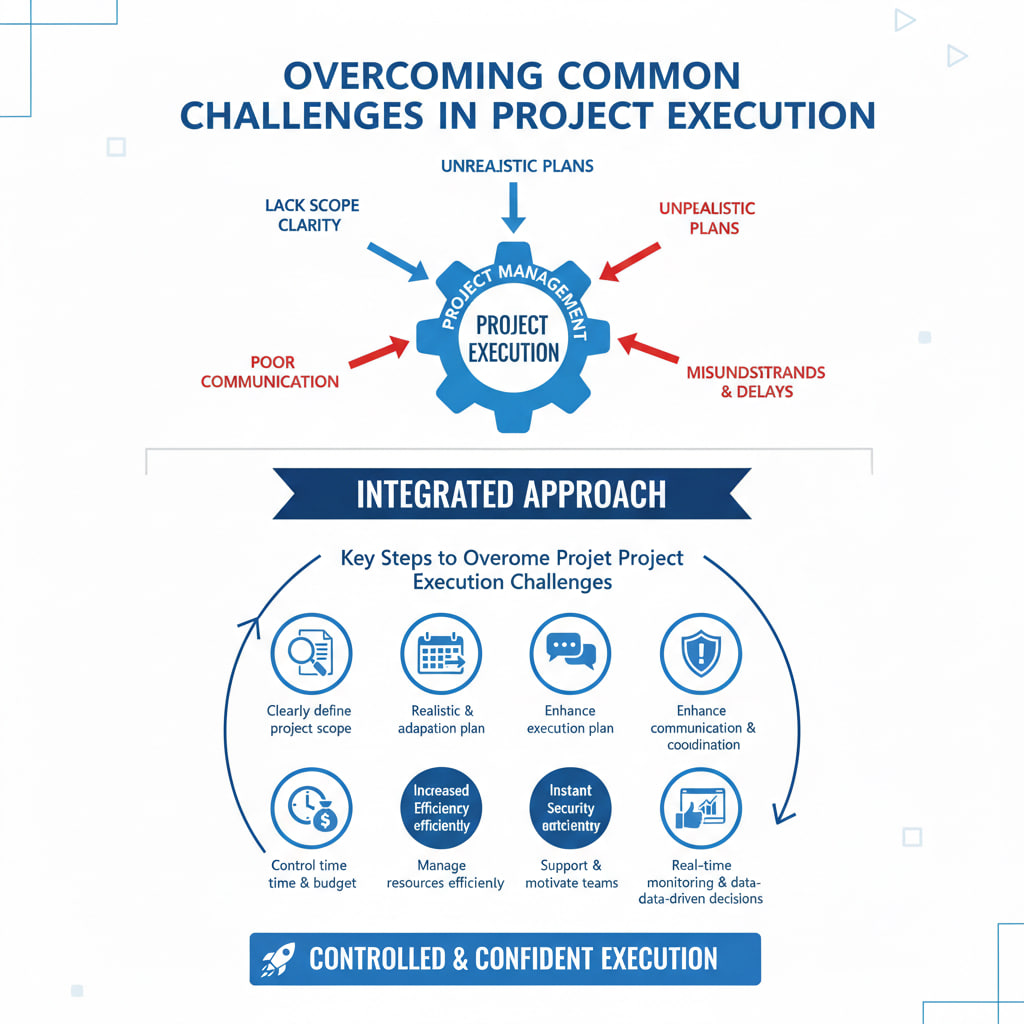
Overcoming the common challenges in project execution requires an integrated approach that includes: clearly defining the project scope from the start, building a realistic and adaptable execution plan, enhancing communication and coordination between teams, proactively managing risks, maintaining precise control over time and budget, managing resources efficiently and flexibly, supporting and motivating teams, and lastly, continuous monitoring and data-driven decision-making. When these elements are managed together within a clear methodology, execution transforms from a high-risk phase into one that can be controlled and led with confidence.
Project execution challenges do not stem from a single factor, but from the accumulation of small errors across several interconnected areas. The lack of scope clarity opens the door to unplanned changes, unrealistic plans deprive teams of the ability to commit, and poor communication leads to misunderstandings and delays in decision-making.
Conversely, proactive risk management, precise monitoring of performance indicators, and smart resource allocation all reduce the likelihood of deviating from the goals. Leadership motivation and continuous team support maintain performance stability, even in the most high-pressure phases of the project.
Therefore, success in execution does not rely on a single action, but on an integrated system of administrative and technical practices that work in harmony.
Key Steps to Overcome Project Execution Challenges:
- Clearly define the project scope and align it with all stakeholders
- Build a realistic and continuously updatable execution plan
- Enhance communication and coordination between project teams
- Proactively manage risks before they turn into crises
- Maintain control over time and budget through precise monitoring
- Manage human and financial resources flexibly and efficiently
- Support teams and provide continuous motivation to improve performance
- Monitor progress in real-time and make quick, data-driven decisions
1. Clearly Define the Project Scope from the Start: A Critical Step to Prevent Deviations and Ensure Execution Success
Clearly and precisely defining the project scope from the outset prevents unexpected changes (scope creep) and lays the foundation for success.
When the scope is well-documented and agreed upon by all stakeholders, disputes are minimized, and efficiency in time and budget allocation improves. A clear scope defines the expected goals, deliverables, and tasks, setting boundaries for the work and ensuring that the team understands exactly what is required.
Specialized sources have confirmed that clearly defining the project scope avoids much of the "misunderstanding and unplanned changes" that lead to delays and cost overruns. According to the professional guide by Deltek, having a clear scope document prevents ambiguity and uncontrolled scope creep, allowing the team to stay focused on the project’s main objectives.
2. Build a Realistic and Updatable Execution Plan: The Smart Foundation for Adhering to Time and Budget
The execution plan must be realistic and include clear milestones, with flexibility to allow for adjustments when necessary.
It’s not enough to have an ideal plan on paper; tasks and their timelines should be allocated based on the team’s actual capabilities and the work environment. Experts recommend adopting dynamic plans (similar to Agile methodologies) that account for the need for rapid changes. Rigid plans often collapse at the first unexpected obstacle, while flexible plans empower the team to adapt.
For example, it is advisable to regularly review project milestones and the timeline, allowing adjustments as new developments arise without wasting time. Guiding articles emphasize that building flexibility into plans and being prepared to adapt to new circumstances can save the project from stalling.
3. Enhancing Communication and Coordination Among Project Teams: The Key to Harmony and Accelerated Completion
Strengthening communication channels and ensuring the swift and clear flow of information between team members and stakeholders reduces errors and increases the chances of success.
Often, poor communication is one of the leading causes of project failure; studies show that 56% of failed projects suffer from communication breakdowns between parties. To address this, a clear communication plan should be established, including periodic review meetings and tracking tools (such as Task Tracking Software) to keep everyone updated on the project’s status.
Problems and delays will shrink if everyone is aware of progress and risks in a timely manner. Project management experts describe ineffective communication as the "silent killer" of projects, as it leads to misunderstandings in tasks, delays in deadlines, and scope creep. Therefore, establishing clear communication channels (including CRM Project Management Software to gather feedback) and real-time reporting enhances internal coordination and facilitates the prompt decision-making of critical matters.
4. Proactively Managing Risks, Not Reactively: Control the Future Before It Controls You
Identifying potential project risks early, assessing them, and putting response plans in place before they occur is essential. Proactive thinking allows you to address what might disrupt the project before it turns into a crisis.
Anticipating risks and creating a Risk Register helps analyze the likelihood and impact of each risk on the project, followed by implementing mitigation measures (such as budget contingencies or alternative plans). Project management sources recommend adopting a Proactive Risk Management strategy, which involves identifying, assessing, and prioritizing risks, then taking appropriate steps to reduce their impact.
When the project faces an imminent risk, the plan can be adjusted in advance or additional resources allocated to contain the issue before it escalates. Consulting firms have found that "getting out in front of risks" meaning analyzing risks early, leads to much better outcomes for projects.
5. Accurately Controlling Time and Budget: Keep Your Project Within Its Boundaries
Continuous monitoring of performance indicators and adjusting the gap between planned and actual progress keeps the project on schedule and within budget.
It's essential to track the project's progress in real time, whether it’s regarding timelines or costs. As experts confirm, time management plays a critical role in project success, and any delay in tasks can lead to significant cost overruns. Similarly, good cost management ensures that the project doesn’t exceed its financial limits.
Studies have pointed out that improper attention to costs can lead to budget overruns, delays, and even project failure. Therefore, a precise monitoring system, such as a Project Performance Dashboard, is used today to compare actual performance with the plan. When any deviation, even small, is detected in time or expenses, immediate action is taken (such as reducing scope or reallocating resources) before the issue escalates into a crisis that’s hard to resolve.
6. Managing Resources with Flexibility and Efficiency: Maximize Your Team’s Potential
Distributing resources intelligently according to each individual’s skills, with the ability to reassign tasks when needed, keeps the project on track without disruptions.
It is essential to allocate tasks to team members based on their expertise and availability within the plan. For example, if one team member becomes unavailable, their tasks can be reassigned to another colleague without derailing the project’s timeline.
Moreover, it is important to avoid overloading any one individual. Maintaining a dynamic balance in workload helps prevent employee burnout and boosts the overall effectiveness of the team. Real-time resource planning and tracking systems facilitate this by providing clear insights into workload distribution. They also help adjust schedules or allocate additional resources when pressure builds up.
Efficient and flexible resource management, whether through a construction-specific ERP system or a task management platform, ensures the continuity of performance and quality throughout the project’s execution phases.
7. Supporting Teams and Continuous Motivation: Make Your Team the Engine of Project Success
Ongoing leadership motivation and recognition of team efforts increase individual commitment and enhance productivity. A project's success isn't only about plans and tools, but also about the team’s morale.
In successful teams, high morale and a positive work environment prevail, reducing conflicts and negative behaviors. When individuals feel appreciated for their efforts, whether through verbal or material rewards, anxiety about change decreases, and motivation to complete tasks with high quality increases. Leadership practices have shown that recognition and acknowledgment of achievements give employees a "sense of accomplishment and belonging to an organization that cares about them," which drives them to contribute even more.
Therefore, leaders are always advised to focus on communication that meets the team’s needs, provide continuous encouragement, and offer the necessary support. This creates an inspiring work environment that helps team members feel the value of their role and understand the clarity of the project's goals.
8. Continuous Monitoring and Quick Decision-Making: Stay on the Path to Success
Real-time progress monitoring and data-driven decision-making protect the project from the gradual accumulation of errors.
Successful project management requires constant, real-time performance monitoring rather than waiting for delayed reports. The primary goal of monitoring is to identify any deviations from the plan early on and implement corrective actions before problems escalate.
Today, information systems (such as a Project Monitoring Information System) are used to display real-time performance indicators, ensuring data is continuously available for decision-making. Studies have shown that "continuous project monitoring ensures the collection of real-time data and its use to support the decision-making process." This enables the project manager to quickly adjust the course when any discrepancies arise.
Experts emphasize that project control relies on tracking performance and analyzing it, followed by making decisions based on accurate data to ensure the project stays within scope, timeline, and budget.
9. The Impact of Leadership and Team Management on Project Execution Success
Effective project leadership and team management significantly enhance the likelihood of completing the project successfully and on time. The project manager plays a central role in ensuring the successful execution of project stages. According to experts, a project's success depends on the project manager's ability to implement best practices in management, as well as define roles and responsibilities clearly for each team member.
An experienced manager enables the team to understand the project's objectives and works to provide the necessary resources and support, fostering harmony among team members. Experts also note that leadership style directly impacts motivation and morale. When a manager actively motivates the team (through clear vision and regular recognition), team productivity increases. Conversely, a lack of motivation can lead to a decline in team performance.
With motivational leadership and effective role organization, the shared goal becomes a driving force for project completion rather than a burden. In summary, combining strong leadership with cohesive team management, adherence to a clear plan, and the use of advanced tools (such as Project Management Systems or PMO platforms) creates the optimal conditions for success within the project’s timeline and budget.
Conclusion: The Key to Successful and Efficient Project Execution
In conclusion, overcoming challenges in project execution is not a matter of chance, but of strategic planning, organization, and wise leadership. By establishing a clear project scope from the start and developing a realistic execution plan, a strong foundation is built. Coupled with enhanced communication and proactive risk management, the project remains on track.
The final piece of the equation lies in supporting the team and providing motivating leadership that boosts morale. Combining these elements – along with modern tracking tools such as Integrated Project Management Systems and Project Performance Dashboards – transforms a project plan into tangible achievement.
As industry experts have pointed out, "If your execution falters, your project will fail," emphasizing that adhering to good management principles is the only way to ensure the successful completion of a project.
💡 To elevate your project management and ensure efficient execution, explore the integrated solutions offered by Master Team and start turning your plans into reality today!
Frequently Asked Questions (FAQs):
1- How can project scope creep be avoided?
By documenting the project scope in an official document agreed upon by all stakeholders from the beginning. Implement a strict change control process that includes impact assessment and approval before any changes are made.
2- What are the strategies for proactive risk management?
Proactive risk management includes early risk identification (Risk Identification), using tools such as impact-probability matrices, and developing mitigation plans (Mitigation Plans). Continuous monitoring should be done throughout the project execution.
3- How does effective communication contribute to project success?
Effective communication is ensured through clear channels (such as regular meetings and CRM systems), and keeping everyone updated on progress in real-time, preventing issues from accumulating and making it easier to address problems early.
4- How can the project team be motivated during execution?
Motivation can be achieved by celebrating small wins and providing positive reinforcement. Additionally, clarifying the project goals and each team member's role increases the team's sense of responsibility and belonging.
5- What tools are available to track project execution?
There are integrated project management systems (Project Management Platforms) that include dashboards, task management systems, and automated reports. These tools help monitor progress in real-time and support quick decision-making.