
Imagine your project is facing a critical delay… and your team only discovers the issue after it’s too late!
This scenario happens daily in hundreds of organizations not due to a lack of expertise, but because of the absence of real-time visibility into what’s happening within projects. Traditional management, relying on delayed reports, slows decision-making, causes priority confusion, creates task overlaps, and allows errors to accumulate unnoticed.
This is where Real-Time Monitoring comes into play. It enables managers to track every detail as it happens from task progress to team performance, including risk indicators and resource allocation.
Modern digital systems, including Master Team’s Project Management Tools, can collect data from various departments, process it instantly, and transform it into interactive Project Dashboards, giving organizations a precise, comprehensive view in just seconds.
In this article, we will explore in depth how these systems operate, why real-time monitoring has become a strategic necessity, and what makes it one of the most powerful factors in the success of modern projects.
Discover how Master Team can elevate your project management with cutting-edge real-time monitoring tools.
Explore P+ PMO Digital Solution for streamlined project oversight, S+ Strategy Digital Solution for strategic alignment, and Diwan Executive Office Solution for executive decision support.
What Is Real-Time Project Monitoring?
Real-Time Project Monitoring refers to the capability to track project workflows moment by moment through a continuous data stream, collected and analyzed instantly without waiting for periodic reports.
This approach relies on digital Project Management Systems that pull information from different teams and departments, immediately converting it into clear indicators of progress, risks, resources, and deadlines.
Unlike traditional management, which depends on weekly or monthly updates, real-time monitoring provides an instant operational view of the project. This allows teams to detect deviations before they escalate, ensuring the project stays on track.
These systems also offer interactive Project Dashboards displaying KPIs, tasks, and operational data with high accuracy, giving managers a solid foundation for faster, more precise decision-making.
In short, real-time monitoring provides a 24/7 comprehensive view, enabling organizations to manage projects more efficiently and respond proactively rather than reactively.
Why Real-Time Project Monitoring Is a Necessity, Not an Option
Real-time project monitoring has become essential because periodic reports are no longer sufficient to keep up with rapid changes. In fast-paced business environments especially in the Saudi and Gulf markets delays in detecting deviations or risks are unacceptable.
Weak coordination between teams and the absence of unified information increase the likelihood of conflicting decisions and project failure. Additionally, the vast volume of data generated by modern digital projects cannot be managed manually.
Moreover, client and stakeholder expectations now demand instant visibility into project progress, while studies show that a lack of visibility and coordination leads to significant annual losses. This makes real-time monitoring the cornerstone for delivering accurate data via Real-Time Dashboards, ensuring faster and more reliable decision-making.
Key reasons why real-time monitoring is critical:
- Periodic reports are insufficient: Weekly or monthly updates create gaps between reality and management perception.
- Accelerated business environments: Projects in Saudi and Gulf markets cannot tolerate delays in detecting deviations or risks.
- Poor team coordination: Missing unified information leads to conflicting decisions and higher failure risk.
- Massive data volumes: Digital projects generate data too large for manual or traditional management.
- Higher stakeholder expectations: Everyone expects instant progress updates rather than delayed reports.
- Losses from poor visibility: Global studies, especially in construction, show that poor coordination results in significant yearly losses.
- Accurate decision-making foundation: Real-time monitoring provides a dashboard that reflects moment-to-moment realities, improving decision quality and reducing errors.
How Digital Project Monitoring Systems Work
Digital project monitoring systems collect real-time data from teams and various organizational systems, process it automatically using AI in Project Management, and display the results on interactive Project Dashboards with automatic updates and Smart Alerts.
These systems operate through several key mechanisms:
- Integration with Enterprise Systems: Connecting with ERP and CRM platforms to gather live data on tasks and resources.
- AI-Driven Data Analysis (AI Insights): Extracting actionable patterns and insights to support informed decision-making.
- Interactive Project Dashboards: Presenting all information in a single, easy-to-read interface with dynamic charts and tables.
- Auto-Sync Updates: Continuously refreshing data whenever tasks are updated or progress is made.
- Smart Alerts: Instant notifications when performance indicators exceed set thresholds.
- Unified and Comprehensive View: Enabling teams to collaborate effectively and achieve maximum coordination and efficiency.
Benefits of Real-Time Project Monitoring
Real-time project monitoring systems offer strategic advantages that empower organizations to make faster and more accurate decisions. They enable immediate detection of deviations, enhance cross-team coordination, improve delivery quality, increase transparency, predict risks, and optimize future planning.
Key benefits include:
- Faster Decision-Making: Large datasets are analyzed rapidly using AI in Project Management, providing managers with instant insights for accurate decisions without waiting days.
- Immediate Detection of Deviations and Errors: Smart Alerts flag potential issues at the earliest sign, allowing corrective action before problems escalate.
- Enhanced Team Coordination: Unified and visible data sources prevent duplicated efforts and improve overall team efficiency.
- Improved Project Delivery Quality: Monitoring quality indicators and compliance ensures standards are met, with real-time corrective plans applied if necessary.
- Increased Stakeholder Transparency: Sharing information moment by moment builds trust and strengthens accountability across all parties.
- Risk Reduction and Early Prediction: Predictive analytics allows teams to anticipate potential problems and implement preventive measures.
- Better Future Planning: Analyzing historical and real-time data enables more accurate resource allocation and scheduling for upcoming tasks.
Key Features of Real-Time Project Monitoring Tools
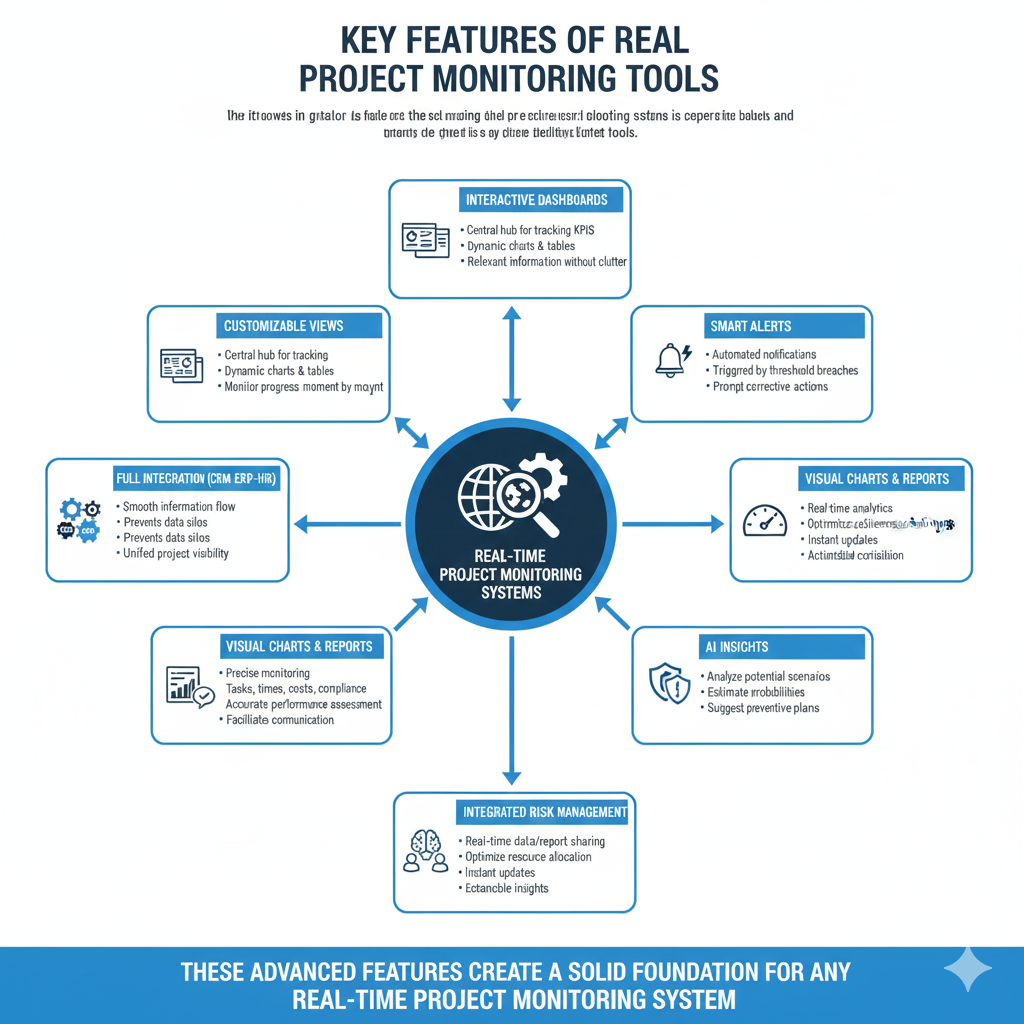
For real-time project monitoring systems to be effective, they must possess advanced technical features that ensure accurate performance tracking, enhance team collaboration, provide predictive analytics, proactively manage risks, and fully integrate with enterprise systems.
The essential features include:
- Interactive Dashboards: Serve as the central hub for tracking KPIs, aggregating data from multiple sources and transforming it into dynamic charts and tables. Managers and decision-makers can monitor progress moment by moment with precision.
- Customizable Views: Platforms offer tailored displays for each role or team, ensuring that every stakeholder receives relevant information without data duplication or clutter.
- Smart Alerts: Automated notifications are triggered immediately when any performance indicator exceeds predefined thresholds, enabling prompt corrective actions.
- Full Integration with Enterprise Systems (CRM – ERP – HR Systems): Ensures smooth information flow between departments, prevents data silos, and strengthens unified project visibility.
- KPI Tracking: Provides precise monitoring of task execution, completion times, costs, and compliance with standards, allowing management to assess performance accurately.
- Visual Charts & Reports: Offers visual representations of project progress, summarizing achievements and challenges while facilitating cross-team communication.
- Collaboration Tools: Real-time data and report sharing keeps all team members updated instantly, enhancing coordination and teamwork.
- AI Insights: Advanced analytics predict timelines, optimize resource allocation, and provide actionable insights for proactive decision-making.
- Integrated Risk Management Modules: Analyze potential risk scenarios, estimate probabilities, and suggest preventive plans to mitigate negative project impacts.
Together, these advanced features create a solid foundation for any Real-Time Project Monitoring system, enabling organizations to manage digital projects efficiently, minimize errors, and achieve strategic objectives with precision.
Real-World Scenarios Demonstrating the Power of Real-Time Project Monitoring
Real-time project monitoring demonstrates its effectiveness by detecting delays before they occur, managing resource allocation across teams, tracking multi-site projects, and analyzing team performance instantly through KPI Tracking.
In one digital project, interactive Project Dashboards enabled the manager to identify delays in critical tasks relative to the planned schedule. This allowed immediate resource reallocation, preventing any launch delays.
In another scenario, real-time data revealed imbalances in task distribution among teams. The discrepancies were addressed before they impacted workflow or team efficiency. For large-scale, multi-site projects, the system unified data and monitored all locations on a single platform, enhancing coordination and optimizing resource utilization across sites.
Additionally, live analysis of KPIs continuously assessed team performance, empowering management to implement timely training and incentive decisions.
These examples illustrate how Real-Time Project Monitoring improves decision-making, strengthens coordination, and ensures projects run smoothly and effectively.
1. Detecting Schedule Delays Before They Happen
Real-time project monitoring systems can identify potential schedule delays before they occur, enabling managers to intervene immediately, correct the course, and ensure deadlines are met.
In one real-world project, a development team used a live Project Dashboard to track feature completion rates in real time. The manager noticed that certain features were lagging behind the planned schedule, triggering an early warning.
Thanks to this instant visibility, tasks were redistributed and additional resources were allocated to the delayed teams, preventing any launch delays. This example highlights how real-time analytics allows managers to anticipate timing issues and intervene before they accumulate, maintaining project flow and improving execution efficiency.
2. Managing Uneven Resource Distribution Across Teams
Real-time monitoring systems can detect unbalanced resource allocation among teams, allowing tasks to be redistributed and overall project performance to be optimized.
In one scenario, dashboards revealed that a large number of tasks were concentrated on one team, while another team had little to no workload. Red flags in the system indicated overburdened teams, prompting the manager to immediately redistribute tasks among available teams.
These systems rely on real-time tracking of individual capacities and completion rates, issuing Smart Alerts when unusual variations in resource usage are detected. Early detection of imbalances ensures smooth workflow, high efficiency, and reduces the risk of bottlenecks that could impact project outcomes.
3. Monitoring Large Multi-Site Projects
Real-time monitoring tools allow organizations to track large projects spread across multiple sites, consolidating data to provide a comprehensive view and full control over each location.
For geographically distributed projects, managing operations and tracking progress becomes complex. Unified dashboards collect live data from all sites into a central platform, giving managers instant visibility of task status, workforce numbers, material delivery progress, and team performance without waiting for separate reports.
These systems also enable comparison of unified KPIs across sites and help identify disparities in productivity or work quality. Real-time resource tracking allows for rapid redeployment of equipment or personnel as needed, ensuring continuous operations without schedule disruptions. This approach standardizes oversight across all sites, making all data visible and current, improving coordination, and reducing operational errors.
4. Real-Time Team Performance Analysis via KPIs
Real-time monitoring enables instant evaluation of team performance through KPIs, allowing managers to take immediate actions to improve productivity and quality.
Specialized dashboards display task completion rates for each employee or department in real time. When high error rates or performance drops are detected, managers can intervene immediately, redistributing tasks or organizing additional training for affected teams to maintain high-quality operations.
This integrated analysis allows objective employee evaluation based on concrete data, supporting informed decisions on rewards or skill development. For instance, in warehouse or hospital technical departments, live reports showing increased errors prompted urgent training sessions, preserving work quality and continuity.
By providing direct, accurate insights, smart monitoring systems enhance cross-functional team performance and empower managers to make informed development and support decisions.
Best Practices for Effective Use of Real-Time Project Monitoring Systems
Implementing best practices in Real-Time Project Monitoring ensures organizations maximize the benefits of these digital tools, improving decision-making accuracy, workflow efficiency, and cross-functional team collaboration.
To achieve effective digital project management, it is essential to focus on clear objectives, standardized workflows, and training teams to work with real-time data. Following these practices ensures full utilization of Master Team’s tools, turning digital information into precise, actionable decisions.
Key best practices include:
- Set Clear and Measurable KPIs from the Start: Establish baseline goals and metrics during the planning phase to ensure the system relies on accurate and consistent data. This guarantees that all subsequent evaluations are based on a solid foundation.
- Standardize Workflows Before Tool Adoption: Define clear procedures, guidelines, and documentation to prevent inconsistencies in data interpretation across teams, ensuring all teams follow the same standards and metrics.
- Train Teams to Read and Interpret Data: Managers should teach staff how to use dashboards and interpret charts, involving them in practical sessions. This builds confidence in the new tool and fosters a data-driven culture, increasing the system’s effectiveness.
- Implement Smart, Non-Intrusive Alerts: Only critical indicators should trigger immediate notifications, preventing alert fatigue while ensuring each alert provides real value for timely decision-making.
- Regularly Review Daily and Weekly Reports: Monitoring daily and weekly summaries of delayed tasks and potential issues helps managers adjust plans quickly, integrate insights with real-time analytics, and improve the quality of decisions.
- Focus on Clear Goals, Continuous Communication, and Hands-On Training: Experts recommend adhering to these principles when deploying any modern monitoring system to ensure full team adoption and maximize the benefits of real-time data.
Common Challenges in Implementing Real-Time Monitoring and How to Overcome Them
Implementing Real-Time Project Monitoring Systems can face several challenges, including employee resistance to change, unclear initial data, poor system integration, misuse or misinterpretation of analytics, and lack of transparency and communication. If not addressed strategically, these issues can hinder system adoption and reduce the effectiveness of real-time monitoring.
Here’s a detailed look at each challenge and practical solutions to ensure effective use of real-time monitoring systems while enhancing decision-making accuracy and team efficiency:
- Employee Resistance to Change: Some staff may feel threatened or anxious about continuous monitoring and task automation. To overcome this, clearly communicate the system’s benefits and involve teams in the implementation process. This reduces fear and increases acceptance of the new system.
- Unclear or Inaccurate Initial Data: Incomplete or inaccurate input data leads to unreliable analyses. The solution is to establish strict data governance policies and conduct regular audits to ensure data quality and reliable results.
- Poor Integration with Existing Systems: When monitoring tools are incompatible with existing enterprise systems, conflicting or incomplete information may result. Careful analysis of workflows and the development of APIs or middleware solutions can ensure seamless data flow.
- Misuse or Misinterpretation of Analytics: Analytical results can be misunderstood if teams are not skilled in reading digital data. Improving team competencies in data interpretation and providing expert support to review and correctly interpret analytics is essential.
- Lack of Transparency and Communication: Unclear objectives for real-time monitoring can impede adoption. Clear communication about the system’s benefits and ongoing training programs build trust, ensuring maximum value is derived from the tool.
The Future of Real-Time Project Monitoring: Where Technology is Heading
The future of Real-Time Project Monitoring is moving toward greater intelligence and predictive analytics, automated decision-making, deep system integration, and advanced technologies such as Digital Twins and voice-enabled assistants. These innovations aim to empower organizations to manage projects more efficiently and make proactive, data-driven decisions.
Key upcoming developments include:
- Predictive AI: Artificial intelligence will be able to anticipate delays or deviations before they occur by analyzing historical and real-time performance patterns, enabling managers to intervene proactively before minor issues escalate into major crises.
- Digital Twins: This technology creates precise virtual replicas of projects, allowing organizations to test multiple scenarios such as resource shortages or plan changes in a simulated environment before applying them in reality. This enhances planning and reduces risks.
- Automated Decision-Making: Systems will handle routine tasks like generating status reports, prioritizing tasks, and allocating resources automatically, reducing managerial workload and increasing responsiveness to changes.
- Voice-Enabled Assistants: Managers will receive instant project updates via voice commands, enabling them to ask about the progress of any phase and get immediate answers without referring to traditional dashboards.
- Enhanced System Integration: Real-time monitoring tools will seamlessly integrate with other enterprise systems, such as HR, accounting, ERP, and CRM, potentially leveraging innovations like blockchain to ensure data integrity and security.
- Smart Recommendations from Live Data: Next-generation systems will go beyond data collection, providing intelligent suggestions such as proactive alerts or alternative action plans automatically, making project management more autonomous and effective.
- Improved Strategic Planning: Using these future-ready tools, organizations can build advanced scenarios, estimate resources more accurately, and address challenges before they arise, elevating governance and competitiveness in modern projects.
Conclusion: Real-Time Data: The Gateway to Success in Modern Projects
Ultimately, the importance of Real-Time Project Monitoring lies in its ability to serve as a gateway to more proactive and modern project management. It provides the clarity, speed, and precision necessary to navigate daily operational changes, enabling managers to track the real-time performance of every key indicator, minimize risks, and enhance team coordination to ensure projects are delivered at the highest quality.
With Master Team’s digital solutions, Saudi companies now have the capability to oversee their projects in real time using advanced tools that integrate business environments with AI-driven analytics, empowering teams to make strategic decisions instantly and reliably.
We encourage every organization and project leader to evaluate their current systems and invest in upgrading them with modern tools that deliver accurate information at the right time. The future depends on the ability to make instant decisions, and real-time monitoring is the key to achieving this.
Discover how Master Team’s solutions can elevate your project management and experience the power of integrated digital oversight today!
Frequently Asked Questions (FAQs)
1. Why is real-time monitoring important for successful digital project management?
Real-time monitoring provides an instant view of project performance indicators, enabling decision-makers to act quickly and strategically. It also improves team coordination and reduces bureaucratic errors, enhancing the overall quality of digital project management.
2. How do real-time tracking tools improve decision-making within organizations?
Real-time tracking tools supply managers with live data on progress, risks, and resources. AI analyzes this data to deliver actionable insights immediately, allowing for accurate and fast decisions without waiting for traditional reports.
3. What are the main features of project management systems for real-time performance monitoring?
Key features include: interactive dashboards for tracking KPIs, smart alerts when critical thresholds are exceeded, full integration with ERP and CRM systems, continuous KPI tracking, and support for collaborative work through shared reporting.
4. How does real-time monitoring impact the efficiency of cross-functional teams?
Real-time monitoring enhances collaboration and aligns understanding of goals and progress across teams. By providing a unified platform for tasks and data, it reduces conflicts and boosts the efficiency of cross-functional teams in managing digital projects.