
Why do some organizations have ambitious, publicly declared strategies but fail to achieve tangible results on the ground?
The answer often lies not in the lack of vision, but in the absence of tools capable of converting strategy into measurable, actionable performance.
In a business environment characterized by rapid change, enterprise performance management is no longer about periodic reports or isolated metrics disconnected from strategic context. Today, leaders face a more complex challenge: How can they align top strategic objectives with operational initiatives, monitor performance in real-time, and make decisions based on reliable, timely data?
This is precisely where Strategic Digital Solutions come into play. These solutions represent the new generation of strategy execution systems that not only measure but actively drive execution, ensuring continuous alignment between vision and outcomes.
In this context, this article delves into how Strategic Digital Solutions are redefining performance management, what makes them the backbone of future strategy execution, and the role of advanced technologies, particularly Artificial Intelligence (AI), in empowering leaders to drive performance rather than merely monitor it.
What Are Strategic Digital Solutions?
Strategic Digital Solutions are technological platforms that integrate strategic planning with operational performance management, linking an organization’s key objectives with initiatives, projects, and performance indicators (KPIs).
These solutions differ from traditional performance management systems, which typically rely on periodic measurements and disconnected spreadsheets. Instead, Strategic Digital Solutions serve as a single source of truth, consolidating both strategic and operational data into a unified centralized dashboard.
In this way, Strategic Digital Solutions enable organizations to connect strategic goals with performance indicators and track them in real-time. They transform high-level vision into an actionable, measurable system. For example, experts highlight that developing measurable KPIs aligned with overarching goals leads to a significant improvement in an organization’s ability to measure and manage its performance.
The Evolution of Performance Management in the Digital Age: From Periodic Reports to Data-Driven Leadership
In the digital age, the concept of performance management has evolved from limited periodic monitoring to continuous, real-time, data-driven oversight.
Performance management no longer relies on annual or semi-annual reports that reflect outdated snapshots of reality. Instead, modern organizations increasingly depend on digital solutions that collect and analyze data in real-time, providing a deeper and more accurate understanding of performance at every stage of execution.
This fundamental shift has moved organizations from performance measurement, which focuses on answering the question "Where are we now?" to performance management, which focuses on "What actions should we take now to improve results?". As a result, performance is no longer just a set of numbers reviewed later, but rather a leadership tool used to guide daily decisions and continuously correct the course.
Digital transformation has also reshaped the concept of organizational performance from a regulatory activity to a dynamic, interactive process, supported by executive dashboards and continuous feedback mechanisms. These tools allow leadership to detect trends early, spot deviations as they occur, and align operational outcomes with strategic goals in real-time, eliminating the time gap between action and result.
In fast-changing business environments, particularly in large organizations and government entities, traditional systems are unable to keep up with the complexity and speed of decision-making.
On the other hand, digital performance management solutions enable the shift from reactive responses to proactive strategies, and from monitoring to strategic control of performance. This paves the way for more mature, strategic performance management, perfectly aligned with long-term strategic goals.
Why Do Performance Management Systems Fail in Many Organizations Today? The Strategy Gap Before the Technology Gap
Traditional performance management systems often fail in many organizations because they are disconnected from the overall strategy and rely on fragmented, outdated data. This makes them focus on activities and number gathering instead of directing performance towards achieving results and value.
On a practical level, many organizations still rely on manual or semi-digital processes to collect data from multiple, disconnected sources. This method consumes valuable team time on entering and aggregating numbers instead of analyzing them and making decisions based on that data. This inherently leads to delayed data and poor quality.
The problem becomes even more complex when discrepancies arise in the figures between departments or systems, undermining trust in performance indicators and causing leadership to hesitate in relying on them. Without a single source of truth, performance reports turn into tools for debate rather than instruments for guidance.
Additionally, gaps in communication between subsystems exacerbate the issue. Each department works on its own set of performance indicators, isolated from the overarching strategic goals. This fragmentation creates a disjointed view of organizational performance and leads to conflicting priorities, weakening alignment between operational plans and strategic initiatives.
The ultimate result of this reality is the transformation of performance management into a routine administrative activity focused on preparing periodic reports rather than improving outcomes. Employees get absorbed in daily activities without a clear understanding of their true impact on the strategy, and performance indicators lose their role as tools for leading strategic performance management and achieving sustainable value.
How Do Strategic Digital Solutions Redefine Performance Management?
Strategic digital solutions redefine performance management by aligning an organization’s strategic direction and transforming performance from a separate monitoring activity into a leadership tool that drives execution and delivers results.
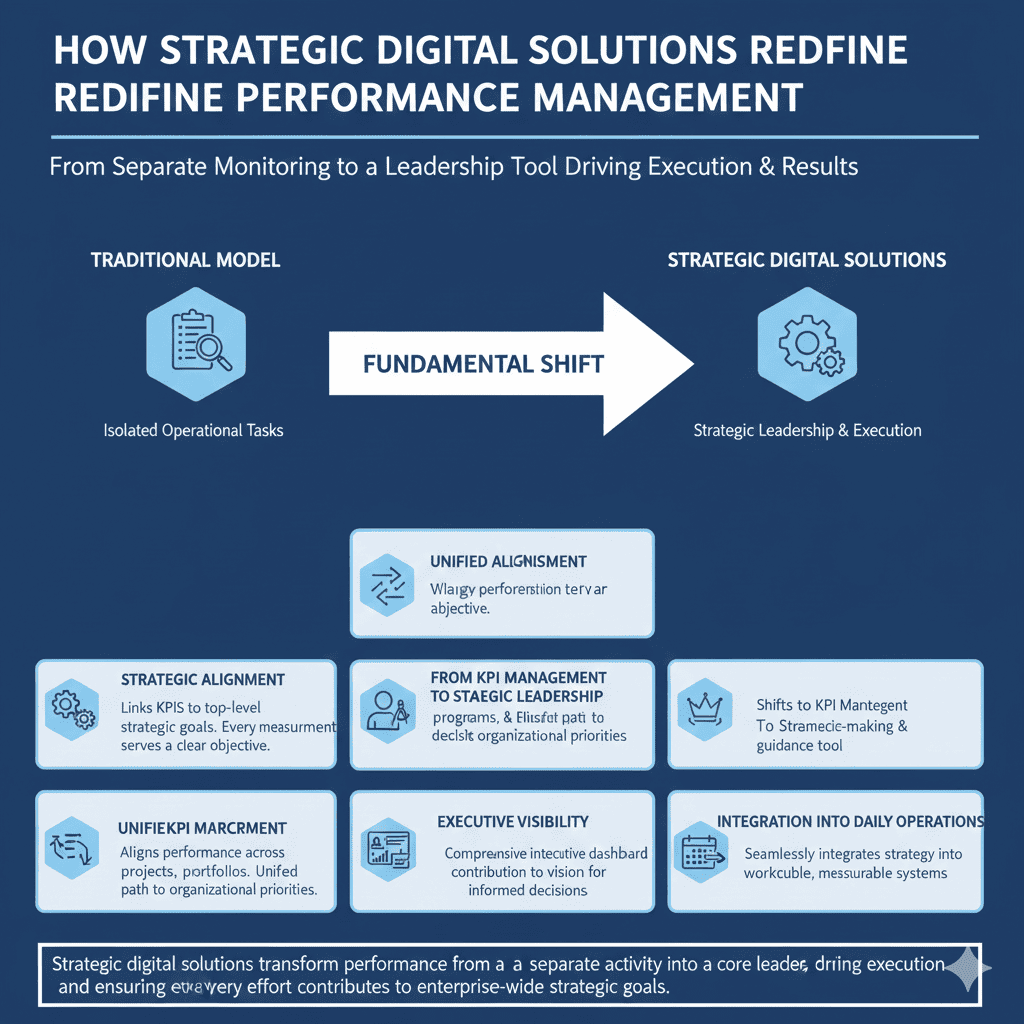
This fundamental shift is due to several key reasons that make strategic digital solutions more capable of managing enterprise performance compared to traditional models:
- Strategic alignment: They directly link performance indicators (KPIs) to the organization’s top-level strategic goals, ensuring that every performance measurement serves a clear strategic objective, rather than focusing on isolated operational tasks.
- Unified performance across initiatives: They align performance across projects, programs, and strategic portfolios, ensuring that all initiatives follow a unified path that serves the organization’s priorities.
- From KPI management to strategic leadership: They shift the organization from simply managing KPIs to leading strategic performance management, where performance becomes a tool for decision-making and guidance, rather than just a report for tracking.
- Executive visibility: They provide a comprehensive executive dashboard for senior management, displaying progress percentages and each initiative’s contribution to the vision, enabling informed decision-making at the highest levels.
- Integration of strategy into daily operations: By seamlessly integrating strategy into daily workflows, they transform strategic plans into executable, measurable, and continuously trackable systems.
Strategic Execution Platforms as the Backbone of Modern Performance Management
Strategy execution platforms are comprehensive digital systems that establish the backbone of modern performance management by bridging the gap between strategy formulation and achieving results. These platforms include tools for designing strategy maps and converting them into actionable objectives, performance indicators (KPIs), and initiatives. They also integrate well-known frameworks like the Balanced Scorecard (BSC) and OKRs (Objectives and Key Results) into a single system.
This integration allows organizations to plan their top-level strategies and break them down into sub-goals and interconnected KPIs, transforming overarching goals into executable actions and performance-tracked initiatives.
In other words, the work on the platform begins with designing the strategy and continues through to achieving tangible results. Automation and the seamless connection between strategic programs and performance indicators make it easier to track progress from the outset to the achievement of goals.
The Role of Artificial Intelligence in the Future of Performance Management
Artificial Intelligence (AI) adds a new dimension to strategy and performance management by offering predictive analytics, early warnings, and executive decision support. In the face of massive data availability, AI provides predictive insights that forecast future performance trends and identify potential risk points.
Smart systems generate early alerts when performance indicators deviate from plans, enabling leaders to take action before crises occur. On an advanced level, the concept of Agentic AI involves independent virtual agents that make well-considered decisions autonomously. These agents interact with teams, automatically readjusting employee goals when there are changes in strategy, suggesting corrective actions, and even collaborating in the formulation and distribution of objectives.
With these capabilities, AI-powered performance management becomes a key partner in strategic planning and performance leadership, transforming traditional planning into a dynamic process based on real-time data and decisions supported by advanced technology.
Performance Management in Large Enterprises and Government Entities
In large enterprises and government entities, performance management emerges as a complex strategic challenge that demands stringent governance and alignment with national goals. Large institutions have diverse services and departments, necessitating centralized solutions to execute and manage performance, especially in the public sector, where performance plays a key role in achieving national visions.
For instance, the National Center for Performance Measurement (Adaa) in Saudi Arabia manages the performance indicators of over 600 government entities and aligns them with the Saudi Vision 2030. The center has observed a notable improvement in the overall performance of the entities being measured. It aims to enhance the efficiency of public institutions and improve their outcomes in line with national strategies, by establishing unified frameworks for building indicators and goals.
This serves as a model for strategic performance governance, where measurable indicators derived from high-level objectives (including national goals and plans) ensure that the performance of government entities aligns with the public interest.
Executive dashboards and periodic leadership dialogues are utilized to evaluate the progress of entities towards achieving the vision's indicators. This is complemented by the role of boards of directors and senior leadership in monitoring and accountability, all within a reliable framework and national standards.
Conclusion: Why Strategic Digital Solutions Represent the Future of Performance Management
Strategic digital solutions represent the future of performance management because they address the core challenge faced by organizations today: transforming strategy from a theoretical document into tangible, measurable, and accountable execution. In the face of rapid changes and the increasing complexity of business environments, organizations can no longer rely on traditional models that separate planning from execution. This is where strategic digital solutions emerge as an integrated system that closes the execution gap by linking strategic goals with initiatives and performance indicators (KPIs), while providing real-time data and intelligent analytics that support decision-making at the right moment.
It is no longer enough for organizations to be managed through isolated performance indicators detached from the overarching vision. Organizations that achieve sustainable results today are those that view digital strategy execution as a competitive necessity, integrating performance with governance and leadership into a unified path that drives the realization of the vision with confidence and continuity.
For organizations aiming to transition from performance management to strategic execution leadership, Master Team provides an integrated practical framework via the S+ (Strategy Digital Solution) platform. This solution connects strategy to performance, empowering leadership to monitor execution and achieve the real impact of their initiatives.
To learn how to transform your strategy into measurable results, visit the Master Team website and discover their strategic digital solutions designed specifically for the needs of Saudi institutions.
Frequently Asked Questions:
1- What is the difference between Performance Management and Strategy Execution?
Performance management focuses on continuously measuring, analyzing, and improving outcomes, while strategy execution is concerned with transforming strategic objectives into actionable initiatives and projects. Performance management tracks "how we perform," while strategy execution ensures "how we achieve the vision."
2- How do Strategic Digital Solutions improve decision-making?
Strategic Digital Solutions provide real-time, integrated performance insights through executive dashboards, enabling leadership to detect deviations early and make data-driven decisions based on up-to-date information. This enhances decision-making by offering a clear view of performance, contributing to better strategic alignment.
3- Can Performance Management support Boards of Directors and Senior Leadership?
Yes, modern performance management systems support boards and senior leadership by providing executive dashboards that display strategic progress and key risks. This strengthens governance, accountability, and decision-making speed, ensuring that leaders can take prompt action when needed.