
🚨 In many organizations today, the challenge is no longer a lack of data. It is quite the opposite. Reports are everywhere, meetings are constant, performance indicators change daily, and executive decisions require faster decision-making and higher accuracy than ever before.
However, the reality highlights a critical challenge: the more systems and tools an organization adopts, the wider the gap becomes between information availability and the ability to make the right decisions at the right time.
An organization may have dozens of dashboards, thousands of reports, and multiple AI-powered tools… yet the most important questions remain:
❓ Who connects and contextualizes all this data?
❓ Who identifies risks before they emerge?
❓ Who helps leadership understand “what needs to happen now” instead of simply showing what has already happened?
This is where the fundamental difference lies between traditional AI tools and an Agentic AI system that operates as a true decision partner within the organization.
💡 Traditional AI tools can:
- Answer questions
- Summarize meetings
- Generate quick reports
- Execute specific commands
However, they often cannot:
- Understand the complete organizational context
- Connect projects, strategy, and governance
- Predict risks before they occur
- Proactively follow up on decision execution
This is precisely where Faris AI delivers its value.
Faris AI is an Agentic AI system designed to serve as a true decision partner for executive teams, project management offices (PMOs), and strategic committees across organizations in Saudi Arabia and the GCC.
Through its integration with +P for project management, +S for digital strategy management, and Diwan for executive office management, Faris AI helps organizations transform complex data into faster decisions, clearer recommendations, and more efficient execution within a Saudi environment that considers data sovereignty, regulatory compliance, Arabic language support, and local dialect understanding.
📈 In this guide, you will discover:
✔ Why traditional AI tools are no longer sufficient for enterprises
✔ The difference between AI Assistant and Agentic AI
✔ How Faris AI operates as an executive decision partner
✔ How it supports projects, strategy, and executive meetings
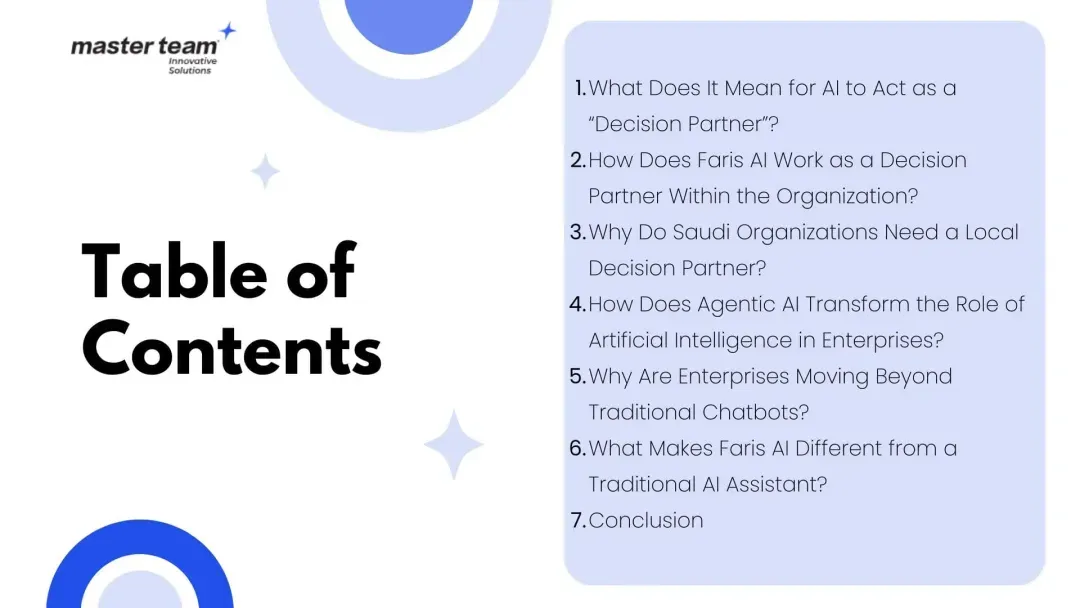
What Does It Mean for AI to Act as a “Decision Partner”?
A decision partner is an AI system that does not simply provide information but actively participates in and supports the organization’s decision-making process.
This means Faris AI does not simply wait for commands.
Instead, AI analyzes, plans, and executes actions on behalf of executive leaders.
In simpler terms, Faris AI goes beyond the role of a conventional operational tool.
AI analyzes organizational data in real time, predicts future trends and risks, recommends proactive corrective measures, and automatically coordinates their implementation with relevant teams.
For example, Master Team highlights that Faris, when integrated with +P, can “reallocate resources based on business needs and generate real-time executive-ready summaries.”
These capabilities make Faris AI a true decision-making partner.
Faris AI transforms analysis and planning from a reactive approach into a proactive decision-making capability, enabling organizations to anticipate problems before they occur and take corrective actions without waiting for manual intervention.
How Does Faris AI Work as a Decision Partner Within the Organization?
Faris AI operates by embedding an advanced agentic AI layer within enterprise systems (P+, S+, Diwan) to intelligently process operational and strategic data, then provide users with actionable insights and executive recommendations.
This process takes place through a series of practical steps: as an integrated layer across core platforms, Faris AI collects organizational data from databases, enterprise systems, emails, and calendars, then transforms it into a centralized view for analysis.
Faris then applies advanced machine learning techniques to analyze current and historical data and predict potential issues, such as project delays or KPI performance deviations, before they occur.
Based on this analysis, Faris AI recommends actionable steps or executes them autonomously.
Ai can adjust schedules, reallocate resources, or generate new alerts automatically-all of which enable teams to maintain execution continuity without waiting for manual intervention.
Teams and managers can also interact with Faris AI in Arabic through text or voice, as if they are communicating with a colleague.
It provides an accessible conversational interface for various operational tasks and information needs without requiring users to switch between multiple applications.
Ultimately, Faris AI acts as an intelligent coordinator through a unified interface layer, connecting systems and data and transforming them into actionable recommendations.
This section covers:
- Integrating an Agentic AI layer within enterprise products (P+, S+, Diwan)
- Collecting, understanding, and contextualizing enterprise data within business operations
- Analyzing and predicting future scenarios before problems emerge
- Recommending or executing actionable steps (scheduling, resources, alerts)
- Intelligent monitoring and interaction with decisions and tasks in Arabic
1. Understanding Enterprise Data and Connecting It to Business Context
Within each Master Team platform (such as +P for project management, +S for strategy management, and Diwan for executive meetings), Faris AI operates as an active intelligence layer embedded directly within the system.
Faris collects real-time operational data (such as task completion rates, schedule progress, resource information, and other relevant inputs) and integrates it with strategic data sources, including business objectives and KPI metrics, within a unified framework.
This comprehensive understanding of context enables Faris AI to understand the complete picture of projects or strategic plans, rather than providing fragmented insights to become a true decision partner for teams.
2. Predictive Analytics Before Problems Occur
Once data is collected, Faris AI applies advanced predictive analytics techniques.
AI does not simply monitor current conditions.
Instead, it applies machine learning models to forecast future scenarios and potential risks.
For example, within +P, it analyzes completion rates, project timelines, and risk indicators to identify potential schedule deviations at an early stage.
Within +S, it forecasts future KPI performance before indicators deviate from strategic targets.
Based on this analysis, Faris AI can generate proactive alerts whenever potential risks begin to emerge.
3. Recommending and Executing Actionable Steps
Faris AI goes beyond risk prediction by recommending solutions and actions to address identified issues.
After analyzing the data, it proactively identifies the next required actions:
It may reschedule tasks, reallocate resources, create customized follow-up alerts, or assign specific tasks to relevant teams.
All of this takes place within the system itself without waiting for direct human intervention. In this way, analysis is directly connected to execution.
Instead of requiring managers to handle routine planning activities manually, Faris AI provides them with a practical sequence of actions that can be implemented immediately, improving response times and increasing execution efficiency.
4. Proactive Alerts for Managers and Executives
One of Faris AI’s key capabilities is its ability to send intelligent alerts to managers before crises occur.
Faris continuously monitors performance metrics and KPIs, and when it detects any significant deviation, it immediately notifies leadership.
For example, if a project shows signs of delay or a KPI begins deviating from its target, Faris AI identifies the issue before it escalates and provides management with relevant insights and appropriate recommendations.
This enables managers to take timely corrective actions before it is too late, rather than reacting to unexpected issues after they occur.
5. Intelligent Decision and Task Tracking
Finally, Faris AI automatically tracks the execution of decisions and assigned tasks.
AI maintains a record of every recommendation or alert it generates and coordinates with teams to ensure that these recommendations are properly implemented.
For example, if it suggests a timeline adjustment or assigns a new task, the system automatically updates the relevant work plans.
Faris also monitors the completion of assigned tasks and notifies responsible teams whenever delays are detected.
In this way, automation significantly reduces the need for intensive manual monitoring.
Every decision or task is automatically added to structured follow-up workflows, allowing leadership to continuously monitor progress without losing visibility into critical details.
Why Do Saudi Organizations Need a Local Decision Partner?
The need for a local decision partner is driven by the unique nature of the Saudi business environment and local regulations, which require AI solutions that align with the local language, legal requirements, and cultural context.
This is exactly what Faris AI delivers through its fully localized approach.
Organizations in Saudi Arabia handle sensitive data that is subject to strict regulations, such as the Personal Data Protection Law (PDPL), in addition to data sovereignty requirements that ensure critical data remains within the Kingdom’s borders.
Regulatory entities such as SDAIA, the National Cybersecurity Authority (NCA), and SAMA enforce strict requirements around data security and protection.
Therefore, Faris AI was designed and developed in Saudi Arabia from the ground up and is fully hosted on national cloud infrastructure to ensure data sovereignty.
This ensures full alignment with SDAIA and SAMA requirements: all data remains hosted within Saudi Arabia and complies with applicable regulations, unlike foreign solutions that may require transferring data outside the Kingdom.
In addition, Faris AI provides comprehensive support for the Arabic language and Saudi dialects across its capabilities.
Faris as an AI tool accurately understands local language patterns, as demonstrated by its ability to transcribe meetings conducted in the Saudi dialect.
More importantly, Faris AI is specifically designed to address the needs of large enterprises:
It is optimized for project management officesProject Management Offices (PMOs), operations teams, and governance functions across both public and private sectors.
It seamlessly integrates with local enterprise systems (ERP/CRM) and considers the Saudi business context when generating recommendations.
In short, Faris AI is a local decision partner that understands the regulatory and cultural environment of Saudi organizations while protecting their data- a capability that global out-of-the-box solutions cannot provide.
This section covers:
- Full compliance with Saudi regulatory requirements (PDPL and others)
- High-accuracy support for the Arabic language and Saudi dialects
- Data sovereignty and local hosting aligned with SDAIA and SAMA requirements
- A customized solution design for the government sector and large-scale organizations in the Kingdom
1. Understanding the Saudi Regulatory Environment
Local regulations require organizations to store sensitive data within the Kingdom and comply with strict security standards, requirements that Faris AI fully addresses.
According to regulations such as the Personal Data Protection Law (PDPL), personal data must remain within Saudi Arabia.
Regulatory entities such as SDAIA and NCA emphasize strict requirements for data security and regulatory compliance. This is where the role of Faris AI becomes clear:
In addition to being fully Saudi-developed, Master Team confirms that Faris AI systems are specifically designed to comply with “Qiyas” and NCA standards.
In other words, organizations seeking sovereign AI capabilities will not face regulatory challenges with Faris AI, as it complies 100% with local data requirements while ensuring transparency and security.
2. Arabic Language and Saudi Dialect Support
Faris AI understands Modern Standard Arabic and Saudi dialects with high accuracy, making it fully aligned with the local business environment.
It is designed to process Saudi dialects with high accuracy.
In practice, this enables accurate transcription of meetings conducted in the Saudi dialect without losing context or meaning.
This comprehensive language support ensures a seamless Arabic user experience for managers and teams while improving the accuracy of analysis and recommendations within the Saudi context.
3. Data Sovereignty and Local Hosting
Faris AI ensures that data remains within Saudi Arabia without external transfers, as the platform is fully hosted on national infrastructure.
All Faris AI services operate on Saudi private cloud infrastructure, aligned with the requirements of “Qiyas” and relevant regulatory authorities, ensuring that sensitive data remains securely protected within the Kingdom.
This means that all information remains subject to strict Saudi regulations and does not leave the country except in rare cases.
In short, Faris AI provides strong data sovereignty capabilities, enabling government entities and large enterprises to adopt AI solutions while remaining aligned with the policies of SDAIA, SAMA, and other regulatory authorities.
4. Alignment with SAMA and SDAIA Requirements
Faris AI is designed to fully align with the requirements of Saudi financial and regulatory institutions, including SAMA, as well as the standards and frameworks established by the Saudi Data and AI Authority (SDAIA).
Local data hosting and compliance with Saudi cloud requirements enable organizations to achieve full adherence to locally approved governance and security frameworks.
Since all services remain within the Kingdom, organizations can effectively meet SAMA requirements related to financial information security and transaction security, as well as SDAIA requirements for data governance.
Ultimately, Faris AI provides the compliance assurance required by Saudi regulatory authorities without the need for additional arrangements with external providers.
5. Purpose-Built Solution for the Government Sector and Large Enterprises
Faris AI is specifically built to address the needs of large Saudi government entities and enterprises while adapting to the requirements of the local operating environment.
The Faris AI platform is tailored for project management offices (PMOs), executive committees, and strategic departments within large organizations.
It integrates with existing PMO and strategy management systems, such as P+ and S+, making adoption easier within the Saudi organizational and regulatory environment.
This customized architecture enables Faris AI to fully align with local business structures and operational requirements, unlike general-purpose global solutions that may not address the specific needs of the Saudi market.
In other words, Faris AI is built specifically for Saudi organizations, making it a local decision partner that understands business needs and protects organizational data in ways that foreign out-of-the-box solutions cannot provide.
How Does Agentic AI Transform the Role of Artificial Intelligence in Enterprises?
Agentic AI represents a fundamental shift in the role of artificial intelligence, transforming it from a tool that simply executes predefined tasks into an active and intelligent partner within the enterprise environment.
Recent advances in AI mean that systems are no longer limited to generating text or images. They are now capable of understanding, reasoning, and acting autonomously.
These agentic systems are characterized by autonomy, goal-oriented behavior, and adaptability, unlike traditional models that require continuous human supervision.
According to the MIT Sloan Management Review, the era of intelligent agents is already underway.
Leading organizations and enterprises are increasingly integrating AI agents at scale to perform diverse and complex tasks with a high level of autonomy.
This shift means that organizations are no longer looking for chatbots that only respond to inquiries.
Instead, they are seeking intelligent AI agents that operate like a digital team capable of managing tasks from initiation to completion.
As a result, the role of AI is evolving from a basic support tool into an intelligent agent that participates in operational and strategic processes and makes decisions based on a comprehensive and continuously evolving understanding of the organization’s context, rather than relying only on simple text inputs.
Why Are Enterprises Moving Beyond Traditional Chatbots?
Organizations today need AI that provides predictive and proactive capabilities, not just an interactive tool that responds directly to questions.
Traditional chatbots served their purpose at the time, but their limitations have become increasingly clear.
Organizations primarily provide predefined information from databases and existing content sources in response to user queries.
However, this approach is no longer sufficient for gaining deeper insights or managing complex workloads.
Global studies show that leading organizations have already started adopting agentic systems.
According to a joint survey by MIT Sloan and BCG, 35% of organizations had adopted intelligent agent technologies by 2023, while another 44% were planning to implement them soon.
Industry experts view intelligent agents as a “multi-billion-dollar opportunity” for improving business performance.
Today, organizations are looking for Faris AI and similar AI agents because they provide a more intelligent and comprehensive solution:
Transforming large volumes of complex data into clear recommendations, predicting deviations before they occur, and improving decision-making speed and accuracy compared to traditional tools.
Furthermore, the adoption of intelligent agents aligns with digital transformation initiatives and Vision 2030 objectives focused on building a data-driven economy powered by artificial intelligence.
What Makes Faris AI Different from a Traditional AI Assistant?
Faris AI is not a traditional AI Assistant, it is a comprehensive Agentic AI system that coordinates a team of intelligent agents and intelligently manages enterprise-wide operations.
While a traditional AI assistant provides responses to specific inquiries and depends on direct instructions, Faris AI operates as an autonomous intelligent agent capable of executing multiple tasks with greater independence and efficiency.
This can be described as a collaborative team of digital agents.
According to MIT Sloan, agentic systems can consist of multiple agents that work together to accomplish complex tasks.
The key difference is that Faris AI goes beyond the capabilities of a traditional chatbot.
Faris AI not only understands questions and provides answers. It understands the deeper business context and takes initiative.
For example, if you ask a traditional chatbot to prepare a report, it will wait for explicit instructions.
However, once Faris AI understands your broader objectives, it can automatically request the required data, connect the results with potential risks, and present a corrective action plan before you even ask.
For this reason, Faris AI integrates with platforms such as +P, +S, and Diwan to provide a comprehensive experience connected to strategic objectives and operational processes.
It works by combining operational and strategic data, analyzing them through a unified approach, and enabling users to interact seamlessly through a single interface.
Simply put, Faris AI is an intelligent operating layer within the organization powered by advanced intelligent capabilities.
An AI role is not limited to answering questions. It learns from organizational context and takes proactive actions.
This is what makes it fundamentally different from any traditional virtual assistant.
Faris AI builds organization-specific intelligent knowledge and transforms it into a local decision partner that understands business needs and protects organizational data.
Conclusion: Why Faris AI Represents the Future of Intelligent Enterprise Decision-Making
In a business environment driven by speed, data intensity, and increasingly complex systems, it is no longer enough for organizations to rely on AI tools that only answer questions or generate traditional reports.
Today, organizations need a true decision partner that understands context, connects data, predicts risks, and recommends the right actions before issues escalate into operational or strategic crises.
This is where the true value of Faris AI becomes evident.
Faris AI is not simply an AI assistant or an enterprise-level chatbot. It is an Agentic AI system designed to operate within the organization’s own environment and integrate with project management systems, strategy, governance, and executive meetings to transform daily operational data into actionable intelligence that enables faster and more accurate decisions.
Through its integration with:
- +P as an intelligent project management system
- +S as a strategy management and KPI tracking platform
- Diwan as a platform for executive meetings and committee management
Faris AI provides executive leaders with a unified operational and strategic view that helps to:
- Accelerate decision-making
- Reduce operational risks
- Improve execution follow-up
- Enhance governance efficiency
- Transform data into practical, actionable recommendations
More importantly, all these capabilities are delivered within a fully localized Saudi environment that considers the following:
- Data sovereignty
- Regulatory compliance
- Arabic language and Saudi dialect support
- The requirements of government entities and large enterprises
The future of intelligent organizations will not depend on fragmented tools but on agentic AI systems that operate as true decision partners within organizations.
Faris AI represents this new era of enterprise intelligence in Saudi Arabia and the Gulf region.
🚀 If your organization is looking for:
- An AI-powered project management system
- An Arabic AI assistant for executive leadership
- An Agentic AI platform for enterprises
- A predictive analytics system for projects and KPIs
- An intelligent decision partner supporting executives and committees
Faris AI provides an advanced enterprise solution that combines operational intelligence and predictive analytics within a platform built around local data sovereignty.
🚀 Start building a faster, clearer, and more capable organization with stronger decision-making capabilities today- with Faris AI.
Frequently Asked Questions (FAQ)
1. What is the difference between Faris AI and traditional AI tools?
The main difference is that Faris AI does not operate as a basic interactive tool or traditional chatbot that only answers questions. Instead, it functions as an Agentic AI system designed to serve as a decision partner within the organization.
Most traditional AI tools rely on direct instructions: users assign a specific task, and the system only executes the requested action. Faris AI, however, understands the organization’s overall context, connects operational and strategic data, predicts risks, recommends corrective actions, and proactively follows up on execution.
2. How does Faris AI support executive teams and Project Management Offices (PMOs)?
Faris AI helps executives reduce the time spent analyzing reports, meetings, and scattered data by transforming them into clear and timely recommendations.
For example, it can:
- Predict project delays before they occur
- Analyze the root causes of operational deviations
- Monitor KPIs in real time
- Send proactive alerts to management
- Automatically generate executive summaries and intelligent reports
- Track decisions and tasks after meetings
This enables PMO teams and executive leadership to make faster, more accurate decisions with less manual effort.
3- Does Faris AI support the Arabic language and Saudi dialects?
Yes. Faris AI is designed as an intelligent Arabic assistant tailored specifically for Saudi and Gulf organizations.
It supports:
- Modern Standard Arabic
- Saudi dialects
- Local enterprise terminology
- Executive meetings conducted in Arabic
It can also transcribe meetings, generate minutes, extract decisions, and create tasks automatically with high accuracy, making it suitable for government entities and large enterprises across the Kingdom.
4- Is organizational data secure when using Faris AI?
Yes. Data security and sovereignty are among the key strengths of Faris AI.
Faris AI:
- Is hosted in Saudi Arabia
- Aligns with SDAIA and SAMA requirements
- Supports PDPL requirements and data governance policies
- Operates within a secure local cloud environment
- Ensures that sensitive data is not transferred outside the Kingdom
This makes it a suitable choice for government entities, the financial sector, and large enterprises requiring sovereign AI capabilities.
5- Can Faris AI integrate with existing enterprise systems?
Yes. Faris AI is designed to integrate seamlessly with various enterprise systems.
It can work with:
- Project management systems
- ERP and CRM systems
- Strategy management and KPI platforms
- Email and calendar systems
- Meeting and governance systems
It also integrates deeply with Master Team platforms, including:
- +P for project management
- +S for strategy management
- Diwan for executive meetings
This integration helps organizations build a unified operating environment that supports real-time and effective decision-making.