
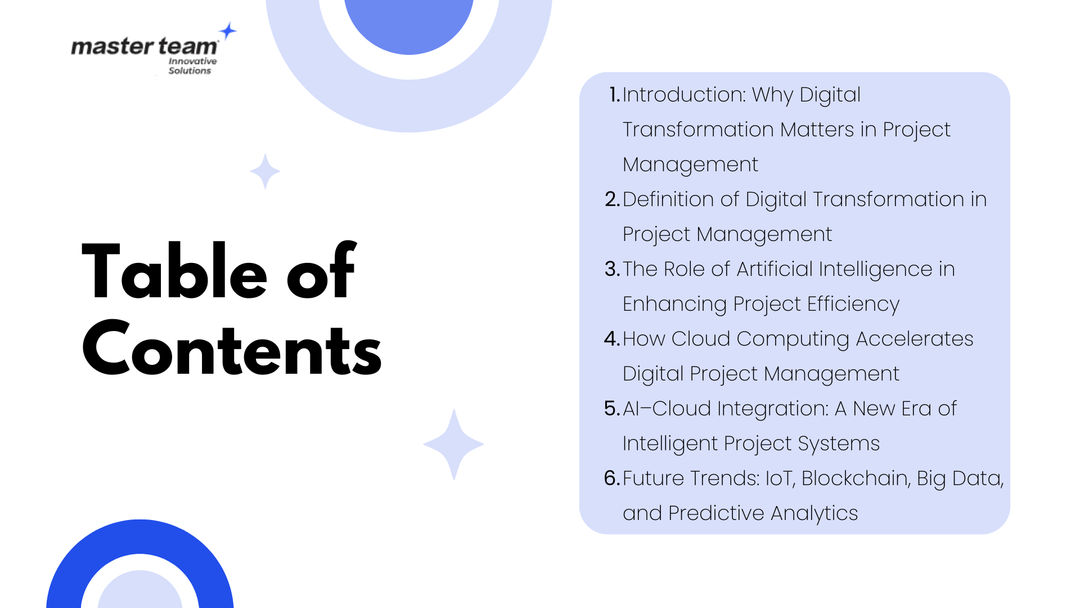
In a business environment where decisions are measured in seconds and losses in millions, project management is no longer just about organizing tasks it's about competitive survival.
A single organization making a late decision or relying on outdated data could lose an entire strategic project not due to a lack of competencies, but because traditional tools are no longer capable of keeping up with the complexities of modern-day realities.
Global reports show that most major project failures are not linked to human resources but to digital governance and management systems. Working with disconnected tools, manual reports, and decisions based on outdated data creates a dangerous gap between planning and execution, and between strategic vision and operational reality.
Today, digital transformation in project management is no longer a technical choice it’s a strategic decision that directly impacts:
✔️ Resource efficiency
✔️ Decision-making speed
✔️ Risk control
✔️ Output quality
✔️ Organizational scalability and sustainability
With the advent of technologies like AI-powered solutions, cloud computing ☁️, and integrated digital project management systems, the concept of project management is fundamentally changing:
🔹 From periodic reporting → to real-time data-based management
🔹 From intuition-based decisions → to predictions supported by data analytics
🔹 From isolated systems → to fully integrated End-to-End Project Management Systems
This article isn’t theoretical; it’s a practical roadmap illustrating how technology can redefine project management within organizations and how a project transforms from an operational burden to a strategic tool for growth, sustainability, and corporate excellence particularly in an ambitious environment like the Saudi market, aligned with the objectives of Vision 2030 and governmental digital transformation.
What is Digital Transformation in Project Management?
Digital transformation in project management is a comprehensive process that integrates modern digital technologies across all project execution phases to redesign organizational processes and improve overall performance. This concept goes beyond just using new devices and software; it requires a radical change in organizational culture and workflow structure to deliver real added value.
In today’s business world, digital project management systems have become a core component of boosting productivity, efficiency, and transparency. By using these systems, data is collected and analyzed in real-time, enabling managers to make faster, more informed decisions compared to traditional methods.
Through IT solutions, project teams can accelerate routine tasks and redirect their efforts to strategic activities. Studies have shown that digital transformation enables organizations to reduce errors and increase project execution speed through tools like AI, big data, and IoT that enhance operational efficiency.
Additionally, integrating modern technologies has become a cornerstone in advanced project management systems. Merging AI tools with cloud computing and data analytics services creates a connected and cohesive work environment where information can be accessed from anywhere, at any time, and shared seamlessly across all team members.
Thus, digital transformation shifts the approach to project management from intuition and periodic reports to real-time, data-driven decisions. Relying on smart dashboards (like the +P platform) and AI technology, managers can foresee challenges and predict risks before they occur. Digital transformation thus helps in creating proactive strategies that achieve objectives with greater flexibility and support long-term planning.
The Role of Artificial Intelligence in Digital Transformation and Project Management Efficiency
AI improves decision-making and project efficiency through its analytical capabilities and intelligent automation. For example, an advanced AI system can analyze vast amounts of historical data and assess the likelihood of risks, then predict potential delays or budget overruns before they occur. Specialized sources indicate that AI systems in project management can send early alerts and data-driven recommendations to improve work plans (such as adjusting schedules or reallocating resources) in real-time.
Additionally, AI greatly contributes to automating routine processes within projects. Instead of teams spending time on repetitive tasks like preparing periodic reports or scheduling tasks, smart virtual assistants handle these tasks automatically. As a result, human resources are freed to focus on activities that require foresight and innovation. Studies have shown that process automation helps save time and resources, speeding up the project lifecycle more effectively.
On the other hand, AI enhances communication and collaboration within teams. Smart assistants powered by natural language processing (like chatbots) simplify information exchange and remind members of real-time tasks, ensuring continuous coordination. This leads to fewer delays caused by poor communication or manual information transfer, enabling faster, more synchronized decisions as data flows clearly and in real-time among all parties.
Practical Examples: Tools such as P+ (Project Management System) feature smart assistants like Faris AI that analyze project data and offer precise forecasts on risks and performance.
How Cloud Computing Contributes to Project Management’s Digital Revolution
Cloud computing plays a vital role in the digital transformation of project management by enabling organizations to manage projects in real-time, centrally, and securely across a unified digital environment that accelerates execution, improves decision-making, and reduces operational costs.
Cloud computing relies on shifting project data and operations from isolated, on-premise systems to centralized digital platforms that can be accessed anytime, anywhere. This shift radically changes the way projects are managed: data is updated in real-time, reports are instantaneous, and decisions are based on actual operational realities rather than delayed reports.
In a cloud environment, project teams and senior management work within the same digital ecosystem, eliminating communication gaps and enhancing coordination between planning and execution. This model also offers higher financial flexibility by reducing reliance on traditional infrastructure, while providing advanced levels of security and digital governance in line with regulatory requirements in Saudi Arabia.
In practice, cloud computing transforms project management by seamlessly integrating the entire project lifecycle from initiation to closure:
- Unifying the Work Environment: Moving all project data (tasks, documents, timelines, costs) to a central cloud platform, creating a single source of truth.
- Enabling Real-Time Access: Allowing project teams and management to access project data anytime, on any device, ensuring that decisions are always based on updated information.
- Enhancing Team Collaboration: Facilitating simultaneous work across multiple locations by sharing real-time data and updates without relying on email or separate files.
- Automating Follow-ups and Reports: Running cloud-based performance dashboards and automated reports to show project status, deviations, and risks in real-time without manual intervention.
- Improving Financial and Time Control Efficiency: Continuously tracking costs and schedules, with early alerts for any potential deviations, supporting financial and executive discipline.
- Strengthening Security and Governance: Applying policy permissions, data encryption, and audit trails to ensure compliance with digital governance and regulatory requirements.
Integration of AI and Cloud Computing in Project Management
When cloud computing and AI come together in project management, the resulting capabilities far exceed the power of either technology alone. Cloud infrastructure provides the computing resources and data storage required to run AI algorithms, while AI adds a layer of intelligence through advanced analytics and predictions.
For example, using cloud-based machine learning, project data can be securely processed to uncover complex patterns, enabling managers to receive accurate predictions on spending and risks. This integration allows organizations to scale their operations dynamically without worrying about infrastructure limitations and apply AI to achieve automated, reliable predictions without large upfront investments.
Additionally, combining these technologies enables better strategic decisions. Cloud systems ensure that relevant parties have access to all the data, and AI turns this data into actionable insights.
In practice, some platforms offer integrated solutions that reflect this concept. For example, the P+ cloud platform links AI features with database management systems to integrate financial performance and risk analysis in one automated environment.
Future Trends in Digital Transformation in Project Management
Studies suggest that the prospects for digital transformation in project management will continue to expand at an accelerated pace, thanks to ongoing advancements in AI and machine learning. For instance, AI systems are expected to handle about 80% of routine tasks in project management by 2030, leading to a stronger focus on strategic roles.
The rapid evolution of analytical algorithms will enhance the accuracy of predictions and future scenario planning, with the ability to anticipate risks and adjust timelines becoming a hallmark of any successful project.
Alongside this, cloud computing will continue to expand with greater integration of data from diverse sources. As big data from IoT devices and smart sensors grows, the cloud will provide a powerful infrastructure to handle and analyze this data.
Emerging technologies like Blockchain will also play a critical role in future project management by providing decentralized, encrypted records accessible to all stakeholders, improving transparency and reducing opportunities for data manipulation.
Moreover, the increasing prevalence of IoT will enhance real-time monitoring of project equipment and operations, improving control over quality and resources. For example, industrial devices and machinery will be equipped with sensors that transmit accurate performance data, interacting with AI platforms to optimize scheduling and predictive maintenance.
Thus, integrating IoT, Blockchain, AI, and cloud computing will make project management even more advanced, enhancing data security, building deeper trust, and ensuring projects stay compliant with national standards, such as the Qiyas initiative and Vision 2030.
Conclusion: How to Start the Digital Transformation in Project Management?
Digital transformation is now a vital component for success in project management, particularly with advancements like AI, cloud computing, and emerging technologies. These are no longer optional but essential for efficient planning, performance monitoring, and ensuring transparency at every stage.
Organizations in Saudi Arabia are already building digital infrastructures aligned with Vision 2030. Solutions like P+ PMO Digital Solution, S+ Strategy Digital Solution, and Diwan Executive Office Solution offer integrated systems that enhance decision-making, project tracking, and strategic alignment, helping businesses stay competitive and efficient.
By exploring these solutions and connecting with project management experts, you can streamline your project execution and reach strategic goals effectively, securing your long-term success in line with the national vision.
FAQs:
1- Is digital transformation in project management suitable for all types of organizations?
Yes, digital transformation is applicable to small, medium, and large enterprises, but the level of complexity and tools used differs based on project size, governance maturity, and technical capabilities. The key is selecting digital solutions that match actual needs instead of adopting overly complex systems.
2- What’s the difference between using separate digital tools and implementing an integrated project management system?
Separate tools address specific tasks (like scheduling or reporting) without comprehensive integration, leading to duplicated data and poor overall visibility. An integrated digital system provides a central platform that consolidates data, links planning to execution, and supports decision-making via real-time performance indicators and analytics.
3- How does AI actually improve project outcomes?
AI helps analyze historical data, predict risks, detect early deviations, and automate repetitive tasks. This leads to fewer delays, better cost control, and improved decision-making, especially in large or multi-party projects.
4- Does digital transformation require organizational changes?
Yes, digital transformation is not only about technology but also involves updating workflows, developing team skills, and adopting a data-driven culture. Success depends on aligning technology with the organizational structure and governance model.
5- What’s the first step to start digital transformation in project management practically?
The first step is to assess your current project management status, including the tools used, integration levels, and weaknesses. Based on that, clear transformation goals should be set, and a digital platform should be chosen that supports those objectives and allows for gradual expansion without disrupting ongoing operations.