
🚀 Imagine that 70% of projects worldwide fail, not due to a lack of funding or poor ideas… but because of poor project management itself!
Yes, the idea might be brilliant, the budget might be available, and the team might be competent, but without smart management of the project life cycle, any project regardless of its size turns into a burden instead of an opportunity for success.
With the acceleration of large-scale projects in Vision 2030, ranging from infrastructure and digital transformation to technological and construction projects, success is no longer a matter of luck… it’s a matter of a clear methodology. And here comes the critical question:
👉 Is your project managed reactively? Or is it being run according to a well-thought-out project life cycle from start to delivery?
💡 Project Life Cycle Management is not just a theoretical term; it’s a practical roadmap that starts with the project idea, moving through planning, execution, and monitoring, and concluding with closure and evaluation of results.
It’s what separates:
❌ A project that stumbles and exceeds its budget
✅ From a project that is delivered on time, with the required quality, and achieves its goals with confidence.
In this practical guide, we’ll walk you through the five stages of the project life cycle step by step and reveal the best global practices adopted by major companies.
Because successful projects aren’t managed haphazardly… they are managed with a smart life cycle.
What is the Project Life Cycle?
The project life cycle is a structural framework that divides the work of a project into organized phases, from initiation to closure. According to standard project management references, the life cycle typically consists of five main stages: Initiation, Planning, Execution, Monitoring & Controlling, and Closing. This division allows organizations to define goals and tasks for each phase, ensuring that all parties stay on track.
This structured progression, like the PMBOK framework, is essential for ensuring project success and providing consistent, non-random work.
Why is the Project Life Cycle Important Across All Sectors?
The project life cycle is vital across all sectors because it provides a unified, methodological framework that ensures proper planning, disciplined execution, and continuous monitoring. This reduces risks and increases the likelihood of project success, regardless of the field.
Modern sectors whether in technology, construction, or services rely on complex, multi-party, and resource-intensive projects. The importance of Project Life Cycle Management (PLM) lies in its ability to divide the work into clear phases, defining responsibilities, managing costs, and controlling quality and time.
In technology projects, for example, the SDLC (Software Development Life Cycle) model is used to organize development, testing, and deployment stages, ensuring stable, high-quality software products. In construction and engineering projects, managing the full project life cycle prevents delays and minimizes budget overruns, especially in large-scale infrastructure projects.
In the healthcare sector, the project life cycle helps improve coordination between medical and administrative teams, ensuring that facilities and services are delivered according to safety, quality standards, and on time.
Recent studies in the Saudi market have shown that adopting Agile Project Management methodologies in technology projects has improved operational efficiency and led to better results compared to traditional methods like Waterfall, especially in dynamic environments.
The Importance of the Project Life Cycle in Different Sectors:
- Unifies work methodology between teams and departments, regardless of specialization.
- Reduces operational and financial risks through prior planning and continuous monitoring.
- Improves adherence to timelines, preventing unexpected delays.
- Enhances the quality of final deliverables, whether it's a technological product, construction project, or healthcare service.
- Increases project success rates by making decisions based on clear performance data and Key Performance Indicators (KPIs).
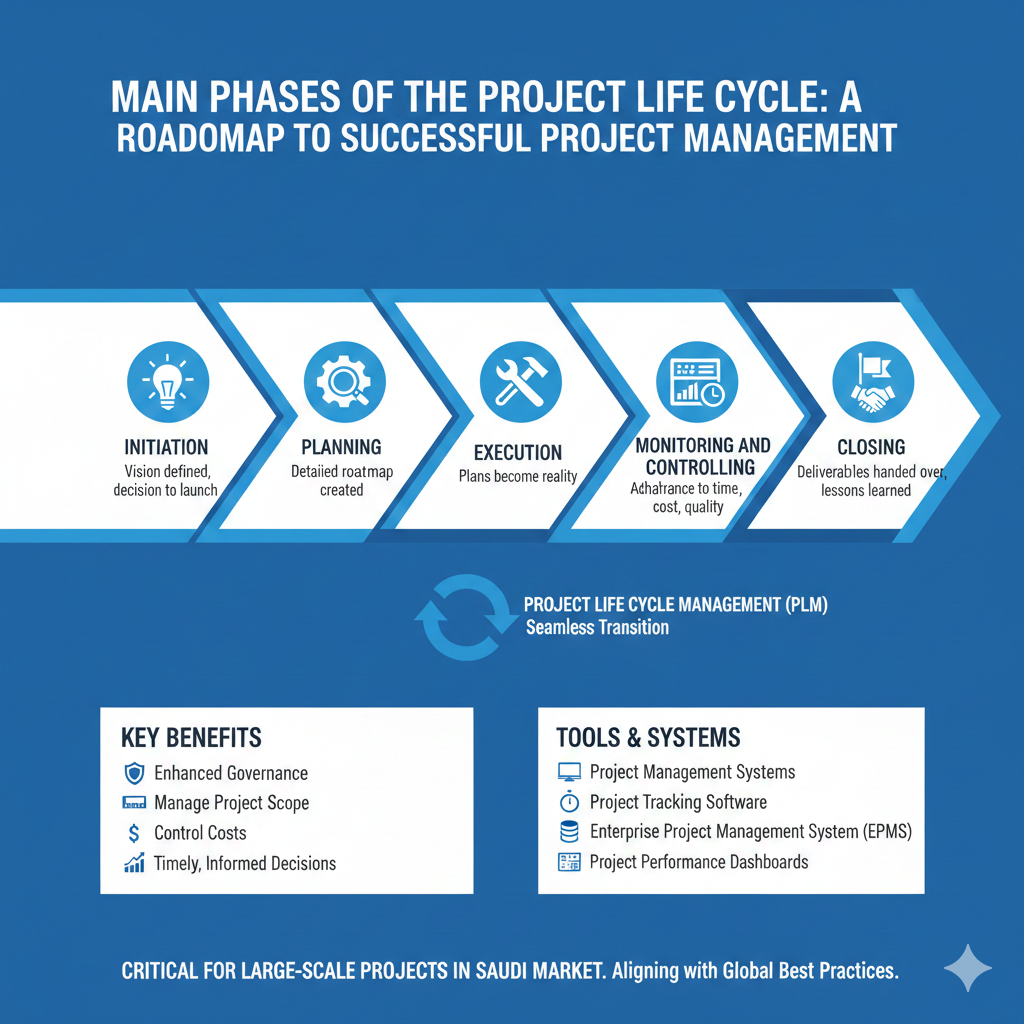
Main Phases of the Project Life Cycle: A Roadmap to Successful Project Management
The project life cycle consists of five interconnected phases that begin with Initiation, where the vision is defined, and the decision to launch the project is made. The cycle then moves to the Planning phase, where a detailed roadmap is created. This is followed by the Execution phase, where the plans are transformed into practical reality. The Monitoring and Controlling phase runs in parallel to ensure adherence to time, cost, and quality standards. Finally, the cycle concludes with Closing, where deliverables are handed over, results are documented, and lessons learned are gathered.
Project Life Cycle Management (PLM) relies on this structured progression to ensure a seamless transition between phases without gaps or improvisation. Each phase builds upon the output of the previous one, enabling the use of tools like project management systems and project tracking software to monitor performance and make timely, informed decisions.
In organizations implementing an Enterprise Project Management System (EPMS) or PMO system, this phase linkage helps enhance governance, manage project scope, and control costs through tools such as project cost control systems and project performance dashboards. This approach is particularly critical in the Saudi market for large-scale projects, where high clarity in planning, execution, and monitoring is necessary to achieve strategic objectives in line with global project management best practices.
Since successful project management depends not only on individual phases but on the integration of all stages, understanding each phase of the project life cycle is the first step in building an effective and sustainable project management system.
The Main Phases of the Project Life Cycle:
- Initiation
- Planning
- Execution
- Monitoring and Controlling
- Closing
Phase 1: Project Initiation – Setting the Foundation for Success
In this phase, the foundation is laid. The business case or project charter is prepared to explain the project's purpose and expected value, and the initial team gathers to assess the project. Key tasks include:
- Forming the Initial Project Team: Selecting the key personnel and assigning project sponsors who will support the project.
- Defining the Project Scope and Key Deliverables: Setting initial objectives and clearly defining what is included in the project and what is not (Scope Statement).
- Conducting a Feasibility Study: Gathering necessary information to verify the project's practical and financial feasibility, such as assessing resources, expected costs, and return on investment.
- Allocating Initial Resources and Budget: Estimating the project's budget and securing initial funding sources.
Best Practices:
- Clear Vision: Ensuring all stakeholders understand the project's goals from the start. It is advised that the project charter includes a clear definition of the project's purpose and expected value, allowing the team to receive the official "go-ahead" signal.
- Comprehensive Feasibility Study: Conducting an in-depth analysis covering both financial and technical aspects (such as ROI estimation) and confirming the availability of essential resources before proceeding. The appropriate analytical tools (such as Earned Value Management (EVM) or feasibility indicators) should be used to ensure the project is valuable and worth pursuing.
Phase 2: Planning – Turning Vision into Actionable Strategy
The planning phase focuses on transforming the project's approved vision into a detailed execution plan, specifying what will be done, how, when, with what resources, and at an acceptable level of risk. This phase lays the practical foundation that guides execution and will later serve as a reference for monitoring, controlling, and decision-making throughout the project's life cycle.
Key Tasks Include:
- Creating the Timeline and Defining Deadlines: Breaking down the project into smaller stages and developing a timeline (such as a Gantt chart) that defines start and end dates for key tasks.
- Allocating Resources: Identifying the human and material resources required for each activity, ensuring their availability according to the schedule.
- Setting the Budget: Estimating costs (including establishing the cost baseline) and balancing resources to ensure adherence to the financial framework.
- Identifying Risks: Recognizing potential risks and analyzing them (using tools like SWOT or Risk Matrix), with a plan to manage and mitigate their impact.
Best Practices:
- Use of Advanced Planning Tools: Utilizing Work Breakdown Structure (WBS) to break the project scope into manageable tasks, and employing techniques like PERT charts to estimate activity durations and identify the critical path.
- Comprehensive and Accurate Planning: Developing a clear and detailed project plan that includes the timeline, budget, and specific tasks with deadlines. Experts say, "Without a proper project plan, the project is doomed to fail before it even begins." Therefore, the plan should also include change management controls and proactive risk mitigation strategies.
- Choosing the Right Methodology: Selecting the most suitable planning approach for the project; traditional projects may benefit from the Waterfall methodology, while dynamic projects may leverage Agile methodologies. A recent study in Saudi Arabia found that Agile significantly improved project execution efficiency compared to Waterfall in many cases.
Phase 3: Execution – Turning Plans into Tangible Results
The execution phase focuses on turning the approved project plans into actual outcomes by managing teams and resources, carrying out tasks according to the defined schedule and budget, ensuring quality outputs, managing changes, and maintaining effective communication with stakeholders to guarantee that project goals are met as planned.
Key Tasks Include:
- Coordinating Teams and Managing Resources: Directing human resources and equipment to execute tasks, ensuring that each team member is clear about their responsibilities (the project manager assigns tasks clearly to team members).
- Tracking Performance: Monitoring the workflow daily using tracking tools (such as Gantt charts or Kanban boards) to ensure adherence to the schedule.
- Managing Changes: When changes in project requirements or work conditions arise, change requests must be documented, evaluated for their impact, and incorporated into the plan if necessary.
- Ensuring Quality: Monitoring the quality of outputs and applying quality management standards through regular reviews and tests to ensure that results meet stakeholder expectations.
- Communicating with Stakeholders: Maintaining continuous communication with sponsors and clients to ensure they understand progress, challenges, and manage their expectations.
Best Practices:
- Accurate Team and Task Management: As explained by ProjectManagement.com, successful execution involves managing the team, resources, tasks, risks, and communication.
- Using Advanced Tracking Tools: Such as Gantt charts, Key Performance Indicators (KPIs), and dashboards (like the Project Performance Dashboard). These tools help visualize project progress and provide a clear snapshot of the current status, facilitating quick corrective actions.
- Regular Progress Monitoring: Holding periodic meetings or using task management software like Slack or Trello for quick updates, which enhances collaboration and reduces delays.
- Quality Control and Continuous Improvement: Ensuring high-quality outputs by applying a continuous improvement approach (such as integrating feedback during execution) to immediately correct the course when necessary.
Phase 4: Monitoring and Controlling – Ensuring Your Project Stays on Track
The monitoring and controlling phase ensures that the project is progressing according to the approved plan in terms of schedule, cost, quality, and scope. It involves measuring performance with clear indicators, comparing actual results to planned ones, detecting deviations early, and taking corrective actions and managing changes systematically to keep the project on track towards achieving its objectives.
Key Tasks Include:
- Measuring Performance and Key Performance Indicators (KPIs): Collecting data on task progress and using indicators such as Schedule Performance and Cost Variance to measure adherence to the original plan.
- Managing Changes: When deviations in schedule, budget, or quality are identified, document them and take corrective actions (such as root cause analysis and plan adjustments) to bring the project back on track.
- Periodic Reviews and Reports: Holding status meetings and generating progress reports for sponsors and stakeholders to identify issues early and replan tasks when necessary.
- Controlling Project Scope: Ensuring that the work completed matches what was agreed upon in the original scope and managing any additional changes through a formal process.
Best Practices:
- Using KPIs: Defining clear indicators such as schedule performance, cost variance, and product quality to facilitate efficient progress monitoring.
- Earned Value Management (EVM): As recommended by PMI, EVM is a powerful measurement technique that provides advanced insights into the ratio of work completed to the expected costs. EVM helps predict budget or schedule overruns before they occur.
- Flexibility and Adaptation: Generating regular performance reports so that the plan can be adjusted immediately when obstacles arise, and ensuring resources are reallocated as needed to maintain project progress towards the goal.
Phase 5: Closing – Ensuring a Smooth Transition and Finalizing Success
The closing phase is all about formally and methodically wrapping up the project, ensuring that all tasks are complete, objectives are met, and final deliverables are handed over. It involves securing official approvals, documenting all project records, evaluating overall performance, and extracting valuable lessons learned to ensure that the project transitions smoothly to the operational phase without future risks.
Key Tasks Include:
- Delivering Outputs: Performing a formal handover of products or services to the client or operational team, ensuring all necessary documentation and instructions are available for continuity.
- Documenting the Project: Gathering all final documents (such as performance reports, records, and financial documents) and storing them in the project's information system to preserve knowledge.
- Project Review (Final Evaluation): Conducting a final meeting with the team and stakeholders to review what has been achieved, compare it with the planned goals, and analyze any deviations (Lessons Learned).
- Identifying Lessons Learned: Documenting both positive and negative outcomes during the project to spread the knowledge for future projects, helping improve project management practices.
- Releasing the Team: Ending contracts, distributing rewards, and acknowledging the team’s contribution, ensuring good relationships and freeing up resources for new projects.
Best Practices:
- Final Evaluation and Lessons Learned Methodology: It's advisable to conduct a thorough evaluation of project performance and document lessons learned as an essential part of the project closure. As management guides suggest, documenting lessons learned helps reuse knowledge and reduce time and cost in recurring projects.
- Securing Official Approval: Ensuring that key stakeholders sign off on the deliverables to avoid any future disputes or liabilities.
- Transitioning to Business As Usual: For technical or construction projects, training the operational team on the final deliverables and handing over necessary tools and data ensures continuity of operations and minimizes disruptions.
Conclusion: Project Life Cycle – The Difference Between Setbacks and Success
In a world where projects are accelerating and complexities are increasing, project management is no longer based on individual effort or quick reactions. It is now grounded in a clear methodology that starts from the idea and ends with delivery and evaluation. Through this guide, we've seen how the Project Life Cycle forms the practical framework that bridges vision and execution, transforming goals into measurable outcomes.
From project initiation and feasibility assessment, through meticulous planning, disciplined execution, continuous monitoring, to project closure and documenting lessons learned, it becomes clear that the success of any project is not achieved in a single phase. Rather, it is the result of the integration of all phases within a cohesive management system.
Whether you are managing a technical, construction, or operational project in the Saudi market, applying best practices in Project Life Cycle Management helps you:
- Reduce risks before they occur
- Control costs and timelines
- Enhance output quality
- Achieve project goals with confidence and sustainability
Ready to start managing your projects with a clear methodology? Visit Master Team today and explore the advanced project management solutions, including:
- P+ PMO Digital Solution: A comprehensive digital solution for project management that enhances the effectiveness of the executive office and helps track project progress while ensuring team coordination.
- S+ Strategy Digital Solution: A strategic digital solution that helps organizations develop long-term strategies and analyze data to support informed decision-making.
- Diwan Executive Office Solution: A tailored solution for executive offices that streamlines task and decision management, improving coordination and communication across teams.
Frequently Asked Questions:
1- What are the main stages of the Project Life Cycle?
The Project Life Cycle includes five main stages: Initiation, Planning, Execution, Monitoring & Controlling, and Closing. Each stage targets a specific set of tasks to ensure the project progresses in an organized manner.
2- How do I choose the right methodology for my project?
It depends on the project type. Projects with fixed and clear requirements may suit the traditional Waterfall methodology, while dynamic, rapidly changing projects benefit from flexible Agile methodologies.
3- Why is a feasibility study important in the first phase of the Project Life Cycle?
The feasibility study ensures that the benefits of the project outweigh its costs before it begins. It prevents wasting resources on non-viable projects and confirms that the project is ready for execution.
4- How can technology improve project management?
Through integrated project management systems (such as Microsoft Project or Asana), which provide real-time tracking, performance dashboards, and online collaboration tools that facilitate team coordination.
5- Why is continuous evaluation important during execution?
Continuous evaluation creates a feedback loop that allows for adjustments to changes. By regularly reviewing performance and providing status reports, managers can modify plans or reallocate resources as obstacles arise, keeping the project on track.