
⚠️ Today, organizations are not losing because of a lack of data… they are losing because of delays in interpreting that data and making the right decisions at the right time.
In a business environment filled with reports, meetings, and multiple disconnected systems, executive leaders face a critical challenge: How can they manage this massive volume of information and transform it into faster, more accurate decision-making before it is too late?
Even a minor delay in identifying an operational issue, unexpected changes in key performance indicators (KPIs), or a setback in a strategic project can quickly escalate into significant financial and operational losses.
💡 The problem is that most traditional AI tools still operate primarily in a reactive manner.
They answer questions and execute commands, but they do not think proactively, connect data across the organization, or take intelligent actions to protect workflows and improve outcomes before problems actually occur.
But imagine having an “AI Agent” inside your organization that operates as an intelligent digital brain and partner, working alongside your team and supporting decision-making in real time…
Most importantly, these systems have now evolved to support Arabic language capabilities and operate within local cloud environments that ensure data sovereignty and meet regulatory compliance requirements in Saudi Arabia.
📈 This is why businesses are no longer looking only for traditional Chatbots… Instead, they are increasingly adopting Agentic AI, the next generation of autonomous intelligent systems capable of reasoning, analyzing, planning, and executing actions as a true decision-making partner within the organization.
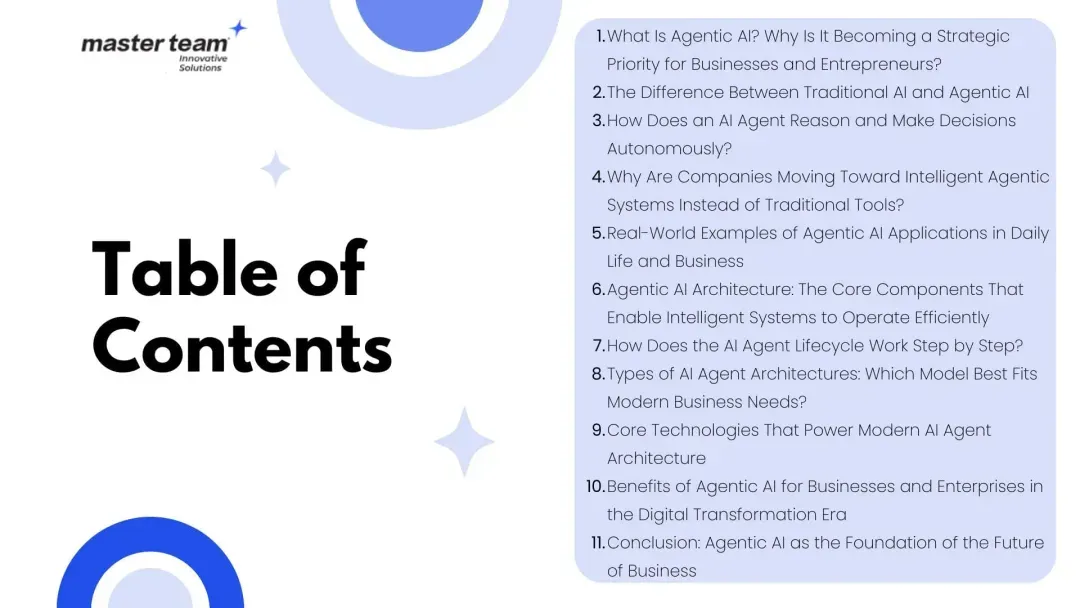
What Is Agentic AI? Why Is It Becoming a Strategic Priority for Businesses and Entrepreneurs?
Agentic AI represents a new generation of artificial intelligence systems designed to operate autonomously or semi-autonomously to achieve specific objectives without continuous human supervision.
These intelligent agents can proactively initiate actions, analyze data, and act proactively, unlike traditional AI systems that are restricted by predefined instructions.
According to IBM’s definition, agentic systems are characterized by “autonomy, goal-oriented behavior, and adaptability,” unlike traditional models that require constant human oversight and operate within predefined boundaries.
According to MIT Sloan research, modern agentic systems are capable of perceiving, reasoning, and acting independently.
In simple terms, the fundamental difference is that Agentic AI can independently initiate actions and execute tasks (such as reorganizing workflows or allocating resources), while traditional AI is limited to generating responses only when prompted.
One of the main reasons Agentic AI has gained significant attention among businesses and entrepreneurs is the substantial value it delivers across business operations.
Intelligent agents can transform massive amounts of complex data into practical recommendations and provide data-driven recommendations that support timely decision-making.
According to a joint survey by MIT Sloan and Boston Consulting Group, 35% of organizations had adopted intelligent agent technologies by 2023, while another 44% planned to implement them soon.
Experts consider Agentic AI a multi-billion-dollar opportunity across various industries.
In summary, businesses are moving toward Agentic AI because it enables more proactive and efficient operations, aligning with digital transformation objectives and Vision 2030’s emphasis on AI innovation.
The Difference Between Traditional AI and Agentic AI
The fundamental difference is that Agentic AI provides autonomy and proactive capabilities, while traditional AI remains a rule-based system operating within predefined limitations.
An AI agent can define objectives, plan actions, and execute tasks without waiting for direct human instructions.
According to reports from Master Team and IBM, agentic systems operate with a higher level of autonomy and adaptability, whereas traditional AI models require continuous human supervision and follow predefined behaviors.
In other words, traditional AI assistants (such as ChatGPT or Copilot) require explicit prompts to interact, while an intelligent agent can proactively initiate actions on its own after understanding its objectives, such as modifying a business plan or sending alerts without immediate human intervention.
How Does an AI Agent Reason and Make Decisions Autonomously?
An intelligent agent relies on a structured sequence of steps to collect information, analyze data, and make informed decisions autonomously.
Initially, the agent captures data from its operating environment through perception modules (such as language understanding and image processing), then interprets this data to identify the required goals and objectives.
Subsequently, the agent uses the reasoning engine to analyze data inputs and evaluate the best possible options through logic derived from advanced algorithms and machine learning techniques.
Based on this analysis, the agent develops an action plan and decides which actions should be executed.
This entire process takes place within the agent’s internal decision-making system without continuous human intervention.
It balances expected outcomes with available resources and may leverage deep neural networks and large language models (LLMs) to enhance its reasoning capabilities.
Software solutions such as Faris AI demonstrate how this works in practice:
The agent continuously monitors live project data, automatically reallocates tasks when needed, and proactively provides recommendations to managers based on the latest available insights.
Why Are Companies Moving Toward Intelligent Agentic Systems Instead of Traditional Tools?
Intelligent agentic systems provide higher business value compared to traditional tools because they can automate complex, multi-step processes, enabling faster, smarter, and more accurate decision-making.
Furthermore, agentic systems help significantly reduce operational costs by minimizing manual effort and accelerating task execution.
According to an MIT Sloan study, using intelligent agents in business processes can substantially reduce operational transaction costs, including the time and effort required for research, communication, and coordination.
They also enable organizations to complete end-to-end workflows through a single automated multi-step process.
In other words, an agent can understand and manage the full sequence of activities (from initial input to outcome) without requiring continuous monitoring.
For these reasons, companies are increasingly replacing traditional tools with agentic assistants because they:
Real-World Examples of Agentic AI Applications in Daily Life and Business
The applications of intelligent agents span a wide range of industries. In project management, for example, systems such as Faris AI (by MasterTeam company) automatically analyze execution data, project timelines, and risk indicators, helping teams maintain project progress and address delays early.
In strategic management, the agent predicts future KPIs performance, alerts leadership teams to potential risks before they escalate, and recommends corrective actions.
During executive meetings, the intelligent agent converts conversations into accurate Arabic transcripts, prepares approval-ready meeting minutes, and tracks the execution of decisions and tasks in real time.
In everyday life, intelligent agents can perform tasks such as automatically planning and booking trips.
The business sector is also adopting these technologies. For instance, companies such as Walmart are developing agents powered by large language models (LLMs) to personalize customer shopping experiences and automate back-office customer service operations.
These practical examples demonstrate how an intelligent agent can operate as a "copilot" within organizations. It interacts with internal systems (CRM, ERP, email, and calendars) to retrieve the required information, then uses the latest data to generate real-time recommendations and optimize workflows.
Agentic AI Architecture: The Core Components That Enable Intelligent Systems to Operate Efficiently
The architecture of an intelligent agent is built on a set of interconnected layers and core components that ensure system autonomy and operational efficiency.
It typically consists of a perception layer that collects inputs from the environment, a reasoning engine that processes this information to make decisions, and memory and continuous learning modules that store experience and continuously improve the agent's performance.
The architecture also includes a planning engine responsible for designing the steps required to achieve defined objectives, along with an action layer that translates the agent's decisions into actions.
Finally, the system incorporates integration mechanisms with external systems and APIs, enabling the agent to access databases and external services.
Together, the following layers work seamlessly to provide an autonomous intelligent system capable of continuous operation.
1. Perception Layer: How Does an AI Agent Understand Data and Inputs?
The perception layer serves as the AI agent's interface with the external environment, responsible for collecting, interpreting, and understanding diverse types of input.
In language-based agents, this layer includes Natural Language Understanding (NLU) components that interpret text and conversations, extract entities and user intent, and convert textual input into structured representations that can be processed by the system.
For AI agents embedded in physical devices, the perception layer may also incorporate computer vision systems for image recognition, speech recognition technologies, sensor data processing, and multimodal data fusion capabilities.
Advances in deep learning have significantly enhanced perceptual capabilities, enabling AI agents to accurately interpret complex and ambiguous inputs.
In essence, the perception layer provides the agent with the information on which all subsequent decisions are based.
It functions as the agent's "senses," enabling it to perceive and understand its operating environment.
2. Reasoning Engine: The Intelligence Behind Autonomous Decision-Making
The Reasoning Engine serves as the cognitive core of an AI agent, responsible for performing reasoning and inference to support autonomous decision-making.
It applies multiple reasoning approaches, including deductive, inductive, and abductive reasoning, to generalize from available information and derive meaningful conclusions.
Large Language Models (LLMs), such as GPT-4, enhance the agent's ability to perform multi-step reasoning.
However, these capabilities are often complemented by specialized task-specific modules that improve accuracy and reliability for individual use cases.
Once the reasoning process is complete, the decision-making components translate analytical outcomes into specific actions using utility-based decision logic, enabling the agent to select the actions most likely to achieve its intended objectives.
3. Memory and Continuous Learning: How Does an AI Agent Retain Knowledge and Continuously Improve?
An AI agent retains information and experience through a multi-layered memory architecture.
While executing tasks, it stores essential information in working memory to maintain context throughout the current workflow.
The agent also maintains the following:
This architecture enables the agent to maintain context across multiple interactions while continuously improving its performance.
In addition, the agent leverages multiple learning approaches to enhance its capabilities, ranging from supervised learning to improve performance through labeled examples to reinforcement learning for optimizing policies based on reward signals and unsupervised learning for discovering patterns within unlabeled data.
Microsoft also notes that effective feedback mechanisms (whether provided by other agents or through human involvement) are essential for improving the accuracy, reliability, and long-term performance of AI agents.
By combining memory with continuous learning, the agent becomes increasingly capable over time.
It learns from past mistakes, applies those experiences to future tasks, and continuously strengthens its autonomy, adaptability, and performance in dynamic environments.
4. Planning and Decision-Making Engine: How Does an AI Agent Determine the Best Steps to Achieve Its Goals?
The Planning and Decision-Making Engine is responsible for constructing hierarchical action plans that enable the agent to achieve its objectives.
These planning modules rely on advanced search algorithms to generate action sequences while anticipating the outcome of each step.
Depending on the use case, the agent may employ classical planning approaches such as the STRIPS algorithm, Hierarchical Task Networks (HTN), or tree-search algorithms such as Monte Carlo Tree Search (MCTS) to decompose high-level objectives into manageable subtasks.
This enables the agent to create dynamic and adaptive plans that automatically adjust when unexpected changes occur.
Such planning capabilities are particularly valuable for complex tasks that require coordination across multiple actions rather than simply reacting to immediate requests.
By planning, the agent can anticipate potential outcomes, identify the resources required for each stage, and make more informed decisions, ultimately improving the overall quality and effectiveness of its decision-making process.
5. Action Layer: How Does an AI Agent Turn Decisions into Real-World Actions?
The Action Layer is responsible for transforming the agent's intentions and plans into real-world actions. Once the AI agent makes a decision, this layer executes the corresponding actions.
For language-based agents, this may include generating text responses, asking users clarifying questions, or invoking application programming interfaces (APIs) to execute operations on external systems.
For physical or embedded agents, actions may involve controlling devices or modifying environmental variables.
Within this layer, the agent evaluates and selects the most appropriate actions based on expected utility, available resources, and safety constraints.
It often relies on a hierarchical execution structure that decomposes high-level objectives into a sequence of smaller executable steps.
A practical example of this integration is an AI agent that can access applications such as Teams or PowerPoint to perform administrative tasks on behalf of the user.
By integrating with external tools through APIs, the agent significantly extends its capabilities.
6. Integration with External Systems and APIs: Expanding the Capabilities of Intelligent Agents
Integration with external systems is a fundamental component of an AI agent's architecture, enabling it to communicate with databases and enterprise services to access contextual information and execute its assigned tasks more effectively.
For example, the agent can retrieve customer information from a CRM system, access HR data from an HR system, or retrieve scheduling data from Google Calendar through APIs.
This level of integration enables the agent to build a comprehensive understanding of the organization's operational context and process information in real time.
In summary, integration with external systems significantly enhances the agent's capabilities by providing access to a wide range of enterprise data and services, enabling more informed and comprehensive decision-making while improving the effectiveness of task execution.
How Does the AI Agent Lifecycle Work Step by Step?
The AI agent lifecycle operates through a continuous sequence of interconnected stages that begins with understanding its operating environment, followed by analyzing objectives, making decisions, executing tasks, and continuously learning from outcomes.
Rather than simply responding to commands, an AI agent follows an intelligent operational lifecycle that enables it to reason, plan, execute, and continuously improve its performance over time.
This lifecycle is built upon the AI agent architecture, which integrates the perception layer, the reasoning engine, the planning and decision-making engine, long-term memory, and self-learning mechanisms into a unified operating framework.
That is why agentic AI systems are considered significantly more advanced than traditional AI tools.
They operate within a continuous, dynamic execution loop that enables them to adapt to changing conditions and make autonomous decisions based on real-time data.
To better understand how an AI agent operates within enterprise environments and intelligent automation platforms, the following are the core stages of the AI agent lifecycle:
1. Collecting Data and Understanding the Operating Environment
The lifecycle begins by gathering data from the operating environment, including documents, emails, databases, key performance indicators (KPIs), voice commands, and natural language inputs.
At this stage, the AI perception layer transforms these inputs into structured data that can be analyzed, enabling the agent to develop an accurate understanding of the organization's operational context.
2. Interpreting Objectives and Automatically Prioritizing Tasks
Once the available data has been analyzed, the AI agent identifies the intended objectives and automatically prioritizes tasks based on task priority, associated risks, and available time.
To accomplish this, it relies on the reasoning engine to determine which actions should be executed first and evaluate the expected outcomes of each decision, improving the accuracy of intelligent decision-making systems across the organization.
3. Building a Dynamic Execution Plan
After understanding the objective, the AI agent creates an intelligent execution plan by decomposing the task into a sequence of connected, executable steps.
This stage relies on AI task planning techniques and autonomous AI planning algorithms, allowing the agent to dynamically adjust its execution plan whenever new information becomes available or priorities change during execution.
4. Executing Tasks and Monitoring Outcomes in Real Time
At this stage, the AI agent moves from reasoning to execution through the action layer, where it performs the required actions, such as sending alerts, updating enterprise systems, generating reports, or initiating AI workflow automation processes.
At the same time, the agent continuously monitors execution in real time to ensure execution remains aligned with the defined objectives and free from significant deviations.
5. Learning from Outcomes and Continuously Improving Performance
The final stage of the AI agent lifecycle is continuous learning.
The agent analyzes previous outcomes, identifies errors and weaknesses, and applies machine learning and reinforcement learning techniques to improve future decisions and optimize its behavior over time.
This continuous learning capability enables AI agents to become increasingly efficient over time while strengthening their ability to adapt to evolving business environments and the accelerating pace of digital transformation.
Types of AI Agent Architectures: Which Model Best Fits Modern Business Needs?
AI agent architectures vary according to their level of autonomy, decision-making approach, and ability to learn and adapt to their operating environment.
Some intelligent agents are designed to respond only to immediate situations, while others provide advanced capabilities such as planning, self-learning, and collaboration within multi-agent systems.
Each type of AI agent is designed for different operational scenarios, some are optimized for rapid automation, others for managing complex decision-making, while more advanced AI agents continuously learn and improve their performance over time.
Today, organizations rely on these architectures to build AI automation solutions and intelligent business systems that accelerate digital transformation, improve operational efficiency, and enable faster, data-driven decision-making across dynamic business environments.
To better understand how intelligent agent architectures are applied in practice, below are the most widely used types of AI agents in modern enterprises:
1. Reactive Agents: Optimized for Instant Response
Reactive Agents represent the simplest category of intelligent agents.
They operate according to a stimulus-response model without relying on long-term memory or future planning.
A reactive agent evaluates only the current state of its environment and immediately performs the appropriate action based on predefined rules.
Because of their speed and low computational complexity, reactive agents are commonly used in real-time automation, customer service, and operational applications that require immediate responses.
2. Goal-Based Agents: Designed to Achieve Specific Objectives
Goal-based agents are more advanced than reactive agents because they do more than simply respond to incoming events.
Instead, they pursue clearly defined goals through planning and informed decision-making.
A goal-based agent applies AI task planning techniques to evaluate available alternatives and select the optimal path toward the desired outcome.
As a result, these agents are widely used in project management systems, risk analysis, and business operations that require accurate, multi-step decision-making.
3. Learning Agents: Continuously Improving Through Experience
Learning agents are among the most advanced and adaptable types of AI agents because they continuously improve their performance by learning from data and previous experiences.
They leverage machine learning and deep learning to analyze past outcomes, identify errors and areas for improvement, and refine their decision-making strategies over time.
These agents are widely used in dynamic and complex environments such as autonomous driving, predictive analytics, and enterprise AI agents.
4. Multi-Agent Systems: Transforming Intelligent Automation
Multi-Agent Systems (also referred to as Multi-Agent Architecture) consist of multiple specialized intelligent agents working together within an interconnected and collaborative system, with each agent responsible for a specific function.
This architecture is transforming AI workflow automation by enabling complex business processes to be executed more efficiently and at greater scale than traditional single-agent systems.
5. Comparing the Most Common Types of AI Agents
Different types of AI agents vary in their levels of intelligence, autonomy, and adaptability. Reactive agents are best suited for fast, straightforward tasks, while goal-based agents excel at managing structured, multi-stage business processes.
Learning agents are the preferred choice for dynamic environments that require continuous improvement, whereas multi-agent systems offer the most powerful architecture for large enterprises that require end-to-end automation and intelligent collaboration among multiple autonomous agents.
Core Technologies That Power Modern AI Agent Architecture
Modern AI agent architecture is built on a combination of advanced technologies that work together to enable intelligent agents to perceive information, analyze context, make decisions, and execute tasks autonomously.
Rather than relying on a single technology, modern agentic AI systems combine Large Language Models (LLMs), machine learning, Natural Language Processing (NLP), intelligent memory, and AI automation technologies to create an integrated ecosystem capable of operating with intelligence that closely resembles human reasoning.
This technological integration enables AI agents to manage complex tasks, analyze large volumes of data, interact with users through natural language, and make accurate real-time decisions within modern business environments.
To better understand how agentic AI systems achieve this level of intelligence and autonomy, below are the core technologies that power them:
1. The Role of Large Language Models (LLMs) in AI Agents
Large Language Models (LLMs), such as GPT, Gemini, and Claude, serve as the cognitive foundation of modern AI agents.
They enable AI agents to understand human language, interpret context, and generate intelligent, contextually relevant responses.
LLM agents analyze vast amounts of textual data to acquire knowledge and perform multi-step reasoning. As a result, they can execute sophisticated tasks such as writing reports, analyzing meeting discussions, and supporting strategic decision-making.
2. How Machine Learning and Deep Learning Improve Decision-Making
Machine learning and deep learning play a central role in enabling AI agents to learn continuously and improve their performance over time.
By analyzing historical data and identifying hidden patterns and relationships, an AI agent can improve the accuracy of predictions and make increasingly intelligent decisions as it gains experience.
In addition, reinforcement learning enables intelligent agents to refine their decision-making strategies based on the principles of reward and penalty, making them more effective in dynamic and constantly changing environments.
3. The Importance of Natural Language Processing (NLP) for Understanding Human Instructions
Natural Language Processing (NLP) is one of the core technologies behind agentic AI, enabling AI agents to understand and interact with human language naturally.
NLP systems use text analysis, intent recognition, command classification, and sentiment analysis to accurately interpret user requests, even when users communicate using conversational language or regional dialects.
In the Saudi market in particular, this technology is especially valuable for solutions such as Faris AI, which can understand both Modern Standard Arabic and the Saudi dialect during meetings and when analyzing executive committee meeting minutes.
4. Using Knowledge Graphs and Long-Term Memory to Improve AI Agent Performance
Agentic AI systems rely on knowledge graphs and long-term AI memory to store, organize, and connect information in a structured manner.
This enables AI agents to preserve context, recall previously stored information, and continuously improve the quality of their decisions over time.
These technologies also support the development of autonomous AI systems capable of retrieving relevant knowledge efficiently while executing complex tasks or analyzing operational data.
5. The Role of Automation and RPA in Executing Complex Tasks
Intelligent automation technologies and Robotic Process Automation (RPA) serve as the operational bridge between AI agents and enterprise systems.
Through AI workflow automation, AI agents can execute multi-step processes automatically, including document processing, sending reports, database updates, and operational task management, without continuous human intervention.
This is why smart automation solutions and enterprise AI agents have become strategic tools for accelerating business operations, reducing operational errors, and improving organizational efficiency.
Ultimately, the strength of modern AI agent architecture does not come from any single technology but from the seamless integration of LLMs, machine learning, NLP, RPA, and knowledge graphs.
Together, these technologies enable AI agents to reason, learn, plan, and execute tasks autonomously, positioning agentic AI as a foundational pillar of future digital transformation and intelligent business systems.
Benefits of Agentic AI for Businesses and Enterprises in the Digital Transformation Era
Agentic AI delivers significant strategic value to modern businesses and enterprises because it functions as far more than a conventional technology tool.
AI acts as an intelligent partner capable of analyzing data, making decisions, and executing tasks autonomously.
As digital transformation accelerates and organizations become increasingly data-driven, AI agents have become one of the most important technologies for improving operational efficiency, reducing costs, and enhancing the quality of decisions and services.
Today, organizations rely on AI automation solutions and enterprise AI agents to accelerate business processes, transform complex data into actionable insights, and automate multi-step workflows without requiring continuous human intervention.
To better understand the business impact of Agentic AI, the following are some of the most significant benefits these intelligent systems deliver to modern enterprises:
1. Reducing Operational Costs While Significantly Increasing Productivity
AI agents automate repetitive and complex tasks, reducing reliance on human intervention and significantly lowering operational costs.
Instead of spending long hours on routine activities, an AI agent can execute processes faster and with greater accuracy, including order processing, data analysis, report generation, and operational task management.
This allows employees to focus on higher-value strategic initiatives, increasing overall organizational productivity while improving the efficiency of business teams.
2. Enhancing Customer Experience Through Intelligent Personalization
Agentic AI enhances customer experience by delivering intelligent, personalized interactions based on a deep understanding of user behavior and individual needs.
AI agents can communicate with customers using natural language, provide personalized recommendations, respond instantly to inquiries, and analyze potential issues before they require escalation.
This leads to higher customer satisfaction and stronger brand loyalty.
As a result, AI-powered customer service solutions have become one of the most valuable applications of intelligent agents across eCommerce platforms and service-oriented organizations.
3. Accelerating Decision-Making with Real-Time Data and Analytics
One of the greatest strengths of agentic AI systems is their ability to analyze data in real time and convert it into immediately actionable recommendations and decisions.
Rather than waiting for manually prepared reports or traditional analytical processes, an AI agent can continuously monitor key performance indicators (KPIs), analyze risks, and predict potential future issues in real time.
This makes intelligent decision-support systems an essential capability for executive leadership, project management offices (PMOs), and organizations that depend on speed, accuracy, and data-driven decision-making.
4. Automating Complex Business Processes While Minimizing Human Intervention
Agentic AI excels at executing multi-stage AI workflow automation without requiring continuous human supervision.
An AI agent can manage an end-to-end sequence of operational activities, including document processing, task scheduling, system updates, communicating with teams, and integrating data across enterprise systems through API integration.
This level of automation reduces human error, accelerates execution, and enables organizations to manage complex operations with greater efficiency, consistency, and operational resilience.
5. How Does an AI Agent Strengthen an Organization's Competitive Advantage?
Agentic AI gives organizations a powerful competitive advantage by accelerating innovation, improving decision quality, and responding more quickly to changing market conditions.
Organizations that leverage intelligent business systems and autonomous AI agents can adapt more quickly to change, deliver superior customer experiences, reduce operational waste, and make more accurate, data-driven decisions.
Conclusion: Agentic AI as the Foundation of the Future of Business
In conclusion, this overview demonstrates that Agentic AI represents a significant leap forward in intelligent technologies.
Built on an architecture that integrates perception, analysis, memory, and execution, AI agents can operate with a high degree of autonomy continuously.
We also explored how the AI agent lifecycle progresses through a structured sequence of stages, from input processing and planning to execution and continuous learning.
We also examined how different AI agent architectures (ranging from reactive agents and learning agents to multi-agent systems) enable organizations to address different business requirements based on the complexity and scale of their operations.
When this architecture is combined with advanced technologies such as large language models (LLMs), deep learning, natural language processing (NLP), and robotic process automation (RPA), AI agents become significantly more intelligent, adaptable, and capable.
As a result, organizations gain tangible benefits from reducing operational costs and improving efficiency to enhancing customer experiences and accelerating decision-making.
As the adoption of Agentic AI continues to expand across large enterprises, this new generation of intelligent systems is expected to become a core pillar of digital business transformation.
By aligning with local data sovereignty and data protection requirements, such as those in Saudi Arabia, while supporting the Arabic language and regional dialects, Agentic AI is well positioned to become a trusted partner in advancing digital transformation initiatives and achieving the objectives of Saudi Vision 2030.
Understanding AI agent architecture and how AI agents operate is the first step for any organization seeking to adopt this transformative technology and build a sustainable competitive advantage.
🚀 Is Your Organization Ready to Move from Reactive Operations to Proactive Intelligence?
Today's leading organizations no longer rely solely on traditional reports or limited automation tools.
Instead, they are looking for an intelligent decision partner that can analyze information, generate predictive insights, and execute tasks autonomously.
With Faris AI from Master Team, your organization can build a smarter and more efficient operating environment through:
Frequently Asked Questions
1. What Is the Difference Between Faris AI and Faris OS?
Faris AI is an Agentic AI solution designed to support decision-making within Master Team platforms, including +P for project management, +S for digital strategy management, and Diwan for executive office management.
It analyzes business data, delivers intelligent recommendations, and executes automated actions.
Faris OS, on the other hand, is a unified intelligent operating system that connects all enterprise platforms (ERP, CRM, email, calendars, and other business applications) through a single interface.
It enables users to access information and complete tasks using natural language without switching between multiple applications.
2. How Does Agentic AI Support Project Management?
Agentic AI serves as an intelligent assistant for project teams by continuously monitoring live project data, including progress, resource utilization, and project risks.
Whenever project conditions change, it can recommend or initiate the redistribution of tasks and resources, analyze project schedules and risk indicators to identify potential issues early, and suggest corrective actions. This helps projects stay on track while reducing delays before they become costly.
3. What Is Agentic AI and How Is It Different from a Chatbot?
Agentic AI is an autonomous system designed to pursue defined objectives by proactively executing complex actions to achieve them.
A traditional chatbot, by contrast, is a reactive conversational assistant that performs tasks only when prompted by a user (such as answering questions or generating text) and does not initiate actions independently.
4. Can Agentic AI Generate Meeting Minutes in the Saudi Dialect?
Yes. For example, Faris AI is integrated into the Diwan platform for executive committee management, where it converts meeting discussions into accurate Arabic transcripts.
Thanks to its ability to understand both Modern Standard Arabic and Saudi dialects with high accuracy, Faris generates intelligent meeting minutes while incorporating the required local terminology.
5. What Is the Best AI Assistant for Executive Committee Meetings?
Faris AI is one of the leading solutions in this area. Built into the Diwan platform, it helps executive committees manage meetings more efficiently by converting discussions into Arabic text, generating draft meeting minutes ready for approval, and tracking the execution of decisions and action items in real time.
6. How Can I Predict KPI Performance Before It Falls Behind?
An AI agent can analyze both historical and current performance data and apply predictive models to forecast KPI performance before the results materialize.
For example, Faris AI uses advanced analytics within the +S strategy management platform to predict Key Performance Indicators (KPIs) before actual results are realized.
7. Is My Data Secure When Using AI?
Yes, provided the appropriate solutions are implemented. For example, Faris AI is designed to operate entirely within a Saudi-based cloud environment to preserve data sovereignty.
Agentic AI systems such as Faris also comply with national regulations, including the Personal Data Protection Law (PDPL), as well as the requirements of regulatory authorities such as SDAIA, NCA, and SAMA, ensuring both security and regulatory compliance.
8. What Are the Advantages of Saudi-Built AI Compared to Global Solutions?
Saudi-developed AI solutions such as Faris AI are specifically designed to address the requirements of the local market.
Faris was developed entirely in Saudi Arabia and operates on a local cloud infrastructure to ensure data sovereignty.
It also supports Modern Standard Arabic and the Saudi dialect with a high degree of accuracy, enabling it to understand local business communications, such as meetings conducted in Gulf dialects, and deliver culturally relevant recommendations.
9. How Does Agentic AI Support Strategic Goal Management?
Agentic AI helps organizations align and manage strategic objectives through continuous analysis of performance indicators.
For example, within the +S platform, Faris AI links strategic objectives to initiatives, predicts their outcomes by forecasting key performance indicators (KPIs), and recommends corrective actions whenever objectives are at risk.
10. How Does Agentic AI Work Through WhatsApp and Email?
AI agents can be integrated with enterprise communication channels such as WhatsApp and email.
For example, Faris OS enables users to interact with the AI agent directly through WhatsApp to receive instant recommendations and responses.
It can also connect to the user's email account, monitor incoming emails, suggest appropriate replies, and associate email threads with related tasks within the same platform.