
🚨 Imagine that your company’s biggest loss in the coming years… will not come from competitors, but from slow decision-making and the growing number of tasks that are still managed manually while the world moves at the speed of AI.
Today, the challenge for enterprises is no longer the lack of data… but the ability to understand it, connect it, and make the right decisions from it at the right time.
Meetings continue to pile up, systems become increasingly fragmented, teams operate in silos, and executives face daily pressure trying to monitor operational details and make fast decisions amid overwhelming amounts of information.
⚠️ This is where a reality that leading companies have already recognized becomes clear: most traditional AI tools, including chatbots, still operate based on a reactive model: wait for a question, then provide an answer.
They are effective tools for conversations and customer service, but they do not think, plan, or take proactive actions to solve problems before they occur.
But today… a completely new era has begun.
An era of intelligent systems capable of operating as a digital executive partner within the enterprise, understanding objectives, monitoring performance, analyzing data, and taking intelligent actions autonomously.
This is where the concept of Agentic AI emerges, a transformative shift that represents one of the biggest transformations in the future of intelligent automation and modern business operations.
Imagine having an intelligent system inside your organization that can:
🤖 Anticipate project delays before they occur and suggest immediate solutions.
📊 Analyze KPIs and risks in real time without human intervention.
⚡ Execute automated operational actions to accelerate execution and improve efficiency.
📝 Transform meetings into decisions, tasks, and actionable reports.
🔔 Send proactive alerts to management whenever critical deviations occur.
🔗 Connect enterprise systems and data into a unified dashboard that supports decision-making.
📈 Increase productivity and reduce operational costs through intelligent automation.
🧠 Continuously learn from data and outcomes to become more efficient over time.
This is exactly why companies today are moving beyond traditional chatbots and investing in Agentic AI as the future of intelligent enterprises and true digital transformation.
In the Saudi market specifically, advanced technology companies such as Master Team and Faris AI have started delivering advanced agentic AI solutions designed to support executive management, Project Management Offices (PMOs), and operational teams while aligning with Saudi market requirements and Vision 2030 objectives.
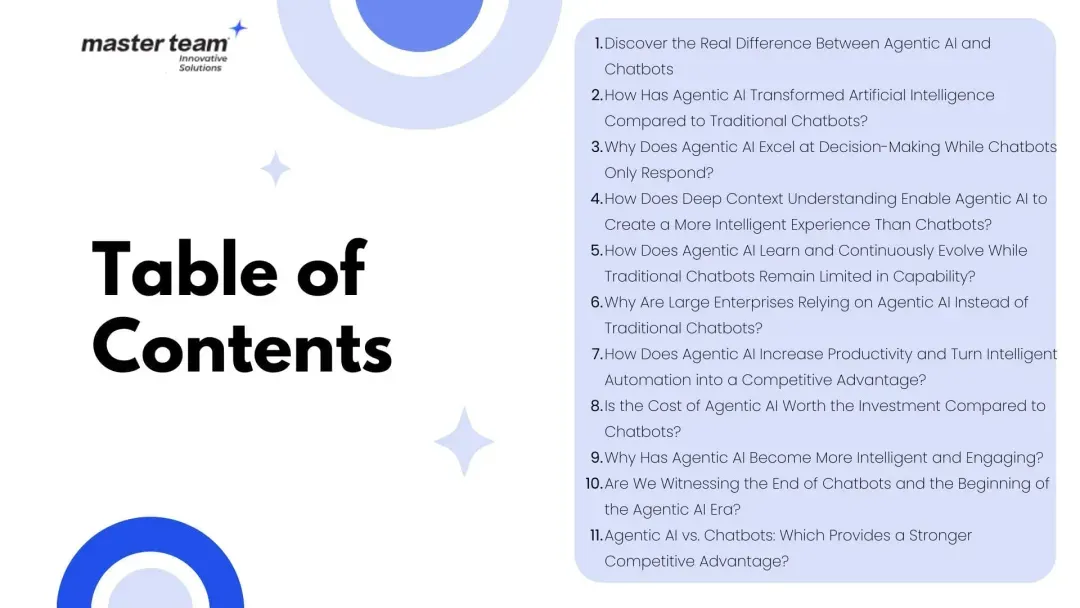
Discover the Real Difference Between Agentic AI and Chatbots and Why Smart Companies Are Moving Toward Agentic Systems
The real difference between Agentic AI and chatbots lies in one fundamental distinction: chatbots provide answers, while Agentic AI thinks, plans, and executes.
With the rapid advancement of technology, relying solely on traditional chatbots is no longer sufficient for companies seeking faster growth and higher operational efficiency.
While chatbots operate by following predefined instructions to answer questions and perform simple tasks, Agentic AI represents a new generation of artificial intelligence systems capable of understanding objectives, analyzing data, making decisions, and executing processes autonomously without continuous human intervention.
Today, intelligent companies are no longer looking only for conversational tools or customer service solutions, they are seeking intelligent systems capable of managing operations, enhancing productivity, and transforming data into informed decisions that drive growth and business expansion.
This is where the fundamental difference between traditional chatbots and agentic AI systems becomes clear:
Chatbots operate on a question-and-answer model, whereas agentic AI operates on a model built around understanding, planning, and execution.
This positions them as the future of intelligent automation within modern enterprises, especially in business environments that rely on speed, accuracy, and real-time decision-making.
A Comprehensive Comparison Between Agentic AI and Chatbots:
How Has Agentic AI Transformed Artificial Intelligence Compared to Traditional Chatbots?
Agentic AI has transformed artificial intelligence from a reactive tool focused on responses into an intelligent system capable of reasoning and executing tasks autonomously.
Traditional chatbots rely on predefined instructions and rules, which limit them to answering questions or performing simple tasks within predefined scenarios.
Chatbots operate through a reactive approach, meaning they wait for user requests and provide predefined responses without deep contextual understanding or the ability to make decisions.
In contrast, Agentic AI follows a fundamentally different approach, leveraging advanced machine learning and data analysis technologies to understand objectives, plan, and execute tasks independently.
AI does not simply wait for commands, it can analyze information, detect problems, recommend solutions, and take automated actions.
This is why Agentic AI is considered the next generation of intelligent automation.
AI transforms artificial intelligence from a supporting tool into a digital partner capable of reasoning, decision-making, and improving productivity across organizations.
Why Does Agentic AI Excel at Decision-Making While Chatbots Only Respond?
Agentic AI outperforms chatbots because it can analyze data, interpret information, and make autonomous decisions, while chatbots remain limited to executing commands and responding to questions.
Traditional chatbots rely on direct instructions and predefined scenarios, making their primary role limited to providing quick answers or performing simple tasks within a restricted scope.
Despite being effective for customer service and handling frequently asked questions, they lack the ability to understand the complete business context or analyze different variables to make intelligent decisions.
Agentic AI, on the other hand, continuously analyzes data to understand objectives, identify patterns, and predict potential issues before they occur. It does not simply respond.
AI can recommend solutions and take automated actions based on available data and the broader business context.
Additionally, Agentic AI stands out for its ability to continuously learn and adapt from new outcomes, making it more accurate and efficient over time.
This is why modern enterprises are adopting Agentic AI systems for intelligent automation and business operations management, as they reduce reliance on human intervention, accelerate decision-making, and significantly improve productivity.
How Does Deep Context Understanding Enable Agentic AI to Create a More Intelligent Experience Than Chatbots?
Agentic AI delivers a more intelligent experience because it understands the full context of conversations and business operations, while chatbots only understand a limited part of the interaction.
Traditional chatbots rely on short-term and limited conversational context, which means they often lose previous details or fail to connect related information.
This makes them suitable for quick responses and frequently asked questions but limits their ability to handle complex conversations or long-term tasks.
Agentic AI, on the other hand, has advanced contextual understanding and powerful data analysis capabilities, allowing it to retain previous interactions and connect them with current data and tasks.
Instead of treating each question separately, it understands the overall objective and business context before taking action or providing a response.
Agentic AI is also distinguished by its ability to efficiently manage multi-step tasks.
AI analyzes the final objective, breaks it down into multiple stages, and intelligently executes each step across different systems and tools.
This is why users perceive Agentic AI as an intelligent partner that understands their needs and real business context, rather than just a chatbot providing predefined responses without a deep understanding of the details.
Agentic AI Does Not Just Respond… It Executes End-to-End Processes
The fundamental difference is that chatbots provide answers, while agentic AI executes complete business tasks and processes autonomously.
Traditional chatbots are limited to answering questions or executing simple commands within predefined boundaries, such as responding to customer inquiries or scheduling basic appointments.
However, they cannot transform conversations into complete operational actions or manage processes from start to finish.
Agentic AI, in contrast, operates as an intelligent autonomous system capable of executing practical business tasks rather than simply engaging in text-based interactions.
AI can analyze requests, break them down into actionable steps, execute the required processes, and automatically monitor outcomes without requiring continuous human intervention.
It can also manage complex multi-step tasks such as marketing campaigns, operational processes, or project management activities with high efficiency.
This is what makes Agentic AI a transformative shift in intelligent automation.
It does not turn artificial intelligence into just a conversational tool.
Instead, it transforms it into a practical system capable of executing business tasks, increasing productivity, and reducing operational time and costs within modern enterprises.
How Does Agentic AI Learn and Continuously Evolve While Traditional Chatbots Remain Limited in Capability?
Agentic AI stands out for its ability to continuously learn and evolve through interactions, while traditional chatbots remain limited by the predefined scenarios and rules they were originally programmed with.
Traditional chatbots rely on fixed responses and predefined rules, which means their capabilities remain limited unless they are manually updated or new scenarios are added.
They can only perform the tasks they were explicitly programmed to execute, but they do not learn from previous interactions or autonomously improve their performance over time.
Agentic AI, on the other hand, leverages continuous learning, data analysis, and ongoing evaluation of outcomes, allowing it to improve performance and make more accurate decisions with every new interaction.
When it completes a task or provides a recommendation, it analyzes the results and automatically adjusts its strategies to improve future performance.
Agentic AI is also highly capable of adapting to changing conditions and dynamic workflows, enabling it to handle new challenges and discover different solutions without requiring reprogramming every time.
This is what makes Agentic AI more effective and adaptable in the long term, as it evolves alongside business growth and increasing operational complexity.
At the same time, traditional chatbots remain limited in capability and heavily dependent on manual updates and continuous human intervention.\
Why Are Large Enterprises Relying on Agentic AI Instead of Traditional Chatbots?
Large enterprises are adopting Agentic AI because it goes beyond customer service and automated responses. It helps manage operations, analyze data, and make intelligent decisions autonomously.
Traditional chatbots are primarily used for simple tasks such as answering customer inquiries, providing technical support, or automating repetitive conversations.
Although they are effective in improving communication speed and reducing pressure on customer service teams, their capabilities remain limited when it comes to deep analysis or complex business operations.
Agentic AI, on the other hand, provides a more advanced level of intelligence and automation.
It can analyze data from multiple departments across the organization, understand operational objectives, and make decisions that improve performance and increase efficiency.
In the Saudi market, companies are increasingly moving toward Agentic AI solutions in alignment with digital transformation initiatives and Saudi Vision 2030, especially with the emergence of advanced systems such as Faris AI by Master Team.
These solutions are designed to support executive teams, enhance decision-making, and improve productivity within organizations.
For this reason, large enterprises are no longer looking only for chatbots that answer questions but for autonomous AI systems that act as intelligent partners capable of supporting planning, analysis, execution, and creating a true competitive advantage.
How Does Agentic AI Increase Productivity and Turn Intelligent Automation into a Competitive Advantage?
Agentic AI increases productivity by transforming automation from simple task execution into intelligent, autonomous management of end-to-end business processes.
Traditional chatbots are limited to automating responses and handling simple, repetitive tasks, while agentic AI can manage complex, multi-step operations without continuous human intervention.
This means companies no longer need to dedicate significant time to manually monitoring operational details, as Agentic AI can track performance, analyze data, and autonomously execute data-driven actions.
It can also manage workflows across the organization and connect different systems to improve efficiency and reduce operational errors.
More importantly, Agentic AI systems operate continuously, helping companies accelerate execution, reduce operational inefficiencies, and enable faster decision-making.
By reducing repetitive tasks, teams can focus more on innovation and development rather than routine operational work.
This is where intelligent automation becomes a true competitive advantage, enabling companies to increase productivity, reduce operational costs, and achieve faster growth in the modern business environment.
Is the Cost of Agentic AI Worth the Investment Compared to Chatbots?
Yes, although Agentic AI requires a higher investment compared to traditional chatbots, it delivers greater long-term value by increasing productivity and reducing operational costs.
The development and implementation cost of chatbots is typically lower because they rely on predefined scenarios and specific instructions to perform simple tasks such as responding to customer inquiries or automating basic conversations.
Therefore, they are a suitable option for companies looking for a quick and cost-effective solution.
Agentic AI, on the other hand, requires greater investment because it relies on advanced technologies such as deep learning, data analysis, and integration with different enterprise systems.
However, it delivers significantly higher value because it does not function merely as a conversational tool.
Instead, it operates as an intelligent system capable of managing operations, making decisions, and continuously improving performance.
This directly contributes to lower costs and increased productivity over time.
For this reason, chatbots may be a suitable choice for limited tasks, but companies seeking long-term growth and advanced intelligent automation recognize that investing in Agentic AI provides greater value and creates a sustainable competitive advantage.
Smart User Experience: Why Has Agentic AI Become More Intelligent and Engaging?
Agentic AI delivers a more intelligent and engaging experience because it deeply understands users and interacts with them in a personalized way, while chatbots remain limited to predefined responses.
Traditional chatbot experiences rely on fixed scenarios, which can sometimes make interactions feel automated and inflexible, especially when the conversation tone changes or the issue becomes more complex.
Traditional chatbots provide predefined answers without truly understanding user emotions or the user's complete context.
While Agentic AI delivers a completely different experience because it can analyze the user’s tone, intent, and interaction context, allowing it to personalize responses and behavior with greater accuracy and intelligence.
If it recognizes that a user is dissatisfied or frustrated, it can respond in a more human-like way by showing empathy and providing the most suitable solution.
Agentic AI is also distinguished by its ability to remember previous user interactions, enabling it to provide personalized recommendations and solutions that align with user needs and behavior.
This creates the impression that the system truly “understands” users rather than simply functioning as an automated response tool.
Through this deep personalization and intelligent interaction, the user experience is significantly enhanced, leading to higher satisfaction and stronger customer loyalty. This is what makes Agentic AI more engaging and effective compared to traditional chatbots.
Are We Witnessing the End of Chatbots and the Beginning of the Agentic AI Era?
We are not witnessing the end of chatbots but rather a transition toward a new era driven by agentic AI, while chatbots continue to handle simple tasks.
Chatbots are unlikely to disappear completely. Instead, their role will become more focused on limited tasks such as customer service and responding to routine inquiries.
The next major evolution in artificial intelligence is moving toward agentic AI as the next generation of systems capable of reasoning, making decisions, and executing tasks autonomously.
In the near future, companies will rely on a hybrid model that combines both technologies. Chatbots will be used for fast and direct customer interactions, while agentic AI will handle more complex tasks such as analysis, planning, and operational process management.
This transformation does not mean replacing chatbots, but rather redefining their role within a broader ecosystem of advanced AI systems designed to improve efficiency and enhance business performance.
Therefore, Agentic AI can be considered the primary driver of the future of intelligent automation, while chatbots will remain a supporting element within this evolving ecosystem.
Agentic AI vs. Chatbots: Which Provides a Stronger Competitive Advantage?
The true competitive advantage depends on your business goals: chatbots are suitable for simple tasks, while agentic AI enables intelligent growth and operational transformation.
If your business goal is limited to improving customer service, responding to frequently asked questions, and automating routine tasks, chatbots are an effective and cost-efficient option with faster deployment.
However, if your goal is to build a true competitive advantage driven by intelligence, speed, and effective decision-making, Agentic AI is the stronger choice.
AI does not simply interact with users, it can think, plan, and execute processes autonomously, significantly improving operational efficiency and accelerating business growth.
In short, chatbots improve communication, while agentic AI reshapes how businesses operate and provides them with greater capabilities to compete in the modern business environment.
Conclusion: From Conversational Tools to Decision-Driven Systems… Where Is Artificial Intelligence Really Heading?
The difference between agentic AI and chatbots is no longer just about how they respond or interact, it has become a difference in the role artificial intelligence plays within organizations.
Chatbots continue to play an important role in improving communication, customer service, and providing quick responses, but they remain limited by predefined scenarios and reactive interactions.
In contrast, Agentic AI represents a fundamental shift toward systems that not only understand but also analyze data, make decisions, and execute tasks autonomously within the business environment.
This transformation means that artificial intelligence is no longer just a supporting tool, it has become an integral part of operational workflows and decision-making processes within modern enterprises.
With the acceleration of digital transformation, the question is no longer: Do we need artificial intelligence? But rather, what level of artificial intelligence do we need to achieve real growth and a sustainable competitive advantage?
The companies that will lead in the coming years will not be those using more tools but those building smarter systems capable of thinking, executing, and continuously improving.
🚀 Start Your Intelligent Transformation with Master Team and Faris AI
If you are looking to move your company from traditional automation to real intelligent operations, the solutions provided by Master Team (such as +P for project management, +S for digital strategies, and Diwan for executive offices) represent a strategic starting point toward this future.
One of the most prominent solutions is Faris AI, designed to help organizations:
- Improve data-driven decision-making
- Automate complex operational processes
- Enhance performance efficiency and reduce waste
- Support executive management with real-time analytical insights
Frequently Asked Questions About the Difference Between Agentic AI and Chatbots
1. Is Agentic AI considered an advanced version of chatbots?
No, Agentic AI is not simply an advanced version of chatbots. The fundamental difference is that chatbots rely on predefined rules and fixed conversational scenarios, limiting their role to responding to inquiries within a restricted context.
Agentic AI, on the other hand, is an autonomous system that uses machine learning to pursue objectives, analyze data, and take actions without requiring detailed instructions.
2. What are the main benefits of Agentic AI for businesses?
The main benefits of Agentic AI lie in improving efficiency and reducing human intervention.
It can automate complex multi-step processes and continuously oversee workflows, helping organizations manage larger operations without requiring significant additional hiring.
3. Can a chatbot be developed into an Agentic AI system?
Transforming a chatbot into an autonomous AI agent system is a significant technical challenge. Traditional chatbots are built on fixed conversational rules and limited architectures, and they cannot inherently self-learn or deeply integrate with enterprise data systems.
In contrast, agentic AI is built on large language models (LLMs) and advanced analytical algorithms that require a fundamentally different architecture.