
🚀 Imagine your organization holds dozens of meetings every month, where critical decisions are discussed, only for half of those decisions to fade away without execution!
The shocking reality is that executives spend nearly 37% of their time making decisions, but over 50% of this time is wasted due to unclear responsibilities and poor follow-up and transparency (TeamGantt).
Since the rise of institutional governance requirements and digital transformation, the real challenge is no longer holding more meetings, but answering a far more important question:
Why don’t meetings turn into results? And why do decisions remain trapped in meeting minutes?
📊 With institutions, especially in Saudi Arabia, focusing on boosting operational efficiency and achieving the goals of Saudi Vision 2030 in governance and institutional performance (Asharq Al-Awsat), Executive Office Management has become a strategic necessity, not just an organizational choice. It enables institutions to:
- Turn decisions into actionable tasks
- Set clear responsibilities and prevent lost outputs
- Accelerate execution and boost executive productivity
- Link meetings directly to strategic goals
💡 In short… the corporate world no longer rewards those who hold more meetings, but those who transform every meeting into a measurable result.
The question that will change the way your organization works is:
Will your executive office remain just a meeting hub, or will it become a true driver of achievement?
🎯 Give me a few minutes of your time, and I’ll show you how modern Executive Office Management, supported by digital systems, can truly take you from meetings… to results.
How Executive Office Management Transforms Meetings into Real Productivity
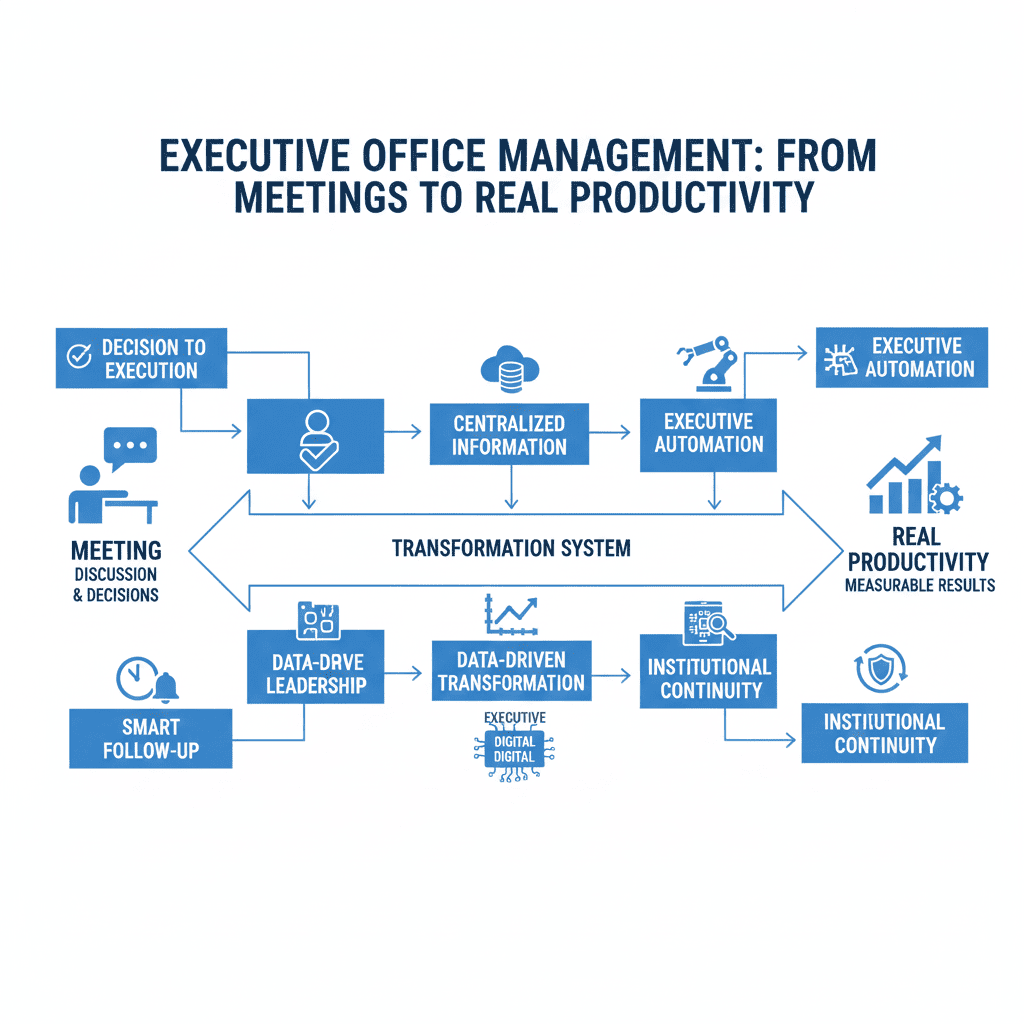
Executive Office Management turns meetings into real productivity when it shifts the organization from merely discussing decisions to systematically implementing them. This transformation is achieved through clear responsibilities, smart follow-up, centralized information, data reliance, automation, institutional continuity, and executive digital transformation. Productivity is not achieved by holding more meetings, but by ensuring that every decision made in a meeting is converted into a measurable result in the real world.
In practice, the problem begins when meetings end without a clear framework for the post-meeting process: Who is responsible? What is the timeline? How will follow-up occur? This is where Executive Office Management comes in as a comprehensive governance and operational system. It doesn’t just document what was said; it links every decision to a clear execution path.
Using frameworks like the RACI Framework, the responsible (Responsible), accountable (Accountable), consulted (Consulted), and informed (Informed) parties for each decision are defined. This eliminates organizational ambiguity and prevents role conflicts. Modern digital systems support this transformation by converting meeting outcomes directly into action items with clear deadlines and performance indicators, while tracking progress in real-time through Executive Dashboards.
With automated, smart follow-up, decisions are no longer reliant on manual reminders or personal follow-ups. Instead, they are managed through systems that monitor progress, track delays, and send instant alerts if there is any deviation from the plan.
Additionally, centralized information ensures that all documents, decisions, and meeting minutes are stored in one trusted environment, enhancing transparency and enabling quick access to information.
When this system is managed based on real data (Data-Driven Leadership) supported by KPIs, decisions become faster and more accurate. The executive office evolves from a coordination center into a driver of institutional productivity, supporting execution, governance, and business continuity, independent of individuals.
In short, understanding how Executive Office Management transforms meetings into real productivity can be broken down into the following pillars:
- From Decision to Execution
- Smart Follow-Up
- Centralized Information
- Data-Driven Leadership
- Executive Automation
- Institutional Continuity
- Executive Digital Transformation
Don’t worry, we’ll dive into each of these pillars in detail and explain how they practically impact executive office performance and organizational productivity. Just give me a few more minutes of your time.
1- From Decision to Execution: Clear Responsibilities Drive Achievement
Executive office management succeeds in turning decisions into actual accomplishments when it ensures clarity in responsibilities from the moment a decision is made. Each party knows what is required of them, when, and under what level of accountability.
True achievement begins when decisions are not left confined to meeting minutes but are immediately converted into clear executive tasks. Assigning at least one person as responsible for execution and another as accountable for the result eliminates organizational ambiguity and prevents efforts from being scattered across teams.
This clarity in role allocation reduces operational errors, prevents reopening discussions about previously made decisions, and accelerates the transition from planning to execution. By adopting frameworks such as the RACI Framework (Responsible, Accountable, Consulted, Informed), every decision has a defined execution path where everyone knows their role precisely without overlap or conflict.
In the executive office environment, converting decisions into written tasks with set timelines is a crucial step to ensure that no outcome from a meeting is lost. When each task is linked to a clear due date and included in an Executive Task Management system, meetings are transformed from mere discussion sessions into actual starting points for achievement.
2- Smart Follow-Up: The Real Driver of Turning Decisions into Results
Executive decisions turn into tangible outcomes when the executive office management relies on automated smart follow-up, which monitors execution in real time and identifies delays before they become institutional barriers.
Once responsibilities are assigned and decisions are converted into clear tasks, the most important phase in the executive achievement cycle begins, the follow-up phase. Traditional follow-up methods, such as relying on manual schedules or delayed reports, often fail to uncover problems in time, leading to delays in execution or loss of control over priorities.
In contrast, Executive Follow-Up Automation monitors progress immediately through Executive Dashboards that are updated in real time. These dashboards enable leaders to view the status of each task, identify what has been completed, what is delayed, and what faces operational obstacles, without waiting for periodic reports.
Smart follow-up also relies on automated alerts and notifications that are sent to task owners when deadlines are approaching or when there is a delay. This proactive follow-up method reduces reliance on manual reminders and enhances a culture of commitment and accountability within the executive office.
When moving from manual follow-up to an Automated Task Tracking Systemthe executive office can manage a larger number of decisions and tasks more efficiently, accelerate the decision-to-execution cycle, and achieve more accurate and sustainable results. Thus, follow-up becomes more than an administrative burden, it becomes a strategic tool that drives executive productivity to advanced levels.
3- Centralized Information: The End of Chaos and the Beginning of Organized Work
Executive office management eliminates organizational chaos when it adopts centralized information, ensuring that all documents, decisions, and reports are stored in one trusted source that supports faster decision-making and more accurate execution.
Many organizations suffer from working within organizational silos, where information is scattered across different departments, personal files, emails, and unconnected systems. This fragmentation leads to duplicated efforts, lost decisions, and delays in response when the right information is needed.
Centralized Executive Information in the executive office is about creating a unified repository for all documents, meeting minutes, executive decisions, and strategic reports. This repository forms a Single Source of Truth, where leadership can access the latest version of any information without the need for multiple searches or communications.
When information is available to the right people at the right time, institutional transparency improves, and decision-making becomes faster and more accurate. Centralization also helps maintain the continuity of institutional knowledge, facilitates collaboration among executive teams, and ensures all parties are working from a unified, updated set of data.
In this way, centralized information goes beyond simply organizing files, it becomes a cornerstone for improving executive performance, building trust among leaders, and creating an organized work environment that supports sustainable achievement.
4- Data-Driven Leadership: Faster Decisions with Greater Confidence
Executive office management enables leadership to make faster, more accurate decisions when they rely on clear, real-time data displayed on unified Executive Dashboards.
In modern executive environments, decision-making is no longer based on intuition or delayed reports, but on data-driven leadership. When real-time KPIs are available on Executive Dashboards, decisions are based on real, actionable numbers that reflect the actual status of the organization.
These dashboards consolidate operational, financial, and strategic progress data into a single interface, allowing the executive leader to gain a comprehensive view of performance without the need for multiple reports or speculative judgments. This integration reduces information gaps, enhances response speed, and provides leadership with more confidence in selecting the most appropriate course of action in real-time.
Moreover, real-time reports and smart alerts connect executive decisions directly to strategic goals, ensuring that every decision made today contributes to executing the strategy both in the short and long term. With this approach, leadership shifts from reactive decision-making to proactive, data-driven decisions based on reliable and precise analysis.
Ultimately, data-driven leadership means not just having numbers at hand, but the ability to read institutional performance clearly, make faster decisions with higher confidence, and directly impact productivity and operational efficiency.
5- Executive Automation: Higher Productivity with Less Waste
Executive office management directly boosts productivity when it relies on automating executive work, as it reduces time waste and accelerates the decision-to-execution cycle.
In traditional executive offices, much time is wasted on repetitive manual tasks such as email follow-up, report preparation, reminder sending, and schedule updating. This is where Workflow Automation comes in, re-engineering executive processes so that systems handle routine tasks instead of individuals.
Through automation, decisions are directly converted into tasks, approval paths are defined, notifications are automatically sent, and execution statuses are tracked without constant manual intervention. This reduces human errors, prevents delays caused by forgetfulness or poor coordination, and ensures a smooth workflow with a clear, interconnected execution cycle.
Automation also allows executive teams to focus on high-value activities such as supporting leadership, analyzing performance, and aligning decisions with strategic goals, rather than being consumed by low-value operational tasks. In this way, automation shifts from a technological tool to a true productivity lever that enhances operational efficiency and supports sustainable organizational performance.
Ultimately, executive automation doesn’t just mean faster work; it means smarter management of time and resources, reduced waste, and building an executive office that operates more efficiently and with clearer results.
6- Institutional Continuity: Systems Stronger than Personnel Changes
Institutional continuity is achieved when the organization relies on clear systems and procedures that preserve knowledge and ensure productivity continuity, regardless of personnel or leadership changes.
Institutional environments, especially in government agencies and large organizations, often face continuous leadership changes and executive team shifts. Without clear systems in place, such changes can often lead to knowledge loss, stalled decisions, and restarting tasks from scratch. This is where Executive Office Management plays a key role in building systems that are stronger than individual reliance.
By documenting decisions, preserving meeting minutes, recording execution paths, and creating centralized knowledge repositories, individual experiences are transformed into institutional assets that are sustainable. This approach ensures that any previous decision, strategic rationale, or execution method remains accessible to current and future leaders without disruption.
Moreover, adopting Knowledge Management Systems within the executive office reduces the risk of losing expertise when employees leave or leadership changes. It also facilitates the handover process and enhances the speed with which new teams understand their roles and responsibilities.
The ultimate result is an organization that operates with a process-driven methodology rather than relying on individuals, and possesses a digital institutional memory that ensures continuous productivity and maintains executive momentum even during the most sensitive phases of change.
7- Executive Digital Transformation: From Traditional Management to Smart Performance
Executive Digital Transformation is achieved when the executive office management shifts from a traditional model relying on manual procedures to an intelligent model based on integrated digital systems, analytics, and AI.
Executive digital transformation doesn’t just mean using technology tools; it represents a shift in mindset and management methods. This transformation starts with adopting modern systems for managing the executive office, which unify meetings, committees, tasks, and decisions in a single digital platform, replacing the traditional reliance on files, email, and disconnected systems.
When these systems are integrated with project and strategy management (such as linking the executive office with PMO systems and strategy management), decision-makers gain a comprehensive view that spans from strategic planning to actual execution, without information gaps or delays in follow-up.
This transformation is further completed with the use of AI and Business Intelligence technologies, where operational data is converted into smart dashboards, proactive alerts, and analytics that help leadership uncover risks, measure performance, and make faster, more accurate decisions.
In this way, the executive office role shifts from routine management based on manual follow-up to smart leadership powered by data and modern technologies, capable of predicting, directing, and achieving high-performance execution that aligns with institutional digital transformation requirements and future vision.
How Master Team's Solutions Enable Leading Organizations to Achieve Advanced Executive Performance
Master Team’s solutions, primarily the Diwan Executive Office management Platform, empower organizations to achieve advanced executive performance by converting meetings and high-level decisions into actionable tasks and directly linking them to governance and strategy within a unified digital system. This system is specially designed for the work environment of governmental and institutional organizations in the Kingdom of Saudi Arabia.
High executive productivity is not achieved through meetings alone; it requires an intelligent platform that covers the entire process from decision → follow-up → execution → measurement. This is exactly the role that Diwan platform is designed to play within executive offices and senior leadership teams.
Key Features of the Diwan Executive Office Platform from Master Team:
- Executive Meetings & Committees Management: Organizes recurring meetings, prepares agendas, documents outcomes, and links each decision to clear actionable items.
- Decision-to-Execution Workflow: Directly creates Action Items from meeting outputs with assigned responsibilities and timelines.
- Interactive Executive Dashboards: Displays the status of decisions, tasks, committees, and progress percentages in real time to support senior leadership.
- Clear Governance via Role and Responsibility Definition (RACI Enablement): Strengthens institutional governance by defining the Responsible, Accountable, Consulted, and Informed roles for each decision or task.
- Aligning Executive Office with Strategy & Governance: Ensures executive decisions are aligned with institutional goals and initiatives instead of remaining isolated, improving strategic alignment.
- Centralized Executive Information & Documents: A unified repository for decisions, reports, and meeting minutes, ensuring a Single Source of Truth.
- Supporting Digital Transformation and Saudi Vision 2030: Enhances transparency, optimizes spending efficiency, and improves government performance through an integrated digital system.
- Integration with P+ PMO Digital Solution and S+ Strategy Digital Solution: Links the executive office to project, program, and portfolio management (PPM) systems to ensure actual strategic execution.
- Saudi-Specific Solution for Government and Institutional Bodies: Designed to meet local regulations, governance requirements, and the unique operational environment in Saudi Arabia.
Through the Diwan Platform, organizations not only organize meetings but also build an intelligent executive system that ensures every decision made in executive meetings is transformed into a measurable outcome. This directly contributes to achieving strategic goals and enhancing institutional productivity at the senior leadership level.
Executive Summary: When Meetings Become the Starting Point for Achievement, Not the Stopping Point
Ultimately, the key to making a true leap in institutional performance isn't the number of meetings, but how they are managed and what results from them. Integrated executive office management relies on a connected system that starts with clear role and responsibility definition (From Decision to Execution), followed by automated smart follow-up on tasks, centralized information, data-driven leadership, and the automation of executive tasks to reduce operational waste.
When these elements are combined within a modern Executive Office Management System, the executive office transitions from an entity struggling with fragmentation and routine to a strategic productivity engine that leads the organization with confidence and clarity. Advanced platforms like the Diwan Executive Office Platform provide comprehensive, real-time executive visibility, enabling leadership to make faster decisions, more accurate follow-ups, and direct connections between strategy and actual execution.
With this approach, Saudi institutions particularly in the government and corporate sectors can achieve higher operational efficiency, stronger governance, and faster execution of strategic goals, aligning with the digital transformation requirements of Saudi Vision 2030. Meetings no longer become waiting stations but transform into the starting point for tangible and sustainable outcomes.
If you're looking to turn your leadership meetings into measurable results and boost your institution's executive productivity with confidence and clarity, it's time to adopt a platform designed for this purpose.
Discover how Master Team's Diwan Platform can move your executive office from traditional management to smart performance and start your transformation journey today.
Frequently Asked Questions:
1- What is the relationship between Executive Office Management and achieving an organization’s strategic goals?
Executive Office Management links daily decisions with the broader goals of the organization, ensuring that vision turns into reality. For example, modern executive management platforms integrate strategic planning with project execution, converting strategic objectives into measurable initiatives (KPIs) and tracking them step by step. This ensures that every project or decision is directly aligned with the long-term goals of the organization, keeping leadership’s efforts focused on achieving the institutional vision.
2- Can the impact of Executive Office Management on organizational performance be measured?
Yes, this impact is measured through Key Performance Indicators (KPIs) and executive follow-up dashboards. By converting decisions into measurable tasks, progress can be assessed based on specific metrics, such as task completion rates and the acceleration of project execution cycles.
3- What is the significance of Executive Office Management in Saudi Arabia’s governmental and institutional work environment?
In the Saudi governmental sector, Executive Office Management is a cornerstone for achieving governance and efficiency, which are central to Vision 2030. Saudi regulatory authorities have confirmed that implementing governance standards significantly enhances public spending efficiency and notably improves the performance of government entities.