
🤖 Imagine having an exceptional employee who never sleeps…
someone who can analyze thousands of data points in seconds, anticipate potential issues before they arise, automate complex workflows, monitor operational performance in real time, and make intelligent decisions faster than any traditional team.
This is no longer a scene from a science fiction movie. It is the reality that agentic AI techniques are being created across today's enterprises and modern organizations.
⚡ In the past, AI solutions were primarily designed to execute commands or answer questions.
Today, however, an entirely new generation has emerged:
AI agents that can reason, analyze, plan, and execute tasks autonomously as an intelligent decision partner that works alongside your business 24/7.
📊 That is why global enterprises and leading Saudi organizations are rapidly adopting Agentic AI systems to improve operational efficiency, automate business processes, increase productivity, and reduce operating costs like never before.
Many organizations have already begun relying on AI agents to manage projects, assess business risks, monitor key performance indicators (KPIs), and even operate customer service centers with minimal human intervention.
With the emergence of advanced Saudi solutions such as Faris AI from Master Team, Agentic AI is no longer viewed as a distant global innovation.
It has become a key pillar of Saudi Arabia's digital transformation journey, particularly with a strong focus on data sovereignty and compliance with SDAIA and SAMA requirements.
📈 The numbers speak for themselves. According to Gartner, more than 33% of enterprise software applications are expected to incorporate Agentic AI capabilities by 2028, compared with less than 1% in 2023.
This means the future of business will belong not only to the fastest organizations but also to the smartest.
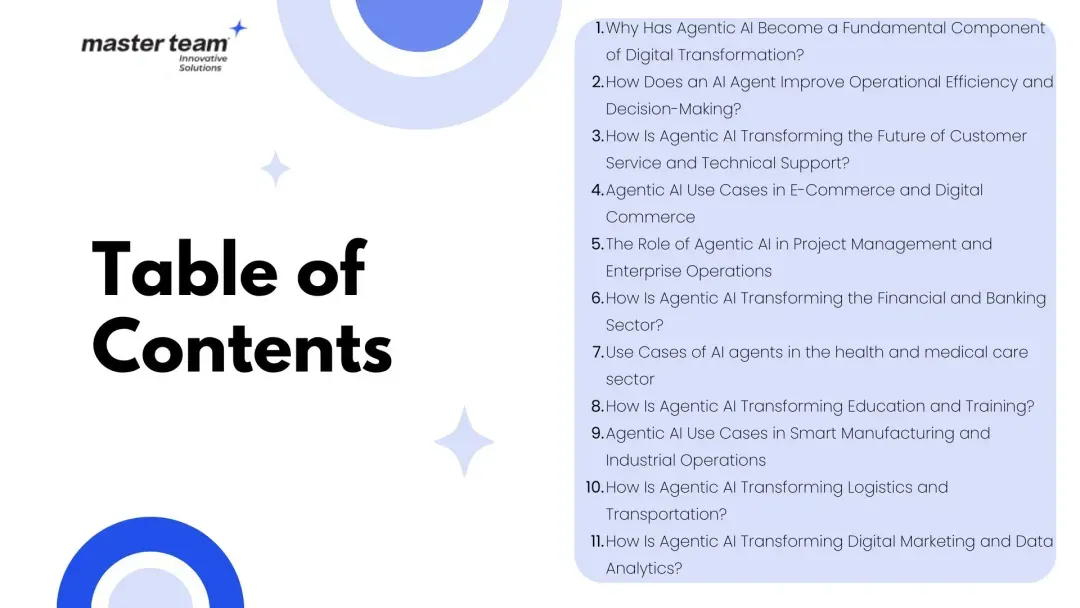
💡 In this article, you'll explore the most impactful use cases of Agentic AI across enterprises, e-commerce, project management, banking, healthcare, education, manufacturing, and digital marketing, while discovering how autonomous intelligent systems are becoming the true driving force behind modern organizations.
Why Has Agentic AI Become a Fundamental Component of Digital Transformation?
In today's data-driven environment, where data is continuously collected from multiple enterprise systems at high speed, traditional AI tools that simply answer questions or generate reports in isolation are no longer sufficient.
Modern organizations need a proactive digital partner that understands the full business context.
Agentic AI fulfills that role. It connects operational and strategic information, anticipates potential risks before they materialize, and recommends corrective actions before issues escalate.
In doing so, AI evolves from a reactive support tool into a proactive intelligence engine that accelerates decision-making and delivers unified operational visibility across the organization.
This is no longer just another technology trend.
According to Gartner, nearly 33% of enterprise applications are expected to incorporate Agentic AI capabilities by 2028, up from less than 1% in 2023.
This confirms that Agentic AI has become a fundamental component of business modernization and a key milestone in enterprise-wide digital transformation.
How Does an AI Agent Improve Operational Efficiency and Decision-Making?
An AI agent brings an unprecedented level of precision and accuracy to operational processes.
AI empowers decision-makers with real-time, diverse insights, enabling them to make faster and more confident decisions based on large and complex datasets.
AI-powered services also pave the way for large-scale workflow automation:
Organizations that adopt these technologies free their teams from repetitive operational tasks, enabling employees to focus on higher-value strategic initiatives.
Ultimately, Agentic AI acts as a productivity multiplier.
It enables workflows that once took weeks to be completed in just days or hours while reducing human error and delivering faster, more reliable outcomes.
Some of the most common enterprise use cases include the following:
1. Automating Operational Processes and Reducing Operating Costs
Companies are leveraging Agentic AI to automate a wide range of routine tasks and operational processes, including invoice processing, employee scheduling, and data analysis.
This significantly reduces the need for manual intervention while lowering operating costs.
Similarly, a report by Hyland highlights that these intelligent systems are revolutionizing organizational decision-making by delivering unprecedented levels of accuracy and efficiency across industries.
The practical outcome is fewer human errors and significant time savings for employees.
2. Managing Tasks and Workflows with Greater Intelligence and Speed
AI agents enable intelligent workflow automation across enterprise environments.
These systems also provide real-time executive dashboards that bring together key performance indicators (KPIs) and critical alerts within a single, easily accessible interface.
As a result, delivery processes become more streamlined.
Industry reports indicate that AI-driven workflow automation significantly reduces the need for manual coordination, allowing teams to focus on higher-priority objectives.
3. Enhancing Internal Collaboration and Enabling Data-Driven Decision-Making
Agentic AI systems collect and process data from multiple sources (such as ERP systems, reports, and enterprise databases) to provide executives with clear, actionable recommendations.
This gives business leaders a comprehensive view of the overall state of business operations at any given moment, enabling faster and more informed decision-making.
In short, Agentic AI transforms complex enterprise data into actionable recommendations, providing a clearer overall view of business operations and strengthening evidence-based decision-making across the organization.
4. How Do AI Agents Help Increase Team and Organizational Productivity?
AI agents directly enhance productivity by relieving individuals of the burden of repetitive tasks.
According to a study by Automation Anywhere, these systems can improve workforce efficiency and accelerate productivity through AI-powered tools.
IBM's internal experience also demonstrates the impact of this technology.
By deploying AI agents across functions such as human resources and finance, IBM achieved productivity gains estimated at approximately $4.5 billion.
5. Real-World Applications of Agentic AI in Enterprises
Organizations around the world have already begun adopting Agentic AI to achieve tangible business benefits.
In Saudi Arabia, for example, the Saudi Projects platform announced the launch of Faris AI by Master Team as an intelligent assistant designed to enhance automation, improve data analysis, and optimize project management.
Similarly, Mars deployed a digital agent that saved more than 500,000 human work hours previously consumed by routine tasks.
In the banking sector, banks and other financial institutions are adopting Agentic AI to accelerate account opening, streamline lending processes, and detect fraud early.
These real-world implementations demonstrate how intelligent agents transform enterprise data into valuable business outcomes, establishing AI as a strategic partner within organizations.
How Is Agentic AI Transforming the Future of Customer Service and Technical Support?
A new era of customer service is emerging, one powered by AI agents that operate around the clock without interruption.
According to an IBM report, approximately 71% of service organizations are expected to move toward fully automated customer support by 2027, with intelligent systems handling customer inquiries across multiple channels while understanding customer context and sentiment.
These intelligent agents enable organizations to deploy intelligent support assistants that operate 24/7, providing instant responses to customer inquiries while dramatically reducing wait times.
They also personalize the customer experience by leveraging behavioral analytics and big data.
This demonstrates how AI agents can deliver personalized offers and promotions based on each customer's behavioral history, increasing customer satisfaction and strengthening long-term loyalty.
In addition, Agentic AI integrates seamlessly with Customer Relationship Management (CRM) systems to automatically update customer records and improve customer follow-up.
Customer information flows directly from the CRM into the intelligent agent, where it is combined with real-time recommendations to deliver seamless and more responsive customer service.
The evolution of contact centers is also accelerating.
Traditional contact centers are gradually evolving into AI-powered intelligent contact centers.
Using AI agents, organizations can automatically resolve a large share of routine customer requests (such as password resets or order tracking) without human intervention.
Over time, these intelligent systems continuously learn from customer interaction patterns and adapt accordingly, improving service quality while simultaneously reducing operational costs.
The primary applications of agentic AI in customer service and technical support include the following:
Agentic AI Use Cases in E-Commerce and Digital Commerce
In today's fast-moving digital commerce landscape, Agentic AI has become a key driver of sales growth and superior shopping experiences.
AI enables e-commerce platforms and online stores to analyze customer behavior and deliver intelligent product recommendations tailored to each shopper's preferences, increasing the likelihood of purchase.
Agentic AI also enables intelligent inventory management and highly accurate demand forecasting.
By analyzing sales data alongside market trends, these systems predict which products will be needed, in what quantities, and when, helping businesses reduce waste while preventing stock shortages.
In digital marketing, Agentic AI can automate and continuously optimize entire marketing campaigns.
It can create highly personalized campaigns for different customer segments based on their behaviors and interests while analyzing large datasets to uncover new marketing opportunities.
Marketers also leverage AI agents to streamline content creation and optimize the user experience.
Intelligent systems can automatically generate SEO-optimized product descriptions and perform A/B testing to identify the highest-performing versions of advertisements and landing pages, all autonomously and around the clock.
Ultimately, these capabilities help increase the profitability of digital stores by improving conversion rates and reducing customer acquisition costs.
According to industry reports, AI-powered marketing campaigns can significantly increase conversion rates while lowering Customer Acquisition Cost (CAC) through more precise audience targeting and enhanced user experiences.
In short, integrating AI agents into e-commerce operations directly translates into higher sales and greater profitability by delivering the best possible shopping experience.
The primary applications of agentic AI in e-commerce include the following:
The Role of Agentic AI in Project Management and Enterprise Operations
The adoption of intelligent agents is rapidly expanding within modern project management environments, where hundreds of interconnected variables must be managed simultaneously.
Agentic AI enables project teams to automate task tracking and schedule management with exceptional accuracy.
It can proactively predict project delays before they occur, analyze the root causes of operational deviations, and develop effective corrective action plans.
It also enhances resource allocation and minimizes operational waste.
Furthermore, Agentic AI performs proactive risk analysis by continuously monitoring operational indicators to identify potential issues and challenges before they occur.
When abnormal operational patterns are detected, the system immediately alerts management and recommends preventive actions.
In addition, it supports project managers in decision-making by providing intelligent recommendations based on accurate data.
Integrating these systems into the enterprise environment is essential, as intelligent agents can connect with ERP and PMO systems, including enterprise resource planning platforms and project management solutions, becoming an integrated part of a unified operational ecosystem.
Executive reports and recommendations generated by the agent can be directly integrated into executive dashboards, ensuring a unified and accurate view of operations and strategy across the organization.
In summary, Agentic AI helps project management teams accelerate delivery, reduce risks, and improve operational governance, making it an essential partner for every project manager seeking stronger business outcomes.
The key applications of agentic AI include the following:
How Is Agentic AI Transforming the Financial and Banking Sector?
The financial sector is uniquely positioned to benefit from Agentic AI due to the volume and diversity of financial data and operational processes.
One of its most valuable applications is real-time fraud detection and suspicious transaction analysis.
Financial institutions also leverage Agentic AI to accelerate service delivery by automating routine operational processes.
AI agents can rapidly review loan applications, assist with account opening procedures, and execute routine banking workflows far more efficiently than traditional manual processes.
Investment managers also rely on Agentic AI to develop intelligent trading strategies and optimize portfolio management.
By continuously analyzing vast amounts of financial and market data, intelligent agents can recommend portfolio rebalancing and asset diversification strategies in response to global market fluctuations.
This enables more accurate investment decisions while strengthening risk management strategies.
Agentic AI also enhances the banking customer experience through intelligent conversational assistants that interact with customers via chat and voice channels, guiding them through routine banking services with faster responses and quicker issue resolution, resulting in a more satisfying customer experience.
In parallel, financial institutions use these systems to analyze large-scale financial datasets (including market movements and financial performance reports) to generate actionable insights and executive reports that help decision-makers assess economic conditions and develop informed hedging strategies.
Looking ahead, Agentic AI is expected to play a central role in the evolution of digital banking. Industry trends indicate that an increasing share of digital banking services will be delivered through intelligent autonomous systems with minimal human intervention.
As regulatory authorities such as SAMA continue promoting responsible innovation through initiatives like the SAMA Regulatory Sandbox, locally developed Agentic AI solutions are becoming increasingly important for supporting digital liquidity while strengthening national data sovereignty.
The primary applications of agentic AI in the financial sector include the following:
Use Cases of AI agents in the health and medical care sector
Agentic AI is rapidly becoming a valuable asset in the healthcare sector, supporting both physicians and patients.
AI assists physicians with diagnosis and medical data analysis by intelligently collecting and processing patient clinical information.
During consultations, for example, an AI agent can recommend alternative diagnoses, identify potential drug interactions, and automatically review a patient's medical history.
This helps reduce diagnostic errors while improving the accuracy of medical decisions. In addition, Agentic AI enhances patient monitoring and healthcare management through intelligent automation.
It can remotely monitor patients using connected health devices and vital sign sensors, automatically alerting healthcare providers whenever a patient's condition deteriorates.
This improves the quality of care while reducing the workload on medical staff.
It also enables predictive maintenance for medical devices through continuously monitoring equipment performance by detecting potential failures before they occur, minimizing downtime and ensuring uninterrupted healthcare services.
In the field of personalized medicine, Agentic AI serves as a powerful enabler. It analyzes genomic data, medical imaging, and extensive clinical records to uncover patient-specific patterns.
Based on these insights, physicians can develop personalized treatment plans tailored to each patient's unique characteristics, improving treatment effectiveness while minimizing potential side effects.
Reducing medical errors is another major advantage of Agentic AI.
Due to its ability to process complex healthcare data with exceptional consistency and precision, it helps physicians avoid many common human errors.
According to IBM, these systems provide a high level of reliability.
While human error is inevitable, intelligent agents consistently retain critical details and perform calculations accurately, significantly reducing problems caused by routine mistakes.
The primary applications of agentic AI in healthcare include the following:
How Is Agentic AI Transforming Education and Training?
Agentic AI is introducing a new generation of intelligent tools that are reshaping modern education.
AI enables the creation of intelligent learning assistants that actively support both students and educators.
These agents provide students with instant academic support across a wide range of subjects while helping educators design learning activities tailored to each student's academic level.
Agentic AI also enables highly personalized learning experiences.
By continuously analyzing each student's performance, it identifies strengths and learning gaps, then recommends targeted learning materials and additional exercises.
Rather than delivering the same curriculum to everyone, this approach allows every student to benefit from an individualized learning journey designed to maximize engagement and academic achievement.
Here, Agentic AI plays a critical role by automating many of these repetitive tasks, including generating assessments, grading exams automatically, and continuously tracking each student's academic progress.
In addition, Agentic AI strengthens interactive learning and remote education.
Within virtual classrooms, intelligent agents can facilitate two-way interactive learning by moderating class discussions, evaluating student understanding in real time, and supporting live instructional activities.
These agents also enhance remote teaching by enabling intelligent educational interfaces and interactive virtual learning sessions that engage directly with students.
As a result, they function as intelligent teaching assistants that help educators deliver more engaging, interactive, and effective learning experiences, even in remote learning environments.
Looking ahead, Agentic AI is expected to become an integral part of intelligent education ecosystems.
By unlocking personalized learning at scale while reducing educators' administrative workloads, these systems will enable schools and universities to adopt entirely new educational models that continuously adapt to each student's evolving needs.
This shift will significantly improve educational quality, efficiency, and learning outcomes.
The primary applications of agentic AI in education include
Agentic AI Use Cases in Smart Manufacturing and Industrial Operations
In today's smart factories, Agentic AI plays a pivotal role in improving both productivity and product quality. Intelligent agents continuously monitor production lines to optimize operational efficiency.
These intelligent monitoring systems also continuously optimize process parameters and automated operations to ensure consistent, world-class quality standards.
Agentic AI also plays a critical role in predictive maintenance.
By continuously collecting and analyzing data from machine sensors, intelligent agents can predict potential equipment failures before they occur.
Whenever abnormal vibration patterns, unusual noise, or rising equipment temperatures are detected, the system automatically alerts maintenance teams to inspect the machinery before a breakdown occurs.
This significantly reduces unplanned downtime, increases equipment availability, and ultimately improves overall production output
In addition, AI agents automate complex industrial operations by independently managing multiple real-time processes.
These intelligent systems also enable manufacturers to analyze production data to improve both quality and operational performance.
By combining operational and environmental data, agentic AI applies machine learning to identify patterns that contribute to defects, inefficiencies, or material waste.
Over time, the system continuously refines production processes to maximize resource utilization.
Case studies have shown that manufacturers adopting intelligent robotics and predictive data management achieve a faster time-to-market and higher product quality without increasing workforce size.
The primary applications of agentic AI in manufacturing include the following:
How Is Agentic AI Transforming Logistics and Transportation?
Agentic AI is transforming supply chain and transportation management by intelligently integrating and analyzing data across multiple operational systems.
For example, Agentic AI platforms consolidate real-time information from ERP, TMS, and WMS, enabling instant forecasting and the automated execution of operational actions.
One enterprise case study demonstrated that integrating an intelligent logistics agent with these systems enabled immediate, highly accurate responses while reducing the manual effort required for searching and reviewing information by nearly 50%.
In addition, Agentic AI helps organizations anticipate shipping and delivery disruptions before they occur.
By continuously analyzing operational data, these systems can predict delays caused by factors such as adverse weather conditions or traffic congestion, allowing logistics teams to proactively adjust transportation plans.
Within transportation operations, Agentic AI optimizes routing and logistics planning.
Agentic AI also automates warehouse operations with minimal human intervention.
Intelligent agents coordinate autonomous warehouse robots for material handling while dynamically managing inventory based on shipment flows, reducing fulfillment errors and improving warehouse efficiency without requiring continuous manual supervision.
Looking ahead, AI-driven transportation is expected to become the industry standard.
Intelligent agents will integrate with autonomous vehicles and fleet management systems to create connected transportation networks built on seamless collaboration between humans and intelligent systems.
According to AWS, organizations implementing Agentic AI in logistics can achieve measurable operational savings, including reducing expedited shipping costs by approximately 3–5% of total logistics spending.
The primary applications of Agentic AI in logistics and transportation include the following:
How Is Agentic AI Transforming Digital Marketing and Data Analytics?
Agentic AI is revolutionizing digital marketing through intelligent automation and deep personalization.
AI enables organizations to launch data-driven marketing campaigns that adapt to audience behavior in real time.
Intelligent agents continuously analyze data from websites and social media platforms, learning which types of content resonate with different audience segments.
Based on these insights, they automatically develop targeted marketing strategies (such as personalized email campaigns and audience-specific digital advertising) optimized to deliver the right message through the right channel at the right time.
Agentic AI also plays a vital role in analyzing large-scale datasets to uncover new marketing opportunities.
It continuously collects and processes customer data from multiple sources (such as website activity, purchase histories, and customer feedback) to identify hidden behavioral patterns, emerging market segments, and unmet customer needs.
These insights enable organizations to identify high-performing campaigns and optimize them automatically.
Intelligent analytics platforms also provide real-time reports that help marketing teams refine strategies quickly without waiting for lengthy manual analysis.
In addition, Agentic AI automates content creation while enhancing the user experience (UX).
Solutions such as Scout can automatically generate SEO-optimized titles and meta descriptions while continuously running A/B tests on website pages to identify the highest-performing content variations.
As a result, organizations can launch SEO campaigns much faster, reducing campaign execution timelines from several months to just a few weeks through intelligent automation.
By combining intelligent personalization with continuous optimization, AI agents significantly improve conversion rates and sales performance.
They deliver the right message to the right customer at the right moment, increasing engagement and purchase intent.
At the same time, automation reduces advertising costs while improving Return on Investment (ROI).
According to the Uniform report, organizations using AI agents to manage SEO and CRO initiatives enable marketing teams to spend more time focusing on creativity and strategic planning, significantly improving the overall return on their marketing campaigns.
The primary applications of agentic AI in digital marketing include:
🚀 Conclusion: Agentic AI… The Strategic Partner for Building Intelligent Enterprises
Agentic AI is no longer a futuristic concept or simply a tool for improving isolated operational tasks.
Today, it has become a strategic capability that is transforming how organizations operate, make decisions, and create value across industries.
From project management and enterprise operations to customer service, e-commerce, healthcare, manufacturing, and financial services, Agentic AI has demonstrated its ability to increase operational efficiency, accelerate business execution, reduce costs, and transform enterprise data into intelligent, real-time, actionable decisions.
As digital transformation continues to accelerate across the Kingdom of Saudi Arabia 🇸🇦, organizations are increasingly seeking enterprise AI solutions that bring together the following:
This is where advanced local solutions such as Faris AI by Master Team introduce a new approach to enterprise Agentic AI for modern organizations.
💡 If your organization aims to:
- Automate operational processes
- Improve project and resource management
- Increase workforce productivity
- Build intelligent executive dashboards for decision-making
- Build a more agile and proactive digital operating environment
Master Team delivers an integrated platform that combines Agentic AI with modern enterprise management solutions.
Master Team's flagship solutions include the following:
- Faris AI for Agentic AI and intelligent analytics
- +P for project management, task management, and enterprise performance tracking
- +S for strategy management and KPI monitoring
- Diwan for executive office management, decision management, and administrative follow-up
Frequently Asked Questions
1. What is the difference between an AI agent and a chatbot?
An AI agent is designed to operate proactively and autonomously to achieve defined objectives, while a traditional chatbot or virtual assistant remains reactive, responding only to explicit user requests.
In simple terms, a chatbot functions like an operator that follows instructions, whereas an AI agent acts more like a manager that plans, orchestrates, and executes multi-step workflows independently.
2. Can AI agents be used by small businesses?
Yes. Small and medium-sized businesses can benefit tremendously from Agentic AI.
Even organizations with limited resources often face operational bottlenecks caused by repetitive manual work.
AI agents help automate these processes, deliver faster and more reliable customer service, and allow teams to focus on strategic growth initiatives instead of routine administrative tasks.
3. Is Agentic AI secure for enterprise use?
Yes. Security and data sovereignty are fundamental design principles of enterprise agentic AI platforms.
These solutions are typically deployed on secure on-premises infrastructure or secure local cloud environments while complying with the highest security and privacy standards.
For example, Faris AI is built on a fully Saudi-hosted infrastructure, complies with SDAIA and SAMA requirements, adheres to the PDPL regulations, and ensures that sensitive enterprise data remains within the Kingdom.
4. What is the future of AI agents in global digital transformation?
Industry analysts widely recognize Agentic AI as the future of enterprise intelligence.
Gartner forecasts that by 2028, 33% of enterprise software applications will incorporate agentic capabilities, compared with less than 1% today.
Other industry research also predicts that by 2029, intelligent agents will handle approximately 80% of routine customer service tasks, fundamentally reshaping how organizations operate and deliver services.